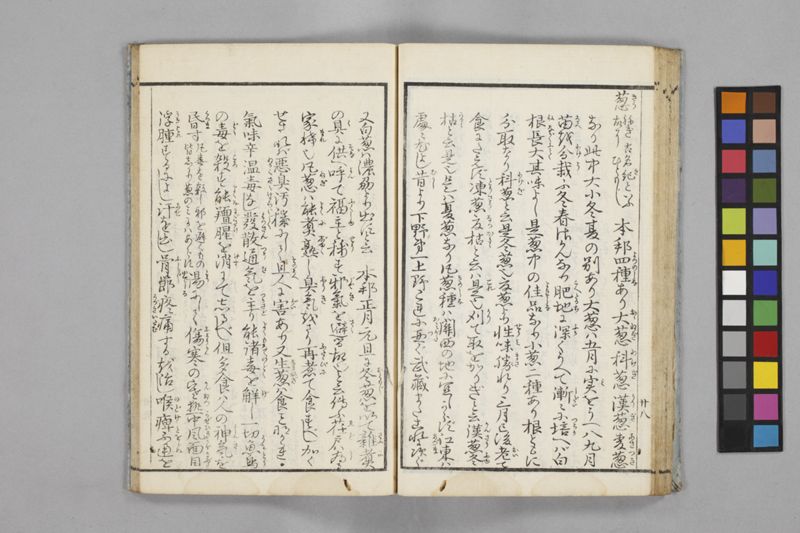
翻刻
【右丁】
葱(さう)《割書:ねぎ 古名 紀(き)といふ|故に ひともじ》本邦 四種(よつのしな)あり大葱(おゝねぎ)科葱(わけぎ)漢葱(かりぎ)麦葱(あさつき)
なり此中大小冬夏の別あり大葱は五月に実(み)をうへ八九月
苗(なへ)を分(わけ)栽(う)ふ冬春さかんなり肥地(こへたるち)に深(ふか)くうへて漸々(しだい)に培(つちか)へば白
根(ね)長大(ながくふとく)甘味よし是葱中の佳品(よきしな)なり小葱二種あり根ともに
分取なり科葱(わけぎ)と云是冬葱也夏葱より性味(せうみ)勝(まさ)れり三月已後 老(おい)て
食にたえず凍葱(とうさう)夏(なつ)枯(かるゝ)と云は是也 刈(かり)て取をかりぎと云 漢葱(かんさう)冬(ふゆ)
枯(かるゝ)云是也是は夏葱なり凡 葱種(きのしな)は《振り仮名:関西| |かみがた 》の地に宜しからず《振り仮名:江東| |あづま 》は
処々尤よし昔(むかし)より下野第一上野これに亜(つ)ぐ武蔵またこれに次ぐ
【左丁】
又白葱は濃州より出すと云 本邦正月元旦に冬葱(ひともじ)を以て雑煑(さふに)
の具(く)に供(そな)へ呼(よん)で福主(ふくしゆ)と称(せう)す邪気(じやき)を避(さく)る故也と云伝ふ荏戸(ゑど)は為(す)る
家 稀(まれ)也凡 葱(ねぎ)は能(よく)煑熟(にじゆく)し臭気(しうき)をさり再(ふたゝび)煑(に)て食すべしかく
せされば《振り仮名:悪臭| |わるくさく 》《振り仮名:汚穢| |けからはしく 》にして且(そのうへ)人に害(がい)あり又 生葱(なまねぎ)は食ことなかれ●
気味辛温毒なし発散(はつさん)通気(つうき)を主(つかさど)り能(よく)諸毒(もろ〳〵のどく)を解(げ)し一切 魚鳥(うをとり)
の毒(どく)を殺(ころ)す能(よく)羶腥(なまぐさけ)を消(けす)にてしるべし但多食は人の神気(しんき)を
昏(くらま)#1す《割書:凡毒を殺し邪を避くもの|皆しかり葱のみにはあらす》《振り仮名:湯|とう|ゆでしる 》にして傷寒(しようかん)の寒熱(かんねつ)中風(かぜひき)面(かほ)目(まぶた)
浮腫(うきはれ)するによし汗(あせ)を出し骨節(ふし〴〵)《振り仮名:疼痛| |うづきいたむ 》するを治し喉痺(のどけ)不通(とをらぬ)を
現代語訳
**葱(ねぎ)**
〔古名を「紀(き)」といい、それゆえ「ひともじ」とも呼ぶ〕
わが国には四種類のねぎがある。大葱(おおねぎ)・科葱(わけぎ)・漢葱(かりぎ)・麦葱(あさつき)がそれである。この中にはそれぞれ大小・冬夏の別がある。大葱は五月に種を植え、八・九月に苗を分けて植え替える。冬から春にかけて盛んである。肥えた土地に深く植えて、次第に土を培っていけば、白根が長く太くなり、甘味も良い。これがねぎの中でも特に良品である。小葱には二種類あり、いずれも根ごと分け取りにする。科葱(わけぎ)というのがこれで、冬葱である。夏葱よりも性質・味が優れている。三月以降は老いて食用に向かなくなる。「凍葱(とうそう)」は夏に枯れる、というのがこれである。刈り取るものを「かりぎ」という。漢葱(かんそう)は冬に枯れるというのがこれで、夏葱である。
およそねぎの種類は、関西(上方)の地にはあまり適さない。関東(東国)は各地でよく育つ。昔から下野(しもつけ)が第一、上野(こうずけ)がこれに次ぎ、武蔵(むさし)またこれに続くとされている。
**(左丁)**
また白葱は濃州(のうしゅう/美濃)から産出するという。
わが国では正月元旦に冬葱(ひともじ)を雑煮の具として供え、これを「福主(ふくしゅ)」と称する。邪気を避けるためだと言い伝えられている。江戸ではこれを行う家は少ない。
およそねぎはよく煮熟(にじゅく)して臭気をなくし、また再び煮て食べるべきである。そのようにしなければ、悪臭があり不潔で、かつ人体に害がある。また生のねぎは食べてはならない。
●**気味(性質・味)** 辛く、温にして毒なし。発散・通気を主り、よく諸毒を解し、一切の魚・鳥(の食毒)を消す。よく生臭さを消すことからもわかる。ただし、多食は人の神気(精神の気)を昏(くら)ます。〔おおよそ毒を消し邪気を避けるものは皆そのようなものであり、ねぎのみではない〕
煎じ汁(湯)にして、傷寒(しょうかん)の寒熱・風邪、顔や目(まぶた)が浮腫(むくみ)するのによい。汗を出し、関節(節々)がうずき痛むのを治し、喉が詰まって通じないのを〔以下次ページへ続く〕
英語訳
**Sō (葱) / Negi (Green Onion / Welsh Onion)**
[Its ancient name is *ki* (紀), and for this reason it is also called *hitomoji* ("one character").]
In our country there are four varieties of *negi*: *ōnegi* (大葱 / large green onion), *wakegi* (科葱 / bunching onion), *karigi* (漢葱 / Chinese onion), and *asatsuki* (麦葱 / chives/thin onion). Among these, there are distinctions between large and small, and between winter and summer varieties. The large onion (*ōnegi*) is planted from seed in the fifth month, and in the eighth or ninth month the seedlings are divided and transplanted. It thrives from winter through spring. If planted deeply in rich soil and earthed up gradually, the white root grows long and thick and the flavor becomes pleasantly sweet. This is the finest variety among onions. There are two kinds of small onion, both of which are propagated by dividing the root clumps. The one called *wakegi* is a winter onion; it surpasses the summer onion in both nature and flavor. After the third month it becomes old and is no longer fit for eating. What is said to be the "frozen onion" (*tōsō* / 凍葱) that withers in summer is this variety. The one obtained by cutting (rather than pulling up the roots) is called *karigi*. *Kansō* (漢葱) is said to wither in winter—this is a summer onion.
In general, varieties of *negi* do not grow well in the Kansai (Kamigata) region. They grow particularly well in many places throughout the Kantō (Azuma / eastern) region. Since ancient times, Shimotsuke (下野 / present-day Tochigi Prefecture) has been regarded as producing the finest; Kōzuke (上野 / present-day Gunma Prefecture) comes next, followed by Musashi (武蔵 / present-day Tokyo/Saitama area).
***(Left page)***
It is also said that white onions come from Nōshū (濃州 / Mino Province, present-day Gifu Prefecture).
In our country, on the morning of New Year's Day (*ganjitsu*), winter onions (*hitomoji*) are offered as one of the ingredients of *zōni* (New Year's rice-cake soup), and they are called *fukushu* (福主 / "Lord of Good Fortune"). This is said to be handed down as a practice to ward off evil spirits (*jaki* / 邪気). In Edo, households that follow this custom are rare.
In general, *negi* should be thoroughly cooked to remove their odor and then cooked again before eating. If this is not done, they will be malodorous and unclean, and moreover harmful to the human body. Furthermore, raw *negi* should not be eaten.
● **Flavor and Nature (*kimi* / 気味):** Acrid (*kara* / 辛), warm (*on* / 温), and non-toxic. They govern dispersion (*hassan* / 発散) and the circulation of *ki* (*tsūki* / 通気), effectively resolving all manner of poisons (*moromoro no doku* / 諸毒), and neutralizing the toxins of all fish and fowl. This can be understood from the fact that they effectively eliminate raw, fishy odors. However, excessive consumption will cloud a person's *shinki* (神気 / the vital spirit/mental energy). [This is true of all things that kill poisons and ward off evil—it is not exclusive to *negi*.]
Made into a decoction (*tō* / 湯 / boiled liquid), it is beneficial for the chills and fever of *shōkan* (傷寒 / cold damage / typhoid-like febrile illness), common cold (*kazehiki* / 中風), and swelling of the face and eyelids. It promotes perspiration, treats aching and painful joints, and for a throat that is obstructed and cannot pass [*continued on next page*]