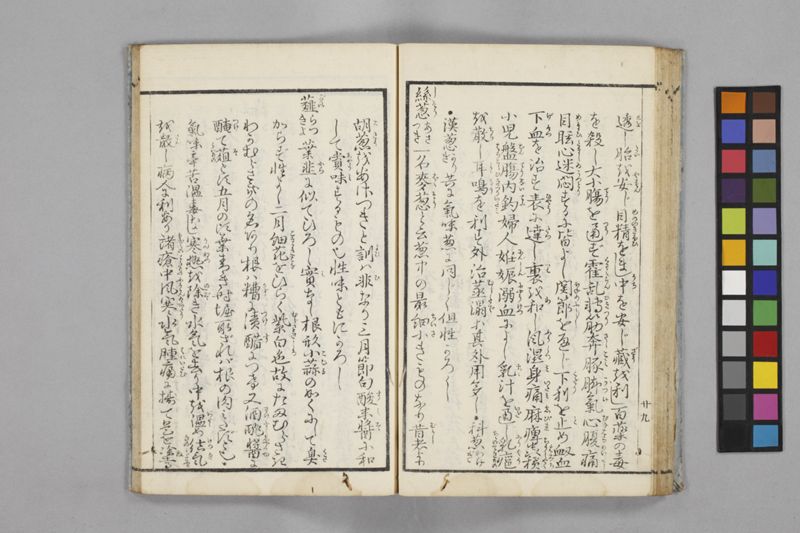
翻刻
【右丁】
透(とを)し胎(たい)を安(やすん)じ目精(めのいきほひ)をまし中(うち)を安じ蔵(ざう)を利し百薬の毒
を殺し大小 腸(てう)を通(つう)ず霍乱(くわくらん)転筋(ひきつり)奔豚(さしこみ)脚気(かつけ)心腹痛(むねはらのいたみ)
目眩(めまひ)心迷悶(たましゐうつとり)するに皆よし関節(ほねのふし〳〵)を通じ下利(くだり)を止(と)め《振り仮名:衄血| |はなぢ 》
下血(げけつ)を治す表(ひやう)に達(たつ)し裏(り)を和(わ)し風湿(ふうしつ)身(み)痛(いたみ)麻痺(しびれ)虫積(ちうしやく)
小児《振り仮名:盤腸内釣|ばんてうないてふ|はらこしひきつりいたみ》婦人 妊娠(にんしん)溺血(にやうけつ)によし乳汁(ちゝ)を通(いだ)し《振り仮名:乳癰|にうやう|ちゝのてきもの 》
を散(ちら)し耳鳴(みゝなり)を利す外治 蒸溻(むしたで)等其外用多し●科葱《割書:わけ|ぎ》
●漢葱《割書:かり|ぎ》共に気味葱に同じく但性かろし
糸葱(しそう)《割書:あさ|つき》一名 麦葱(ばくそう)と云葱中の最 細小(ちいさ)きものなり昔者(むかし)より
【左丁】
胡葱(こさう)をあさつきと訓(よむ)は非(ひ)なり三月節句 酸未醤(すみそ)に和
して賞味(しやうみ)するもの也性味ともにかろし
薤(がい)《割書:らつ|きよ》葉 韭(にら)に似てひろし実(み)なし根形 小蒜(こひる)の如くにして臭(くさ)
からず性よし二月 細花(こまかきはな)をひらく紫(むらさき)白(しろ)色故にたまむらさき
わかむらさきの名あり根は糟(かす)に漬(つけ)醋(す)につけ又 酒(さけ)酢(す)醤(しやうゆ)に
醃(つけ)て《振り仮名:葅|そ|くいもの 》とす五月の頃葉青き時堀取ざれば根の肉みたずと也●
気味辛苦温毒なし寒熱(かんねつ)を除(のぞ)き水気を去り中を温(あたゝ)め《振り仮名:結気|けつき|きのとゞこふる》
を 散(さん)し病人に利あり諸瘡(もろ〳〵のてきもの)中風寒(ふうかんのあたり)水気 腫痛(はれいたむ)に擣て是を塗(ぬ)る
現代語訳
**(前ページより続く:ねぎの薬効)**
〔喉の閉塞を〕通じさせ、胎を安んじ、目の力を増し、腹中を安定させ、臓腑を助け、百薬の毒を消し、大腸・小腸を通じさせる。霍乱(かくらん)・転筋(ひきつり)・奔豚(さしこみ)・脚気・胸腹の痛み・めまい・気が遠くなるようなほてりには、いずれにもよい。関節を通じさせ、下痢を止め、鼻血・下血を治す。表(体表)に達し、裏(体内)を和し、風湿による身体の痛み・麻痺・虫積・小児の盤腸内釣(腹と腰のひきつりの痛み)・婦人の妊娠中の血尿によい。乳汁を出させ、乳癰(ちちのできもの)を散らし、耳鳴りを改善する。外治としては蒸し湿布(蒸溻)などがあり、その他にも外用の用途は多い。
●**科葱(わけぎ)** ●**漢葱(かりぎ)**
いずれも気味はねぎと同じであるが、ただし性質が軽い(作用がおだやかである)。
---
**糸葱(あさつき)**〔一名を麦葱(ばくそう)ともいう〕
ねぎの中で最も細く小さいものである。昔から
**(左丁)**
「胡葱(こそう)」を「あさつき」と読むのは誤りである。三月の節句に酢味噌で和えて賞味するものである。性質・味ともに軽い(おだやかである)。
---
**薤(がい)〔らっきょう〕**
葉は韭(にら)に似ているが、より広い。実はなく、根の形は小蒜(こひる)のようであるが臭くない。性質はよい。二月に細かい花を開く。紫色または白色であるため、「たまむらさき」「わかむらさき」という名がある。根は酒粕に漬けたり、酢に漬けたり、また酒・酢・醤油に漬けて漬物(くいもの)にする。五月ごろ、葉が青いうちに掘り取らなければ、根の肉が充実しないという。
●**気味** 辛く苦く、温にして毒なし。寒熱を除き、水気を去り、腹中を温め、気の滞り(結気)を散じ、病人に有益である。もろもろのできもの(諸瘡)・風寒にあたったもの・水気による腫れと痛みには、これを搗いて塗る。
英語訳
***(Continued from previous page: medicinal properties of negi)***
[The decoction] clears [throat obstruction], calms the fetus, strengthens the eyes, settles the interior of the body, benefits the viscera, neutralizes the toxins of all medicines, and promotes movement through the large and small intestines. It is beneficial for all of the following: *kakuran* (霍乱 / cholera-like sudden illness with vomiting and cramps), *hikitsuri* (転筋 / muscle cramps/spasms), *sashikomi* (奔豚 / "running piglet" syndrome—a sensation of surging abdominal pain), *kakke* (脚気 / beriberi), pain in the chest and abdomen, dizziness, and feverish confusion with clouded consciousness. It opens the joints, stops diarrhea, and treats nosebleeds and rectal bleeding. It reaches the exterior (*hyō* / 表) and harmonizes the interior (*ri* / 裏), and is beneficial for body pain and numbness due to wind-damp (*fūshitsu* / 風湿), parasitic accumulations (*chūshaku* / 虫積), abdominal and lumbar spasms in young children (*bantō naikyō* / 盤腸内釣), and blood in the urine during pregnancy in women. It promotes the flow of breast milk, disperses breast abscesses (*nyūyō* / 乳癰), and improves ringing in the ears (*miminari* / 耳鳴り). For external treatment, steaming and warm compresses (*jōtō* / 蒸溻) are used, and there are many other external applications.
● ***Wakegi*** (科葱 / bunching onion) ● ***Karigi*** (漢葱 / Chinese onion)
Both share the same flavor and nature as *negi*, but their nature is lighter (milder in action).
---
**Shisō (糸葱) / *Asatsuki*** [also known as *Bakusō* (麦葱)]
This is the smallest and finest of all *negi* varieties. Since ancient times,
***(Left page)***
it has been incorrect to read *kosō* (胡葱) as *asatsuki*. It is a plant enjoyed during the Festival of the Third Month (the Doll's Festival / *hina matsuri*), served mixed with *sumiso* (酢味噌 / vinegar-miso sauce). Both its nature and flavor are light and mild.
---
**Gai (薤) / *Rakkyo*** (らっきょう / *Allium chinense* / Chinese scallion)
The leaves resemble those of *nira* (韭 / garlic chives / *Allium tuberosum*) but are broader. It bears no fruit. The shape of the root resembles that of *kohiru* (小蒜 / small wild garlic), but it is not malodorous. It has a fine nature. In the second month it opens small flowers, which are purple or white in color—hence its poetic names *tama-murasaki* ("jeweled purple") and *waka-murasaki* ("young purple"). The roots are pickled in sake lees (*kasu* / 糟), in vinegar (*su* / 醋), or marinated in a combination of sake, vinegar, and soy sauce (*shōyu* / 醤) to make pickles (*kuimono* / 葅). It is said that if they are not dug up around the fifth month while the leaves are still green, the flesh of the roots will not develop fully.
● **Flavor and Nature (*kimi* / 気味):** Acrid and bitter, warm, and non-toxic. It removes chills and fever (*kannetsu* / 寒熱), dispels dampness (*suiki* / 水気), warms the interior, disperses stagnant *ki* (*kekki* / 結気), and is beneficial for the sick. For all manner of sores and boils (*moromoro no tekimono* / 諸瘡), affections due to wind-cold (*fūkan* / 風寒), and swelling and pain from dampness (*suiki* / 水気), pound the bulbs and apply them topically.