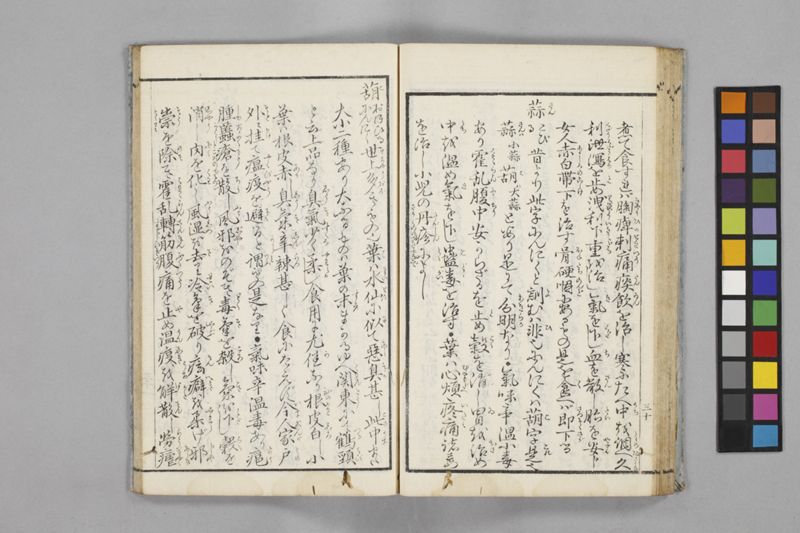
翻刻
【右丁】
煮て食すれば胸痺刺痛(きやうひのせきつう)痰飲(たんゐん)を治し寒にたへ中(うち)を調(とゝの)へ久(ひさしき)
利(くだり)泄瀉(くだりはら)を止(と)め洩利下重(りびやういきみだち)を治し気(き)を下(くだ)し血(ち)を散(さん)し胎(たい)を安(やすん)じ
女人 赤白帯下(あかしろのこしけ)を治す骨硬(ほねたち)咽(のんど)にあるもの是を食(く)へば即(さつそく)下(さが)る
蒜(さん)《割書:こび|る》昔より此字にんにくと訓(よ)むは非(ひ)也にんにくは葫(こ)字 是(これ)也
蒜(さん)は《割書:小蒜》葫(こ)は《割書:大蒜》とあり是にて分明(あきらか)なり●気味辛温小毒
あり霍乱(くわくらん)腹中(ふくちう)安からざるを止(と)め穀(こく)を消(☐☐)#1し胃(ゐ)を治(おさ)め
中(うち)を温め気(き)を下し《振り仮名:蠱毒|こどく|こくがい 》を治す●葉は心煩(むねもだへ)疼痛(いたみ)諸毒
を治し小児の《振り仮名:丹疹|たんしん|さうみのあつきふきで 》 によし
【左丁】
葫(こ)《割書:おほひる|にんにく 》世上(せちやう)多(おほ)きもの也 葉(は)は水仙(すいせん)に似(に)て悪臭(あしきか)甚し此中(このうち)また
大小二種あり大なるものは葉の末(すえ)まかるゆへ関東(くわんとう)にて鶴頸(つるくび)
と云上品なり臭気(しうき)少(すくな)く柔(やわらか)し食用に尤 佳(か)なり根皮(ねのかわ)白(しろ)し小
葉は根皮 赤(あか)し臭気(しうき)《振り仮名:辛辣|しんらつ|からみ 》甚しく食にたえず今(いま)人家(じんか)戸(との)
外(そと)に挂(かけ)て瘟疫(やくびやう)を避(さく)ると謂(いふ)もの是なり●気味辛温毒あり癰(よう)
腫(しゆ)《振り仮名:䘌瘡|ぢよくさう|かくしところのでもの 》 散(ちら)し風邪(ふうじや)をのぞき毒気(どくき)を殺(ころ)し気(き)を下(くだ)し穀(こく)を
消(しやう)し肉(にく)を化(くわ)し風湿(ふうしつ)を去(さ)り冷気(れいき)を破(やぶ)り《振り仮名:痃癖|けんへき|うちかた 》を柔(やわら)げ《振り仮名:邪|じや|あしき 》
《振り仮名:祟|そう|たゝり 》を除(のそ)き霍乱(くわくらん)《振り仮名:転筋|てんきん|すじひきつり 》腹痛(ふくつう)を止(や)め温疫(うんゑき)を解散(げさん)し労瘧(らうぎやく)
現代語訳
**(前ページより続く:らっきょうの薬効)**
煮て食べれば、胸痺(きょうひ)の刺すような痛みや痰飲(たんいん)を治し、寒さに耐えられるよう体内を整え、長く続く下痢・泄瀉(くだりばら)を止め、痢病のいきみ立ちを治し、気を下ろし、血を散じ、胎を安んじ、女性の赤白帯下(赤白のこしけ)を治す。魚の骨などが喉に刺さっているものは、これを食べればたちまち下りる。
---
**蒜(さん)〔こひる〕**
昔から「蒜」の字を「にんにく」と読むのは誤りである。「にんにく」は「葫(こ)」の字がこれに当たる。「蒜(さん)」は小蒜(こひる)であり、「葫(こ)」は大蒜(おおひる/にんにく)であると書物にある。これにて明らかである。
●**気味** 辛く、温にして小毒あり。霍乱(かくらん)・腹中の安からざるを止め、穀物の消化を助け、胃を整え、腹中を温め、気を下ろし、蠱毒(こどく)を治す。
●**葉は**、胸のもだえ・疼痛・諸毒を治し、小児の丹疹(そうみの熱いふきで)によい。
---
**葫(こ)〔おおひる・にんにく〕**
世間に多くあるものである。葉は水仙に似ており、悪臭が甚だしい。この中にまた大小二種がある。大きいものは葉の先が曲がるため、関東では「鶴頸(つるくび)」と呼ばれ、上品なものである。臭気が少なく、柔らかく、食用として最もよい。根の皮は白い。小さい種は根の皮が赤く、臭気と辛みが甚だしく、食用に耐えない。今、人家の戸口の外に掛けて瘟疫(悪病・疫病)を避けるというものは、これ(小種のにんにく)のことである。
●**気味** 辛く、温にして毒あり。癰腫(よう・しゅ)や褥瘡(隠し所のできもの)を散じ、風邪(ふうじゃ)を除き、毒気を殺し、気を下ろし、穀物を消化し、肉を化し、風湿を去り、冷気を破り、痃癖(うちかた・腹内の硬いしこり)を柔らげ、邪の祟りを除き、霍乱・転筋(筋のひきつり)・腹痛を止め、温疫を解散し、労瘧(ろうぎゃく)を〔治し……次ページへ続く〕
英語訳
***(Continued from previous page: medicinal properties of rakkyo)***
When boiled and eaten, it treats the stabbing pain of *kyōhi* (胸痺 / chest impediment / angina-like chest pain) and *tan'in* (痰飲 / phlegm-fluid retention), enables the body to endure cold, regulates the interior, stops prolonged diarrhea and *geri* (泄瀉 / loose bowels), treats the straining sensation associated with dysentery (*ribbyō ikimidachi* / 洩利下重), descends *ki*, disperses blood stagnation, calms the fetus, and treats red and white vaginal discharge (*akashiro no koshike* / 赤白帯下) in women. If a fish bone or the like is lodged in the throat, eating this will cause it to descend immediately.
---
**San (蒜) / *Kohiru*** (small wild garlic / *Allium grayi*)
It has long been incorrect to read the character 蒜 (*san*) as *ninniku*. The word *ninniku* corresponds to the character 葫 (*ko*). It is written that 蒜 (*san*) refers to *shōsan* (小蒜 / small garlic / *kohiru*), while 葫 (*ko*) refers to *daisan* (大蒜 / large garlic / *ninniku*). This makes the distinction clear.
● **Flavor and Nature (*kimi* / 気味):** Acrid and warm, with mild toxicity. It stops *kakuran* (霍乱 / cholera-like illness) and restlessness in the abdomen, aids the digestion of grains, regulates the stomach, warms the interior, descends *ki*, and treats *kodoku* (蠱毒 / gu-poison / harmful toxic afflictions).
● **The leaves** treat distress in the chest (*munemodae* / 心煩), pain, and various toxins, and are beneficial for *tanshin* (丹疹 / hot, fiery skin eruptions) in young children.
---
**Ko (葫) / *Ōhiru* / *Ninniku*** (大蒜 / garlic / *Allium sativum*)
This is something found abundantly throughout the world. The leaves resemble those of *suisen* (水仙 / narcissus / *Narcissus tazetta*) and have a remarkably foul odor. Within this variety there are again two kinds, large and small. The large variety has leaves that curve at their tips, and is therefore called *tsurukubi* (鶴頸 / "crane's neck") in the Kantō region; it is the superior variety. It has little odor and is soft, making it by far the best for eating. The skin of its root is white. The small variety has a red root skin, with an extremely pungent odor and acridity that makes it unpalatable. What people today hang outside the doors of their homes to ward off pestilence (*yakubyō* / 瘟疫) refers to this small variety.
● **Flavor and Nature (*kimi* / 気味):** Acrid and warm, with toxicity. It disperses *yōshu* (癰腫 / abscesses and swellings) and *jokusō* (褥瘡 / 䘌瘡 / sores in hidden/private areas of the body), removes *fūja* (風邪 / wind evil / pathogenic wind), kills toxic *ki*, descends *ki*, aids the digestion of grains, transforms meat (aids in digesting meat), dispels wind-damp (*fūshitsu* / 風湿), breaks up cold *ki* (*reiki* / 冷気), softens *kenpeki* (痃癖 / abdominal hardness and accumulations), removes malign influences and evil curses (*jasō* / 邪祟), stops *kakuran* (霍乱), muscle spasms (*suji hikitsuri* / 転筋), and abdominal pain, disperses *on'eki* (温疫 / warm-type epidemic diseases), and [treats] *rōgyaku* (労瘧 / consumption-malaria / malarial fever with debility)… *(continues on next page)*