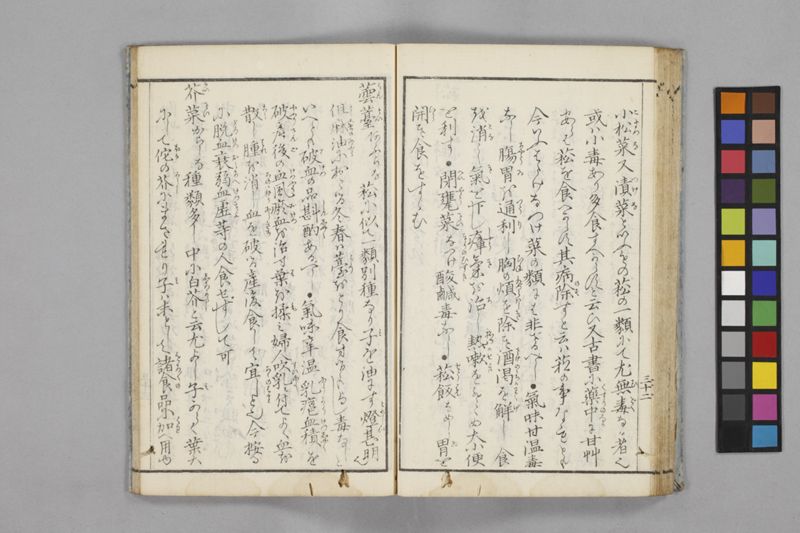
翻刻
【右丁】
小松菜(こまつな)又 漬菜(つけな)といふもの菘の一類にて尤 無毒(むどく)なる者也
或は小毒あり多食すへからすと云ひ又古書に薬中(くすりのなか)に甘草
あらは菘を食へからす其病 除(のそ)すと云は菘の事なれとも
今いふはたけなつけ菜の類には非ざるべし●気味甘温毒
なし腸胃(ちやうゐ)を通利(つうり)し胸(むね)の煩(わづらはしき)を除き酒渇(さけのゝちかわく)を解(げ)し食
を消(こな)し気(き)を下し《振り仮名:瘴気|しやうき|きりのむすき 》を治(ち)し熱嗽(ねつのせき)をとゝめ大小便
を利す●閉甕菜(へいやうさい)《割書:なづけ》酸鹹毒なし●菘飯(せうはん)《割書:なめし》胃(ゐ)を
開(ひら)き食をすゝむ
【左丁】
蕓薹(うんたい)《割書:あふらな》菘に似て一類別種なり子(み)を油にす灯(ともしひ)甚明也
但(たゝ)麻油(こまのあふら)におとる冬春は薹(とう)をとり食するもよろし毒なしと
いへとも破血(はけつ)の品 斟酌(しんしやく)あるべし●気味辛温 乳癰(にうよう)血積(けつしやく)を
破(やふり)産後(さんご)の《振り仮名:血風|けつふう|ちのゝほり 》 《振り仮名:瘀血|おけつ|あしきち 》を治す葉(は)を揉(も)み婦人《振り仮名:吹乳|すいにう|ちゝのはり 》に付てよく血を
散(ちら)し腫(はれ)を消し血を破る産後食して宜しと也今按る
に脱血(だつけつ)衰弱(おとろへ)血虚(けつきよ)等の人食せずして可
芥菜(かいさい)《割書:からしな》種類多し中に白芥(しろからし)と云尤よし子(み)からく葉大
にして佗(ほか)の芥(からし)にまされり子(み)は末として諸(もろ〳〵の)食品に加(くわ)へ用ゆ
現代語訳
**(前ページより続く:菘〔な・はたけな〕について)**
小松菜、またはつけ菜と呼ばれるものは、菘の一類であって、最も毒のないものである。あるいは小毒があり、多食すべきではないという説もある。また古書には「薬の中に甘草がある場合は菘を食べてはならない、その病が除かれなくなる」とあるが、これは菘のことを指しているとはいえ、今いうはたけな・つけ菜の類には当たらないであろう。
●**気味** 甘く、温にして毒なし。腸胃を通利し、胸のわずらわしさ(胸中の煩熱)を除き、酒の後の渇きを解し、食物を消化し、気を下ろし、瘴気(霧のむすき・湿地から生じる悪気)を治し、熱による咳をとめ、大小便の通じをよくする。
●**閉甕菜(へいようさい)〔なづけ〕** 酸く鹹(しおから)く、毒なし。
●**菘飯(しょうはん)〔なめし〕** 胃を開き、食欲を進める。
---
**蕓薹(うんたい)〔あぶらな〕**
菘に似て一類別種である。実(み)から油を採る。灯火にすると非常に明るい。ただし胡麻油には劣る。冬から春にかけては薹(とう)を摘んで食するのもよい。毒なしとはいえ、破血の性質がある品であるから、斟酌(加減)すべきである。
●**気味** 辛く、温。乳癰(乳房の腫れ物)・血積(ちのかたまり)を破り、産後の血風(血ののぼせ)・瘀血(悪い血のかたまり)を治す。葉を揉んで婦人の吹乳(乳房の張り)に貼り付けると、よく血を散らし、腫れを消し、血を破る。産後に食するのがよいとされる。今考えるに、脱血・衰弱・血虚等の人は食べないのがよいであろう。
---
**芥菜(かいさい)〔からしな〕**
種類が多い。その中で白芥(しろからし)というものが最もよい。実が辛く、葉は大きく、他の芥(からし)に勝っている。実は末(粉末)として各種の食品に加えて用いる。〔次ページへ続く〕
英語訳
***(Continued from previous page: on Shō / 菘 / Brassica greens / *na*)***
What is called *komatsuna* (小松菜) or *tsukena* (漬菜 / pickling greens) belongs to one category of *shō* (菘) and is the most non-toxic among them. There is also a view that they have a slight toxicity and should not be eaten in large quantities. Furthermore, an old text states, "If *kanzō* (甘草 / licorice root) is present among one's medicines, one must not eat *shō*, lest the illness fail to be resolved." This passage refers to *shō*, but it is likely not applicable to what we today call *hatakena* or *tsukena*.
● **Flavor and Nature (*kimi*):** Sweet and warm, with no toxicity. It promotes free flow through the intestines and stomach, relieves vexation in the chest, resolves thirst after drinking alcohol, aids digestion, descends *ki*, treats *shōki* (瘴気 / miasma / noxious vapors from damp lowlands), stops coughing from heat, and promotes smooth urination and defecation.
● ***Heiyōsai* (閉甕菜 / *naduke* / brined greens):** Sour and salty, with no toxicity.
● ***Shōhan* (菘飯 / *nameshi* / greens rice):** Opens the stomach and promotes appetite.
---
**Untai (蕓薹) / *Aburana* / Rapeseed (*Brassica napus* / *Brassica rapa*)**
Similar to *shō* (菘) and of the same family but a different variety. Oil is extracted from its seeds. It burns very brightly as lamp fuel, though it is inferior to sesame oil. In winter and spring, picking the flowering stalks (*tō* / 薹) to eat is also fine. Although said to be non-toxic, it is a substance with blood-breaking (*haketsu* / 破血) properties and should be consumed with discretion.
● **Flavor and Nature (*kimi*):** Acrid and warm. It breaks up *nyūyō* (乳癰 / breast abscess / mastitis) and blood accumulation (*ketsushaku* / 血積). It treats *ketsufū* (血風 / upward surging of blood) and *oketsu* (瘀血 / blood stasis / stagnant blood) after childbirth. Rubbing the leaves and applying them to a woman's *suinyū* (吹乳 / breast engorgement / milk stasis) effectively disperses blood, reduces swelling, and breaks up blood stasis. It is said to be appropriate for consumption after childbirth. However, upon reflection, those suffering from blood loss (*datsuketsu* / 脱血), debility, or blood deficiency (*ketsukyо* / 血虚) would do well not to eat it.
---
**Kaisai (芥菜) / *Karashina* / Mustard greens (*Brassica juncea*)**
There are many varieties. Among them, *shiro-karashi* (白芥 / white mustard / *Sinapis alba*) is considered the best. Its seeds are pungent, its leaves are large, and it surpasses other varieties of mustard. The seeds are ground into a powder and used as an addition to various foods. *(continues on next page)*