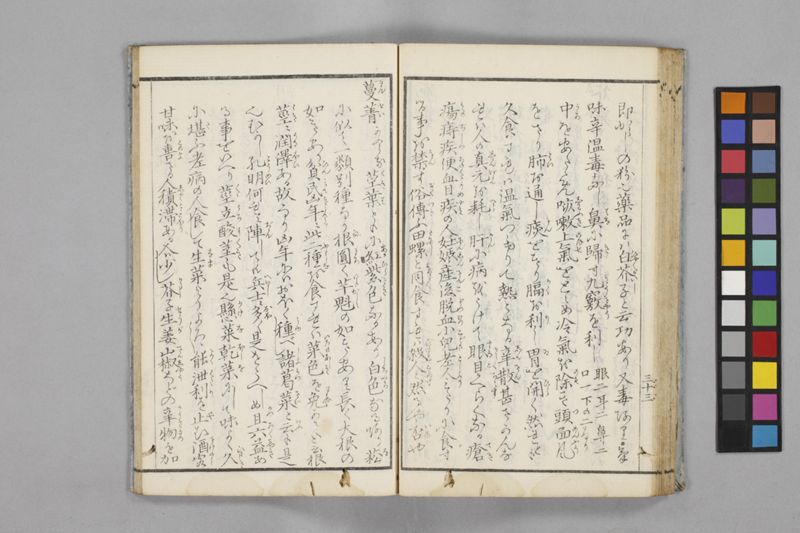
翻刻
【右丁】
即からしの粉也薬品には白芥子(ひやくがいし)と云功あり又毒あり●気
味辛温毒なし鼻(はな)に帰(き)す九竅(きうきやう)を利し《割書:眼二耳二鼻二|口一下の二なり》
中(うち)をあたゝめ咳嗽(しわふき)上気(のほせ)をとゝめ冷気を除(のそ)き頭面(つめん)風(ふう)
をさり肺(はい)を通し痰(たん)をきり膈(かく)を利(り)し胃(ゐ)を開(ひら)く然れとも
久食すれは温気つもりて熱となる《振り仮名:辛散|しんさん|からくちらす 》甚さかんな
れは人の真元(しんげん)を耗(へら)し肝(かん)に病をうけて眼目(まなこ)くらくなる瘡(てき)
瘍(もの)痔疾(ぢしつ)便血(ちのくたり)目疾(めやみ)の人 妊娠(にんしん)産後(さんこ)脱血(だつけつ)小児(こども)老人(としより)みたりに食す
る事を禁(きん)ず俗(ぞく)伝(つた)ふ田螺(たにし)と同(おなしく)食すれは殺人(ひとをころす)と然るや否(いな)や
【左丁】
蔓菁(まんせい)《割書:かふらな》茎葉(くきは)ともに紅紫色(あかむらさき)なるあり白色(しろいろ)なるあり菘(な)
に似て一類別種なり根(ね)円(まろ)く芋魁(いもかしら)の如きあり長く大根の
如きあり貧民(ひんみん)凶年(きゝんとし)に此 二種(ふたしな)を食すれは菜色(いろのあしき)を免(まぬ)かるゝと云根
茎(くき)に潤沢(うるほひ)ある故なり凶年にはおほく種(うゆ)べし諸葛菜(しよかつさい)と云も是
也むかし孔明(こうめい)何れに陣(ぢん)しても兵士に多(おほ)く是をうへしめ且(かつ)六益(ろくゑき)あ
る事をいへり茎立(く☐たち)酸茎(すくき)も是也 懸菜(かけな)乾菜(ほしな)にして味よく久(ひさしき)
に堪(た)ふ老病の人食して生(なま)菜よりよろし能(よく)泄利(くたり)を止(や)む酒客(さけのみ)
甘味を喜(このま)さる人 積(しやく)滞(とゝこほり)ある人は少し芥子(からし)生姜(せうが)山椒(さんしやう)などの辛物(からきもの)を加
現代語訳
**(前ページより続く:芥菜〔からしな〕について)**
すなわちからしの粉のことである。薬品としては白芥子(はくがいし)と呼ばれ、効能があり、また毒もある。
●**気味** 辛く、温にして毒なし。鼻に帰する。九竅(きゅうきょう)〔両眼・両耳・両鼻孔・口・前後の二陰〕を利し、体の内部を温め、咳・のぼせをとめ、冷気を除き、頭面の風(ふう)を去り、肺を通じさせ、痰を切り、横隔膜の通りをよくし、胃を開く。しかしながら、長く食し続けると、温気が積もって熱となる。辛散(からく散らす性質)が非常に盛んであるため、人の真元(根本の生命力)を消耗させ、肝に病を受けて目が暗くなる。瘡瘍(できもの)・痔疾・便血・目の病の人、妊娠中・産後・脱血の人、小児・老人は、みだりに食することを禁ずる。俗に「田螺(たにし)と一緒に食べると人を殺す」と伝えられているが、これが正しいかどうかは定かでない。
---
**蔓菁(まんせい)〔かぶらな〕**
茎・葉ともに紅紫色のものあり、白色のものあり。菘(な)に似て一類別種である。根が丸く芋の頭(かしら)のようなものあり、長く大根のようなものあり。貧民が凶作の年にこの二種を食べれば、菜色(顔色が悪くなること)を免れると言われている。根や茎に潤沢(うるおい・栄養分)があるゆえである。凶年にはおおく種(たね)をまくべきである。諸葛菜(しょかつさい)と呼ばれるものも同じものである。昔、孔明(諸葛孔明)はどこに陣を置いても兵士にこれを多く植えさせ、かつ六つの益があることを語ったと言われている。茎立(くきたち)・酸茎(すぐき)もこれと同じである。懸菜(かけな)・乾菜(ほしな)にすると味がよく、長期保存に耐える。老人や病人が食べるには、生菜よりも優れている。よく下痢をとめる。酒飲みで甘い味を好まない人、積滞(食物の停滞・消化不良)のある人は、少し芥子・生姜・山椒などの辛いものを加え〔次ページへ続く〕
英語訳
***(Continued from previous page: on Kaisai / 芥菜 / Mustard greens)***
This is, in other words, mustard powder. In pharmacology, it is known as *hakugaishi* (白芥子 / white mustard seed) and has both medicinal benefits and some toxicity.
● **Flavor and Nature (*kimi*):** Acrid and warm, with no toxicity. It acts upon the nose and benefits the nine orifices (*kyūkyō* / 九竅: two eyes, two ears, two nostrils, the mouth, and the two lower orifices). It warms the interior of the body, stops coughing and upward surging of *ki* (*nobose* / 上気), removes cold *ki*, dispels wind affecting the head and face, opens the lungs, cuts through phlegm, promotes the free flow of the diaphragm (*kaku* / 膈), and opens the stomach. However, if consumed over a long period, the warm *ki* accumulates and turns to heat. Since its acrid, dispersing nature (*shinsan* / 辛散) is very vigorous, it depletes a person's *shin'gen* (真元 / fundamental vitality / primordial *ki*), causes the liver to take on illness, and leads to dimming of the eyesight. Those with sores and abscesses (*sōyō* / 瘡瘍), hemorrhoids, bloody stools, or eye ailments, as well as those who are pregnant, postpartum, or suffering from blood loss, and also children and the elderly, are forbidden from consuming it carelessly. It is popularly transmitted that eating it together with *tanishi* (田螺 / freshwater snails / *Cipangopaludina*) can kill a person — though whether this is true or not is uncertain.
---
**Mansei (蔓菁) / *Kaburana* / Turnip (*Brassica rapa*)**
The stems and leaves may be either reddish-purple or white in color. It resembles *shō* (菘) and belongs to the same family, but is a distinct variety. The root may be round like a taro (*imo kashira*), or long like a *daikon* radish. It is said that if the poor eat these two varieties during years of crop failure, they can avoid *saishoku* (菜色 / the sallow, pallid complexion that comes from malnutrition), owing to the nourishment (*uruoi* / moisture and richness) found in its roots and stems. Therefore, it should be sown abundantly in lean years. What is called *Shōkatsusai* (諸葛菜 / Zhuge vegetable) is the same plant. In ancient times, Zhuge Kongming (諸葛孔明 / Zhuge Liang) reportedly had his soldiers plant it in large quantities wherever he encamped, and he also spoke of it having six benefits. *Kukitachi* (茎立) and *suguki* (酸茎) are also the same plant. When made into *kakena* (懸菜 / hung-dried greens) or *hoshina* (乾菜 / dried greens), the flavor is excellent and it keeps well for a long time. For the elderly and the infirm, it is better than fresh greens. It is particularly effective at stopping diarrhea. Those who drink heavily and do not favor sweet flavors, or those with food stagnation (*shakutai* / 積滞 / digestive blockage), should add a small amount of spicy things such as mustard, ginger, or *sanshō* pepper... *(continues on next page)*