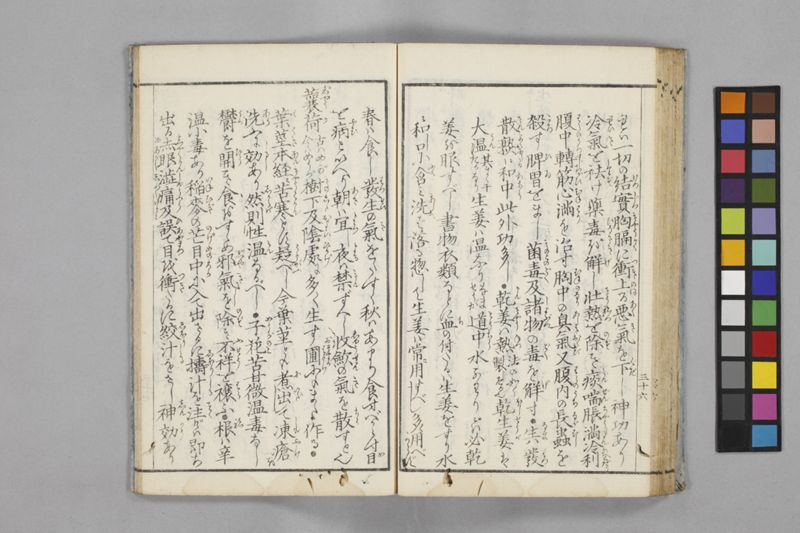
翻刻
【右丁】
れは一切の結実(けつじつ)《振り仮名:胸膈|きやうかく|むなさき 》に衝上(つきのほ)る悪気(あくき)を下(くだ)し神功あり
冷気(れいき)を袪(しりぞ)け薬毒を解(げ)し壮熱(さうねつ)を除(のぞ)き痰喘(たんぜん)脹満(ちやうまん)冷利(ひへくだり)
腹中(はらのうち)転筋(すじちがひ)心満(むねはり)を治す胸中(むねのなか)の臭気(あしきおくび)又 腹中(はらのうち)の長虫(ながむし)を
殺(ころ)す脾胃(ひゐ)をまし菌毒(きのこのどく)及 諸物(しよぶつ)の毒(どく)を解(げ)す●生(なま)は発(はつ)
散(さん)熟(よくにたる)は和中(わちう)此外功多し●乾姜(かんきやう)は熱(ねつ)《割書:法の如く|製したる也》 乾生姜(ほしせうが)は
大 温(うん)《割書:其まゝ干|たるなり》 生姜は温なり《割書:なま|せうが》道中(とうちう)水かわりには必乾
姜を服すべし書物衣類なとに血(ち)の付たるは生姜をすり水
に和し口に含(ふく)み洗(あらへ)ば落る総【惣】して生姜は常に用すべし多く用べからず
【左丁】
春は食し発生(はつせい)の気(き)をたすく秋はあまり食すべからす目(め)
を病(やむ)といへり朝(あさ)は宜(よろ)し夜は禁(きん)ずへし《振り仮名:収斂|しゆうれん|おさまる 》の気(き)を散(ちら)すと也
蘘荷(じやうか)《割書:古はめが|今はめうが》樹下(きのした)及(およひ)陰処(ひかげ)に多く生す圃(はたけ)にもまた作る●
葉(は)茎(くき)本経(ほんきやう)に苦寒(くかん)とす疑(うたがふ)べし今葉茎とも煮出(にいだ)して凍瘡(しもやけ)を
洗(あら)ふに効(しるし)あり然(しからば)則性 温(うん)なるべし●子花(めうがのこ)苦甘微温毒なし
鬱(うつ)を開(ひら)き食をすゝめ邪気(じやき)を除(のぞ)き不祥(ふせう)を禳(はら)ふ●根(ね)は辛
温小毒あり稲麦(いねむぎ)の芒目中(のげめのちう)に入て出さるに擣汁(しほりしる)を注(そゝ)げは即ち
出る《振り仮名:赤眼|しやくかん|めあかく 》《振り仮名:渋痛|しゆうつう|しぶくいたみ 》及ひ誤(あやまつ)て目を衝(つき)たるに絞汁(しほりしる)をさし神効(しんかう)あり
現代語訳
【右丁】
(続き:生薑について)
(煎じてその汁を服す)れば、あらゆる結実(体内に凝り固まったもの)が胸膈(胸の辺り)に突き上げてくる悪気を下し、神験がある。冷気を退け、薬毒を解し、壮熱(高熱)を除き、痰喘(痰が絡んだ喘鳴)・脹満(腹部の張り)・冷利(冷えによる下痢)・腹中の転筋(腹の筋違い・けいれん)・心満(胸の張り)を治す。胸中の臭気(くさいげっぷ)、また腹中の長虫(回虫)を殺す。脾胃を益し、きのこの毒および諸々のものの毒を解す。
●生のものは発散の効あり、よく煮たものは中(胃腸)を和す。この他にも効能は多い。
●乾姜(かんきょう)は熱性である(法の如く製したもの)。乾生姜(ほしょうが)は大温である(そのまま乾したもの)。生姜は温性である(生のしょうが)。
旅の途中で水が変わる際には、必ず乾姜を服用すべきである。書物・衣類などに血が付いたときは、生姜をすり潰して水に混ぜ、口に含んで洗えば落ちる。総じて生姜は常に用いるべきだが、多く用いてはならない。
【左丁】
春は食べて発生の気(春の陽気)を助けるとよい。秋はあまり食べるべきでない。目を病むといわれる。朝は宜しいが、夜は禁ずべきである。収斂の気(秋の引き締まる気)を散らしてしまうからである。
---
**蘘荷(じょうか・みょうが)**(古くは「めが」、今は「みょうが」)
樹の下および日陰の場所に多く生える。畑でも作る。
●葉・茎:『本経』(神農本草経)には苦寒とあるが、疑わしい。現在、葉茎ともに煮出してしもやけを洗うのに効果があるから、性は温であるべきであろう。
●子花(みょうがの花穂・実):苦甘、微温、毒なし。鬱(気のふさぎ)を開き、食欲を進め、邪気を除き、不祥(不吉なこと)を払う。
●根:辛温、小毒あり。稲や麦の芒(のぎ)が目の中に入って出ないときに、絞り汁を注げば即座に出る。赤眼(目の充血)・渋痛(しぶくて痛む症状)、および誤って目を突いた場合に絞り汁を点眼すれば、神験がある。
英語訳
**[Right folio]**
*(Continuing: On Fresh Ginger)*
—when decocted and the juice drunk, it brings down all manner of *ketsujitsu* (congealed accumulations in the body) that surge upward into the chest and diaphragm region, and its efficacy is remarkable. It repels cold qi, resolves drug toxicity, removes high fever (*sōnetsu*), and treats phlegm-rattling wheezing (*tanzen*), abdominal bloating and fullness (*chōman*), cold-type diarrhea (*hie-kudari*), abdominal cramps and spasms (*korogari-suji*/*転筋*), and oppressive fullness in the chest (*shinman*). It kills the foul-smelling belching from the chest, as well as intestinal roundworms (*naganushi*) in the abdomen. It strengthens the spleen and stomach, and resolves mushroom poisoning and the toxins of various other substances.
●When raw, it has a dispersing effect; when well-cooked, it harmonizes the middle (the digestive organs). Beyond these, its merits are many.
●*Kankyō* (dried processed ginger) is hot in nature (processed according to the proper method). *Hoshi-shōga* (simply dried ginger) is greatly warming in nature (dried as-is). Fresh ginger (*nama-shōga*) is warming in nature.
When traveling and encountering a change of water (local water that may cause digestive upset), one should always take dried ginger. When blood has stained books, clothing, or similar items, grind fresh ginger, mix it with water, hold the mixture in the mouth, and wash the stain—it will come out. In general, ginger should be used regularly, but one should not use it in excess.
---
**[Left folio]**
In spring, eating it is beneficial, as it assists the *hassei no ki* (the generative, rising qi of spring). In autumn, one should not eat it too much, as it is said to harm the eyes. It is suitable in the morning but should be avoided at night—this is because it disperses the *shūren no ki* (the contracting, gathering qi of autumn).
---
**Myōga** (*Zingiber mioga*; anciently called *mega*, now called *myōga*)
It grows abundantly beneath trees and in shaded spots. It is also cultivated in gardens.
●**Leaves and stems**: The *Honkyō* (*Shennong Bencao Jing*, the Divine Husbandman's Classic of Materia Medica) classifies them as bitter and cold (*kukan*), but this is doubtful. Today, boiling both the leaves and stems and using the liquid to wash chilblains has proven effective; therefore, the nature should likely be warming.
●**Flower buds** (*myōga no ko*, the edible flower spike): Flavor—bitter and sweet; nature—slightly warm; non-toxic. It opens up depression and emotional stagnation (*utsu*), stimulates the appetite, removes pathogenic qi, and wards off misfortune and inauspiciousness.
●**Root**: Flavor—acrid; nature—warm; slight toxicity. When an awn (the bristle-like tip) from rice or wheat straw enters the eye and cannot be removed, instilling the squeezed juice will immediately cause it to come out. For red, inflamed eyes (*shakugan*), astringent pain (*shūtsū*), and cases of accidental injury to the eye, instilling the squeezed juice produces remarkable results.