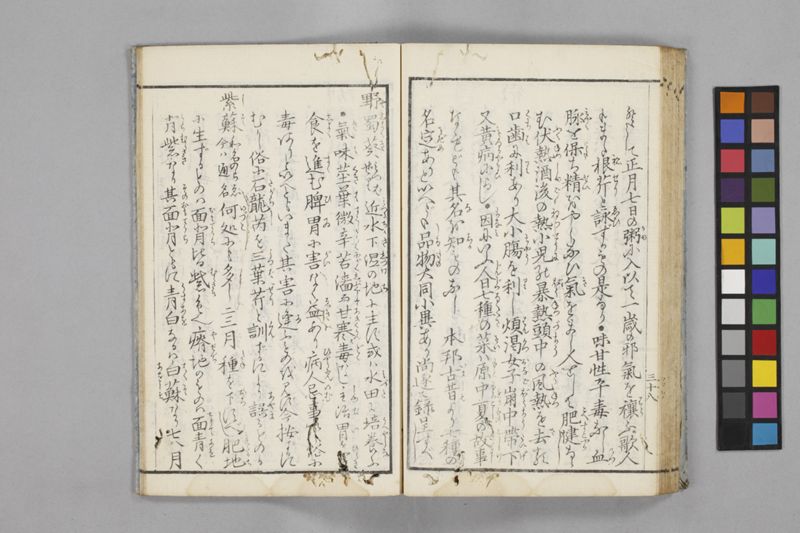
翻刻
【右丁】
として正月七日の粥(かゆ)に入以て一歳の邪気を禳(はら)ふ歌人
もまた根芹(ねせり)と詠(ゑひ)ずるもの是なり●味甘性毒なし血(けつ)
脈(みやく)を保(たも)ち精(せい)をやしなひ気(き)をまし人として肥(こへ)健(すこやか)ならし
む伏熱(ふくねつ)酒後(しゆご)の熱(ねつ)小児(せうに)の暴熱(ぼうねつ)頭中(づちう)の風熱(ふうねつ)を去(さ)る
口歯(くちは)に利(り)あり大小 腸(ちやう)を利し煩渇(はんかつ)女子(をなご)《振り仮名:崩中|ぼうちう|をりもの 》《振り仮名:帯下|たいげ|こしけ 》
又 黄病(きなるやまひ)によし●因(ちなみ)にいふ人日(じんじつ)七種(なゝくさ)の菜(さい)は原(もと)中夏(もろこし)の故事(こじ)
なれども其 名(な)を知(しる)ものなし 本邦 古昔(いにしえ)より七種の
名 定(さだめ)ありといへども品物(しなもの)大同小異あり尚逐て録呈すべし
【左丁】
野蜀葵(やしよくき)《割書:みつば|ぜり》近水下(みつにちかき)湿(しつけ)の地(ち)に生ず或は水田(みづた)に培養(うへやしな)ふ
●気味(きみ)茎葉(くきは)微(すこし)辛(からく)苦(にがく)濇而(しぶくして)甘(あまく)寒(かん)に毒(どく)なし主治(しゆぢ)胃(い)を開(ひらき)
食(しよく)を進(すゝ)む脾胃(ひゐ)に害(がい)なく益(ゑき)あり病人(ひやうにん)忌(いむ)事□□#1俗に
毒ありといへともいまだ其害に逢(あ)ふものを見ず今按ずるに
むかし俗に石竜苪(たがらし)を三葉芹(みつばぜり)と訓(くん)ずるにより誤(あやま)るものか
紫蘇(しそ)《割書:和名のらゑ|今は通名》何処(いづこ)にも多し二三月 種(たね)を下(おろ)すべし肥地(こえたるち)
に生ずるものは面背(おもてうら)皆 紫(むらさき)色也 瘠地(やせぢ)のものは面(おもて)青(あを)く
背(うら)紫(むらさき)なり其(その)面背(おもてうら)ともに青白(うすあを)なるは《振り仮名:白蘇|はくそ|あをしそ 》なり七八月
現代語訳
【右丁】
(前ページより続き:芹〔せり〕)
正月七日の粥(かゆ)に入れて、一年の邪気を払うものとして(七草の一つとされている)。歌人がまた「根芹(ねせり)」と詠むのも、これのことである。
●味は甘、性は(平)、毒はない。血脈を保ち、精(せいき)を養い、気を増し、人を肥え健やかにする。伏熱(体内に潜む熱)・酒後の熱・小児の暴熱(急な発熱)・頭中の風熱を去る。口や歯に効用があり、大小腸を通利し、煩渇(のどの渇きと胸の苦しさ)・女子の崩中(おりもの、不正出血)・帯下(こしけ)、またはいわゆる黄疸の病にも良い。
●付記:人日(正月七日)に七草の菜を食べる風習は、もとは中国の故事に基づくものであるが、その(中国での)具体的な品名を知るものはない。わが国では古来より七草の名目は定まっているといえども、品物については大同小異がある。なお順を追って記録して呈示すべき(後に詳述する)。
---
【左丁】
**野蜀葵(やしょくき)〔みつばぜり〕**
水辺に近い湿地に生える。または水田に栽培することもある。
●気味:茎葉はやや辛く、苦く、渋みがあって甘く、寒(性)であり、毒はない。主治として、胃を開き、食欲を進める。脾胃(消化器)に害なく益がある。病人が忌むこと(については記載が不明)。俗に毒があるというが、いまだその害に遭った者を見たことがない。今、考えてみるに、昔、俗に石竜苪(たがらし)を三葉芹(みつばぜり)と訓読みしていたことにより、誤解が生じているのではないか。
---
**紫蘇(しそ)〔和名:のらえ、今は通名(しそ)〕**
どこにでも多く生えている。二月・三月に種を蒔くとよい。肥えた土地に生えるものは、葉の表裏ともに紫色である。痩せた土地のものは表が青く、裏が紫である。その表裏ともに青白い(薄い青)ものは「白蘇(はくそ・あおしそ)」である。七月・八月……(次ページへ続く)
英語訳
**[Right folio]**
*(Continuing from previous page: Seri [Japanese Parsley])*
It is placed in the rice gruel (*kayu*) eaten on the seventh day of the first month, to ward off evil influences (*jaki*) for the year ahead. When poets compose verses on "root parsley" (*neseri*), this is the plant they refer to.
●Flavor: sweet; nature: (balanced); non-toxic. It preserves the blood and pulse, nourishes the vital essence (*sei*), increases the qi, and makes people well-nourished and healthy. It dispels latent heat (*fukuetsu*, heat lodged within the body), heat following alcohol consumption, sudden fever in children, and wind-heat in the head. It is beneficial for the mouth and teeth, promotes the proper functioning of the large and small intestines, and is good for vexatious thirst (*hankatsu*), uterine bleeding and vaginal discharge (*崩中・帯下*, flooding and leaking conditions in women), and what is commonly called jaundice (*kinaru yamai*, "the yellowing disease").
●Incidental note: The custom of eating the seven herbs on *Jinjitsu* (the seventh day of the first month, "Human Day") originally derives from a tradition in China, but no one knows the specific names of the plants used there. In our country, the names of the seven herbs have been established since ancient times, though there are minor differences in the actual plants included. These will be recorded and presented in turn, one by one.
---
**[Left folio]**
**Yashokuki [Mitsuba-zeri]** (*Cryptotaenia japonica* / Japanese honewort / mitsuba)
It grows in moist ground near water. It is also cultivated in paddy fields.
●Properties: The stems and leaves are slightly acrid, bitter, astringent, and sweet; nature is cold; non-toxic. Principal uses: opens the stomach and stimulates appetite. It is beneficial, not harmful, to the spleen and stomach. [Note on what those who are ill should avoid is unclear/missing in the text.] In popular usage, it is said to be poisonous, but I have yet to see anyone who has actually suffered harm from it. On reflection, I believe the confusion arose in the past from the popular practice of reading *tagarashi* (石竜苪, *Ranunculus sceleratus*, the cursed crowfoot—a genuinely toxic plant) with the reading *mitsuba-zeri*, thus causing the misattribution of toxicity to mitsuba.
---
**Shiso [Perilla]** (*Perilla frutescens* / perilla / beefsteak plant)
*(Japanese name: norae; now widely known by the common name shiso)*
It grows abundantly everywhere. Seeds should be sown in the second or third month. That which grows in fertile soil has leaves that are purple on both the upper and lower surfaces. That growing in lean, poor soil has green upper surfaces and purple undersides. That whose upper and lower surfaces are both pale bluish-white (a light green) is called *hakusu* (白蘇, "white perilla" / *ao-shiso*, green perilla). In the seventh and eighth months… *(continues on next page)*