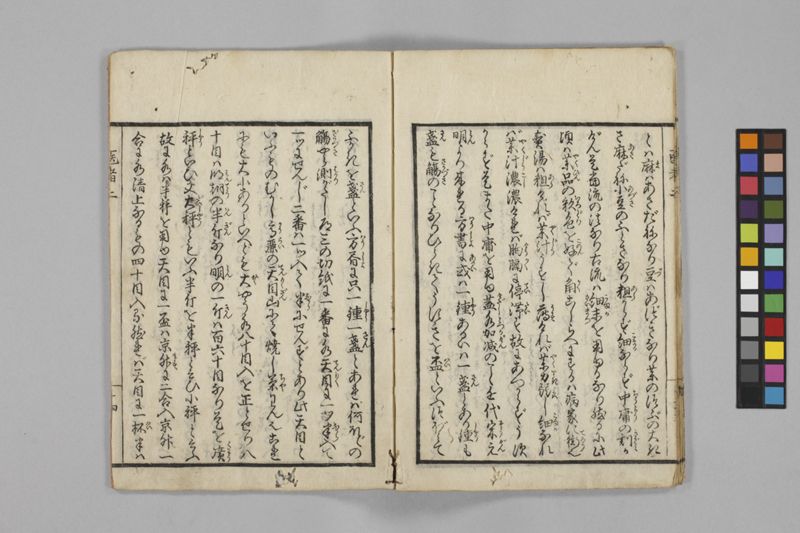
翻刻
とは麻(ま)はあさだねなり豆(づ)はあづきなり薬のつぶの大き
さ麻(あさ)だね小豆(あづき)のふとさなり粗(あら)からず細(こまか)ならず中庸(ちうよう)の刻(きざみ)か
げん是当流の法なり古流は細末(こまか)【左ルビ・さいまつ】を用ゆるなり然るに此
頃は薬品(やくひん)の彩色(いろどり)を好(このん)で角(かく)こしらへにするは病家に衒(てろう)也
煎湯は粗(あら)ければ薬汁(やくじう)うすし薄(うす)ければ薬力(やくりき)弱(よは)し細(こまか)なれ
ば薬汁(やくじう)濃(こし)濃ければ胸膈(けうかく)に停滞(ていたい)す故にあつからずうす
からず是また中庸を用ゆ蓋(けだし)水加減(みつかげん)のこと近代 宋元(そうげん)
明(みん)より来れる方書(はうしよ)に或(あるい)は一 鍾(しやう)あるいは一 盞(さん)とあり鍾(しやう)も
盞(さん)も觴(さかづき)のことなりひらきてうすきを盃(はい)といふつぼみて
ふかきを 盞(さん)といふ方(はう)■(しよ)【書ヵ】に只一 鍾(しゅ)一 盞(さん)とあれば何ほどの
觴(さかづき)やら測(はかり)がたし道三の切紙に一番に水 天目(てんもく)に一ッ半(なから)入て
一ッにせんじ二番は一ッ入て半(なから)にせんずとあり此天目と
いふものむかし高麗(かうらい)の天目山(てんもくざん)にて焼し茶(ちや)わん也これ
にも大小ありといへども大(おゝ)やう水八十目入を正とせり八
十目は明朝(みんてう)の半斤(はんぎん)なり明(みん)の一 斤(きん)は百六十目なり是を広(くわう)
秤(しやう)といひ又 大秤(だいしやう)ともいふ半斤を半秤と云ひ小秤と云ふ
故に水は半秤を用ゆ天目に一盃は京 升(ます)に二合入京升一
合に水清上なるもの四十目入る然れば天目に一 杯(はい)半は
現代語訳
とは、麻(ま)は麻の種であり、豆(づ)は小豆である。薬のつぶの大きさは、麻の種や小豆の太さである。粗からず細からず、中庸の刻み加減、これが当流の法である。古流は細末を用いるのである。しかるにこの頃は薬品の彩色を好んで角ばった拵えにするのは、病家への衒いである。
煎湯は粗ければ薬汁が薄く、薄ければ薬力が弱い。細かなれば薬汁が濃く、濃ければ胸膈に停滞する。故に厚からず薄からず、これもまた中庸を用いる。思うに水加減のことは、近代、宋・元・明より来た処方書に、あるいは一鍾、あるいは一盞とある。鍾も盞も觴(酒杯)のことである。平らいて薄きを盃といい、窄みて深きを盞という。処方書にただ一鍾一盞とあれば、どれほどの觴やら測りがたい。
道三の切紙に、一番に水を天目に一つ半入れて一つに煎じ、二番は一つ入れて半分に煎ずとある。この天目というものは、昔高麗の天目山にて焼いた茶碗である。これにも大小あるといえども、大体水八十目入りを正とした。八十目は明朝の半斤である。明の一斤は百六十目である。これを広秤といい、また大秤ともいう。半斤を半秤といい小秤という。故に水は半秤を用いる。天目に一杯は京升に二合入る。京升一合に水清上なるもの四十目入る。然れば天目に一杯半は
英語訳
This means that "ma" (麻) refers to hemp seeds and "zu" (豆) refers to adzuki beans. The size of medicine particles should be like the thickness of hemp seeds and adzuki beans. Neither coarse nor fine, but a moderate cutting balance—this is the method of the current school. The old school uses fine powder. However, nowadays, favoring colorful preparations and making them angular is merely showing off to patients.
For decoctions, if too coarse, the medicinal liquid becomes thin; if thin, the medicinal power is weak. If too fine, the medicinal liquid becomes concentrated; if concentrated, it stagnates in the chest and diaphragm. Therefore, neither too thick nor too thin—this also employs the middle way. I believe that regarding water measurement, in recent times, prescription books from Song, Yuan, and Ming dynasties mention either "one zhong" or "one zhan." Both zhong and zhan refer to drinking vessels (shang). Flat and shallow ones are called "hai" (cups), while narrow and deep ones are called "zan."
When prescription books simply state "one zhong" or "one zan," it is difficult to measure exactly what size vessel is meant. Dosan's instruction paper states that for the first preparation, put one and a half portions of water in a tenmoku bowl and boil it down to one portion; for the second preparation, put one portion and boil it down to half. This tenmoku refers to tea bowls fired long ago at Mount Tenmoku in Goryeo. Although these come in various sizes, generally those holding eighty me of water were considered standard. Eighty me equals half a kin in Ming dynasty measurement. One kin in Ming equals 160 me. This is called "broad scale" or "large scale." Half a kin is called "half scale" or "small scale." Therefore, half scale is used for water. One cup in a tenmoku bowl equals two go in a Kyoto measure. One go of Kyoto measure holds forty me of pure water. Therefore, one and a half cups in a tenmoku bowl is...