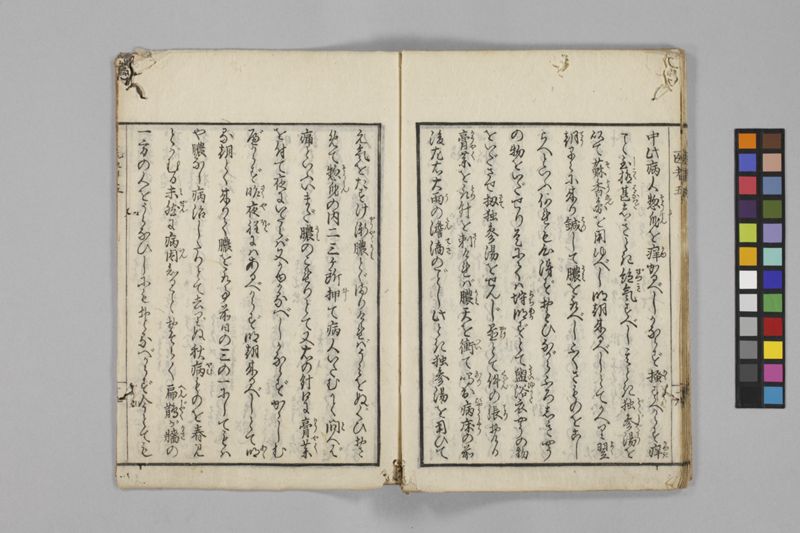
翻刻
中此病人/惣身(そうしん)を痒(かゆ)かるべしかならず搔(かく)すべからす痒(かゆき)
こと至極(しこく)甚(はなはだ)しきとき絶気(ぜつき)すべし其とき独参湯(どくじんたう)を
以て蘇香円(そかうゑん)を用ゆべし明朝来るべしとてかへり翌(よく)
朝(てう)早々に来り鍼(はり)して膿(うみ)を取べしふくさものをこし
らへといふ何れも心得ずおもひながらふろしきやう
の物をいだせり是にては埒明(らちあか)ずとて盥浴(たらいゆかた)衣やうの物
をいださせ扨(さて)独参湯をせんじ置(おけ)とて件(くだん)の張(はり)出けり
膏薬(かうやく)を取(とり)針を刺(さき)ければ膿(うみ)天を衝(つい)て鳴(なり)病床の前
後左右大/雨(う)の澹滴(たんてき)のごとし此とき独参湯を用ひて
元気をたすけ漸(ようやく)膿(うみ)とゞまりければうみをぬぐひおさ
めて惣身(そうしん)の内二三ヶ所/押(おし)て病人いたむかと問(と)へば
痛といふいまだ膿(うみ)のこれりとて又右の針口に膏薬(かうやく)
を付て夜にいたらば又かゆかるべしかならずかゝしむ
べからず昨夜(さくや)程(ほど)にはあるべからず明朝来るべしとて明(あく)
る朝とく来りて膿を取事前日の三の一にしてもは
や膿なし病治したりとて去りぬ秋/病(やむ)ものを春見
とがむる未然(みぜん)に病/因(いん)知ることおそらく扁鵲(へんじやく)が牆(かさ)の
一方の人をうらなひしにもおとるべからず今とても
現代語訳
今夜中にこの病人の全身がかゆくなるだろうが、決してかいてはいけない。かゆいことが極めて甚だしい時は気絶するだろう。その時は独参湯に蘇香円を用いるべきである。明朝来る」と言って帰った。翌朝早々に来て「針をして膿を取るから、拭くものを用意しなさい」と言う。誰も何のことか分からず困りながら、風呂敷のような物を出した。「これでは埒が明かない」と言って、盥や浴衣のような物を出させ、さて「独参湯を煎じておけ」と言って、例の貼った膏薬を取り、針を刺したところ、膿が天を衝いて鳴り、病床の前後左右、大雨の滴るがごとしである。この時独参湯を用いて元気を助け、ようやく膿が止まったので、膿を拭い収めて、全身の内二、三ヶ所を押して「病人は痛むか」と問えば「痛い」と言う。「まだ膿が残っている」と言って、また右の針口に膏薬を付けて「夜になったらまたかゆくなるだろうが、決してかいてはいけない。昨夜ほどではないだろう。明朝来る」と言って、翌朝早く来て膿を取ったが、前日の三分の一ほどで、もはや膿はない。「病気は治った」と言って去った。秋に病む者を春に見て咎める。未然に病気の原因を知ることは、恐らく扁鵲が壁の向こうの人を占ったのにも劣らないであろう。今でも
英語訳
"During the night, this patient's entire body will become itchy, but he must absolutely not scratch it. When the itching becomes extremely severe, he will lose consciousness. At that time, use Sōkōgan (Aromatic Pills for Resuscitation) with Dokujintō (Ginseng Decoction). I will come tomorrow morning," and he returned home. The next morning he came early and said, "I will use needles to draw out the pus, so prepare something to wipe with." No one understood what he meant and, while puzzled, brought out something like a furoshiki cloth. "This won't do," he said, and had them bring out things like a basin and yukatas. Then he said, "Prepare the Dokujintō decoction," removed the plaster he had applied, and inserted a needle. The pus shot up toward the sky with a sound, and around the sickbed - front, back, left, and right - it was like heavy rain dripping. At this time he used the Dokujintō to support the patient's vital energy, and when the pus flow finally stopped, he wiped it clean and pressed two or three places on the patient's body, asking "Does the patient feel pain?" "It hurts," came the reply. "There is still pus remaining," he said, and again applied plaster to the needle puncture, saying "Tonight it will itch again, but you must absolutely not scratch it. It won't be as bad as last night. I will come tomorrow morning." The next morning he came early and drew out pus, but it was only about one-third of the previous day's amount, and there was no more pus. "The illness is cured," he said and departed. To observe in spring one who will fall ill in autumn, and to discern the cause of illness before it manifests - this probably is not inferior to Bian Que's divination of a person beyond the wall. Even now