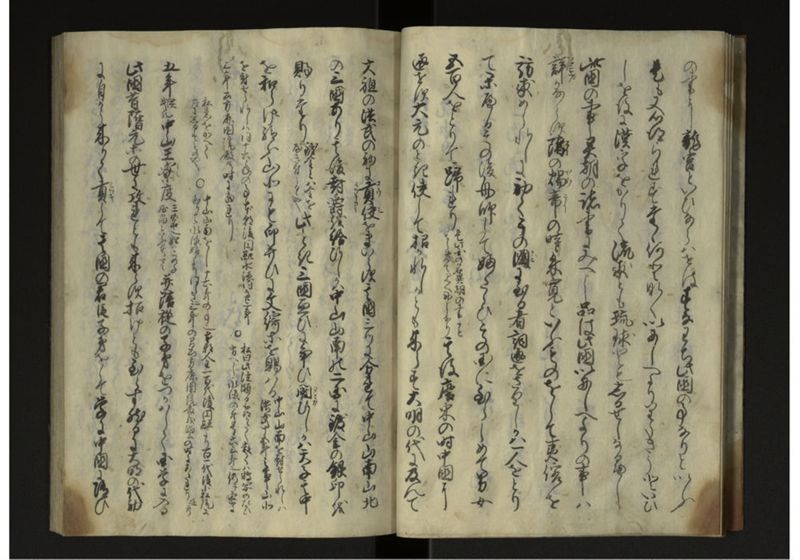
翻刻
の書に龍宮といひならわさはすなわち此国の事なりといふ
是も又心得られずたゝ何となくいにしへよりりうきういひ
しを後に漢字をかりて流求とも琉球ともしるせしなるへし
此国の事異朝の諸事にみへし品は此国いにしへよりの事は
/詳(ツマヒラ)かならす/隋(スイ)の/煬帝(ヤウテイ)の時朱寛といふものをして夷□を
訪求められしに初てその/国(クニ)に至る者調通をさりしかは一人をとり
て閑へるその後舟帰してふたゝひその国に至らしめて男女
五百人をとりて帰せり《割書:是此国の名異朝の書にも|はしめて見へ初しなり》其後唐宋の時中国に
通さす大元のとき使して招かれしかとも来らす大明の代に及んて
太祖の洪武の初に/貢使(コウシ)をまいらす其国三川に分れて中山山南山北
の三国あり其後封爵を給ひしかは中山山南の二国に鍍金の銀印を
賜りたり《割書:鍍金とは金を|やき付たるゝや》此とき三国互ひに争ひ/闘(タゝカ)ひしかは天子其中
を和らげ給う山北にも印幷ひに文繍等を賜はる《割書:中山山南を封せられしは|洪武十五年の事山北》
《割書:を封せられしは同十六年の事本朝後円融永徳同キ廿二年|三年公方鹿園院殿の時に当れり》
《割書:私曰此註頗る心得かたく趣くは転写のたひ|替へし永徳の年号六三年也仍て蜜に》
《割書:私意を加へて|左にしるすもの也》
《割書:中山山南をし十六年の事也人王一百代後円融より百一代後小松院に|至りて永徳始より同しき二三年の間公方鹿園院■義満公の時にあたれり■■
五年《割書:洪|武紀》中山王■度《割書:王の名也姓はこの子|姪尚といふ本の■》并隋従の子弟をつかわして国学に入る
此国昔隋元等の世に攻められとも来らす招けとも至らす然るに大明の代舡
に自から来りて/貢(ミツキ)して其国の君臣子弟をして学に中国に随ひ
キ
現代語訳
の書に龍宮と言い習わしているのは、すなわちこの国の事であるという。これもまた理解しがたい。ただ何となく古くから「りうきう」と言っていたものを、後に漢字を借りて「流求」とも「琉球」とも記したのであろう。
この国の事が外国の諸史に見える事柄については、この国の古くからの事は詳しくない。隋の煬帝の時、朱寛という者にその地域を探訪させたところ、初めてその国に至った者が交渉を拒んだので、一人を捕らえて調べた。その後船を帰して再びその国に至らせ、男女五百人を捕らえて帰った。《割書:これがこの国の名が外国の書にも初めて現れた始まりである》
その後唐宋の時は中国に通じず、大元の時使者を送って招いたけれども来なかった。大明の代に及んで、太祖の洪武の初めに貢使を派遣した。その国は三つに分かれて中山・山南・山北の三国がある。その後封爵を与えたので、中山・山南の二国に鍍金の銀印を賜った。《割書:鍍金とは金をやき付けたものか》この時三国が互いに争い戦ったので、天子がその仲を和らげられた。山北にも印章並びに文繍等を賜る。《割書:中山・山南を封じられたのは洪武十五年の事、山北》《割書:を封じられたのは同十六年の事、本朝後円融永徳同じく二十二年三年、公方鹿園院殿の時に当たった》《割書:私に曰く、この注はかなり理解しがたく、おそらく転写の際に替わってしまったのであろう。永徳の年号は六年から三年である。よって密かに》《割書:私見を加えて左に記すものである》《割書:中山・山南を封じたのは十六年の事である。人王百代後円融から百一代後小松院に至って永徳の始めから同じく二、三年の間、公方鹿園院義満公の時に当たった》
五年《割書:洪武の記録》中山王の某度《割書:王の名である。姓はこの一族は尚という。本の》並びに随従の子弟を遣わして国学に入れる。
この国は昔、隋・元等の世に攻められても来ず、招いても至らなかった。然るに大明の代には自ら船で来て貢ぎ物を献上し、その国の君臣・子弟を学問のために中国に随行させた。
英語訳
The books say that what is customarily called "Dragon Palace" (Ryūgū) refers to this country. This too is difficult to understand. It seems that what was simply called "riukiu" from ancient times was later written using borrowed Chinese characters as either "Liuqiu" (流求) or "Ryukyu" (琉球).
Regarding the affairs of this country as they appear in foreign historical records, the ancient matters of this country are not detailed. During the time of Emperor Yang of Sui, a man named Zhu Kuan was sent to explore that region. When he first reached that country, the people refused to negotiate, so he captured one person for interrogation. Afterward, he returned with ships and went to that country again, capturing five hundred men and women and bringing them back. {{Marginal note: This was the beginning of this country's name first appearing in foreign books as well}}
Thereafter, during the Tang and Song periods, there was no communication with China. During the Yuan dynasty, envoys were sent to invite them, but they did not come. When the Ming dynasty began, tribute missions were sent during the early Hongwu period of Taizu. That country was divided into three parts: Chūzan, Sannan, and Sanhoku. After being granted feudal ranks, the two countries of Chūzan and Sannan were bestowed with gold-plated silver seals. {{Marginal note: Does "gold-plating" mean gold was burned onto it?}} At this time the three countries fought among themselves, so the Son of Heaven mediated between them. Sanhoku was also granted seals along with embroidered textiles. {{Marginal note: Chūzan and Sannan were enfeoffed in the 15th year of Hongwu, while Sanhoku}} {{Marginal note: was enfeoffed in the 16th year of the same period, corresponding to the 22nd-23rd years of Eitoku under Emperor Go-En'yū in our country, during the time of Shōgun Rokuon-in}} {{Marginal note: I say privately that this annotation is quite difficult to understand, and the transcription may have been altered. The Eitoku era lasted from the 6th to 3rd years. Therefore, I secretly}} {{Marginal note: add my personal opinion as recorded below}} {{Marginal note: The enfeoffment of Chūzan and Sannan was in the 16th year. From the 100th sovereign Go-En'yū to the 101st sovereign Go-Komatsu, during the 2nd-3rd years from the beginning of Eitoku, corresponding to the time of Shōgun Rokuon-in Yoshimitsu}}
In the 5th year {{Marginal note: Hongwu records}} King [某度] of Chūzan {{Marginal note: This is the king's name. The surname of this lineage is Shō. The original}} along with his retainer children were sent to enter the national academy.
This country in ancient times did not come even when attacked during the Sui and Yuan periods, nor did they come when invited. However, during the Ming dynasty, they came of their own accord by ship to offer tribute and sent the country's lords, retainers, and children to China for scholarly pursuits.