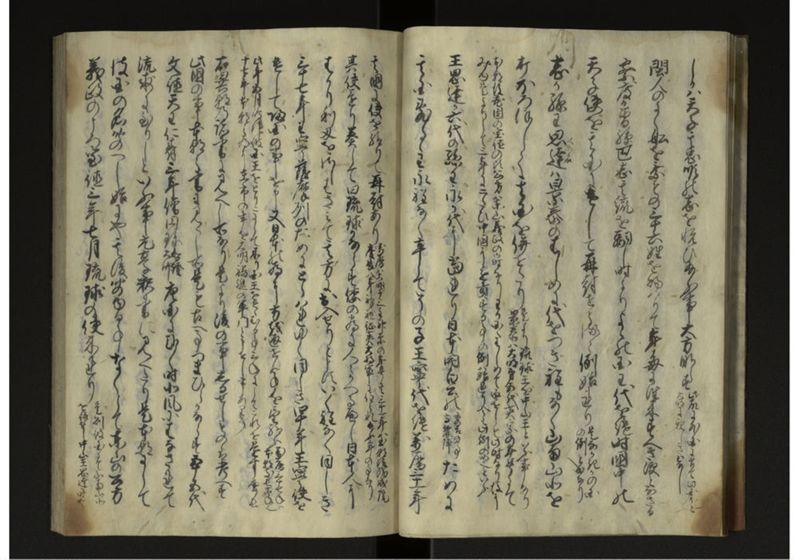
翻刻
しかは天子其忠順の志を悦ひ給ふ事大方ならす《割書:此故に外国に背て此国ほと|大明に親しきはなし》
閩人のよく舩を乗もの三十六姓を賜はりて年毎に往来すへき便となさる
察度の曾孫巴資其流を嗣し時よりよゝの国王代を遣時国中の
天子使を其国に遣して冊封をし流々例始れり《割書:是なる記かの国|の例と成なり》
志か孫王/恩達(人の名)は景泰のむしめに代をつぎ程もなく山南山北を
打ほろほして其国を併せたり《割書:是より琉球王を中山王といふ事なり|景泰は大明第五代英宗の年号にて》
《割書:本朝後花園の宝徳の頃公方は東山義政の御時なりわか国へはしめて通せしも此時なり後に|み内是よりして三年に二たひ中国に進貢する事の例は始れり今も此例の如也といふ》
王恩達か六代の孫王永々代に当れり日本関白公の《割書:変□の當|高□陣》ために
其国□□□王永程なく卒てその子王寧代を遣万暦三十一年
其国に使を積りて再封あり《割書:万暦は大明十三至神奈の年号其三十一年は本朝後陽成院|慶長八年神祖征夷大将軍に任られ給ふ年の事なり》
其使送り奏して曰琉球かならす倭の為に人々かへるへし
日本人に
はかり利刃をおしはさみて其方に出入せりと申すいく程なく同しき
三十七年王寧薩摩州のためにとらはれゆく同しき四十年王寧使を
遣して帰国の事を申又日本の為に方を返けん事を届給ふ《割書:万暦三十七年は|本朝慶長十四年也》《割書:此年五月嶋津彼国王をとりこにして取り国王をとゝむる事三年にしてこれを遣す慶長|十七年本朝の為に在市の事を大明福□の軍門と申けし事ありき》
右異朝の諸書に見へし所なり是より後の事しるせしものは考へす
此国の事本朝の書に見へし所是も古へ事つまひらかならす五十五代
文徳天皇仁寿三年僧円珍《割書:智証|大師》唐国に赴く時北風にはなされて
琉球に至りしといふ事元亨釈書に見へたり是本朝にして
彼国の名聞へし始にや其後聞ゆる事なくして東山の公方
義政のころ宝徳三年七月琉球の使来れり《割書:是則彼国にて山南山北|を併せし中山王恩達が時也》
現代語訳
そこで天子はその忠順の志を喜ばれることは並大抵ではなかった。《割書:この故に外国に背いてこの国ほど大明に親しいところはない》
閩人でよく船を操縦する者三十六姓を賜って、年ごとに往来すべき便宜とされた。
察度の曾孫巴志がその流れを継いだ時より、歴代の国王が代替わりする時、国中の天子が使者をその国に遣わして冊封をする慣例が始まった。《割書:これがかの国の例となった》
志の孫王尚達(人名)は景泰の末に代を継ぎ、程なく山南・山北を打ち滅ぼしてその国を併合した。《割書:これより琉球王を中山王というようになった。景泰は大明第五代英宗の年号で》
《割書:本朝後花園の宝徳の頃、公方は東山義政の御時である。我が国へ初めて通じたのもこの時である。後に見るように、これより三年に二度中国に進貢する例が始まった。今もこの例の通りであるという》
王尚達の六代の孫王尚永の代に当たった時、日本関白公の《割書:変の当高陣》ために、その国。王尚永は程なく卒去して、その子王尚寧が代を継いだ。万暦三十一年、その国に使者を送って再封があった。《割書:万暦は大明十三代神宗の年号、その三十一年は本朝後陽成院慶長八年、神祖が征夷大将軍に任じられた年のことである》
その使者が送り状を奏上して曰く「琉球は必ず倭のために人々が帰ることになるであろう。日本人に謀られ、利刃を押し挟まれてその方に出入りしている」と申した。いくらも経たずに同じく三十七年、王尚寧は薩摩州のために捕らわれていく。同じく四十年、王尚寧は使者を遣わして帰国の事を申し、また日本のために方針を変える事を届け出た。《割書:万暦三十七年は本朝慶長十四年である》《割書:この年五月、島津がかの国王を捕虜にして取り、国王を留める事三年にしてこれを遣わす。慶長十七年、本朝のために在市の事を大明福建の軍門と申したことがあった》
右は異朝の諸書に見える所である。これより後の事を記したものは考察していない。
この国の事が本朝の書に見える所は、これも古い事は詳らかでない。五十五代文徳天皇仁寿三年、僧円珍《割書:智証大師》が唐国に赴く時、北風に流されて琉球に至ったという事が元亨釈書に見えている。これが本朝においてかの国の名が聞こえた始まりか。その後聞こえることなくして、東山の公方義政の頃、宝徳三年七月に琉球の使者が来た。《割書:これはすなわちかの国で山南・山北を併合した中山王尚達の時である》
英語訳
Therefore, the Son of Heaven was extraordinarily pleased with their loyal and obedient intentions. {{Marginal note: For this reason, among foreign countries that turned against others, none was as close to the Ming as this country}}
Thirty-six surnames of Fujian people skilled in navigation were granted to serve as yearly conveniences for travel back and forth.
From the time when Hashi, the great-grandson of Satto, succeeded to this lineage, the custom began whereby whenever successive kings changed reign, the Son of Heaven would send envoys to that country for investiture ceremonies. {{Marginal note: This became the established custom of that country}}
Shō Toku, grandson of Hashi (personal name), succeeded to the throne at the end of the Jingtai era and soon destroyed Sannan and Sanhoku, annexing those countries. {{Marginal note: From this time the Ryukyu king came to be called the Chūzan king. Jingtai was the era name of Yingzong, the fifth emperor of the Ming}} {{Marginal note: During the Hōtoku period of Emperor Go-Hanazono in our country, the shōgun was Higashiyama Yoshimasa. The first communication with our country also occurred at this time. As will be seen later, the custom of sending tribute to China twice every three years began from this time. It is said this custom continues today}}
During the reign of King Shō Ei, the sixth-generation descendant of King Shō Toku, due to the Japanese Regent {{Marginal note: [unclear text about military campaigns]}} that country [text unclear]. King Shō Ei died shortly after, and his son King Shō Nei succeeded him. In the 31st year of Wanli, an envoy was sent to that country for re-investiture. {{Marginal note: Wanli was the era name of Shenzong, the 13th emperor of the Ming. The 31st year corresponds to Keichō 8 in our country under Emperor Go-Yōzei, the year when the Divine Ancestor was appointed as Seii Taishōgun}}
That envoy submitted a memorial saying: "The people of Ryukyu will inevitably return due to the Japanese. They have been deceived by the Japanese, who force sharp blades upon them and control their comings and goings." Not long afterward, in the same 37th year, King Shō Nei was captured by Satsuma Province. In the same 40th year, King Shō Nei sent an envoy to request permission to return to his country and also to notify them of changing policy in favor of Japan. {{Marginal note: The 37th year of Wanli corresponds to Keichō 14 in our country}} {{Marginal note: In the fifth month of this year, the Shimazu took the king of that country prisoner. After detaining the king for three years, they released him. In Keichō 17, there was an incident where they petitioned the Ming military command in Fujian regarding trade matters on behalf of our country}}
The above is what appears in various foreign historical records. I have not examined records of events after this period.
Regarding the appearances of this country in our country's records, ancient matters are also unclear. In the third year of Jisai during the reign of the 55th emperor, Emperor Montoku, when the monk Enchin {{Marginal note: Chishō Daishi}} was traveling to Tang China, he was blown by north winds and reached Ryukyu, according to the Genkō Shakusho. This may be the first time that country's name was heard of in our country. After that, nothing was heard until the time of Shōgun Higashiyama Yoshimasa, when Ryukyuan envoys came in the seventh month of Hōtoku 3. {{Marginal note: This was during the time of Chūzan King Shō Toku, who had annexed Sannan and Sanhoku in that country}}