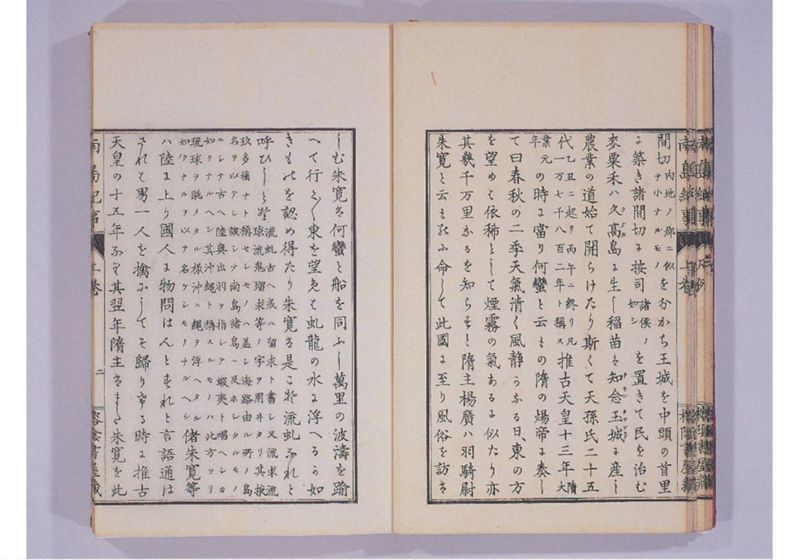
翻刻
間切《割書:内地ノ郡ニ似|テ小ナルモノ》を分かち王城を中頭の首里
に築き諸間切に按司《割書:諸侯ノ|如シ》を置きて民を治め
麥粟禾は久髙(クダカ)島に生し稲苗は知念(チネン)玉城(タマグスク)に産し
農業の道始て開らけたり斯くて天孫氏二十五
代《割書:乙丑ニ起リ丙午ニ終リ凡|一万七千八百二年ト稱ス》推古天皇十三年《割書:隋|大》
《割書:業元|年》の時に當り何蠻と云もの隋の煬帝に奏し
て曰春秋の二季天氣清く風静かなる日、東の方
を望めは依稀として煙霧の氣あるに似たり亦
其㡬千万里なるを知らすと隋主楊廣は羽騎尉
朱寛と云ものに命して此國に至り風俗を訪は
しむ朱寬は何蠻と船を同ふし萬里の波濤を踰
へて行く〳〵東を望めは虬龍の水に浮へるか如
きものを認め得たり朱寛は是こそ流虬なれと
呼ひしとそ《割書:流虬古ヘ或ハ留求ト書シ又流求流|球流鬼瑠求等ノ字ヲ用ヰタリ其掖》
《割書:玖多禰ナト稱セシモノハ盖シ海路由ル所ノ島|名ヲ以テシ該シテ南島諸島ニ及ホシタルモノ》
《割書:ニシテ古ヘ陸奥出羽ヲ指シテ蝦夷ト唱ヘシカ|如クナルヘシ其沖縄ト稱スルモノハ此方ヨリ》
《割書:琉球ヲ眺メタル様沖に縄ヲ浮ヘタル|如クナルヲ以テ名ケシモノナルヘシ》偖朱寛等
は陸に上り國人に物問はんとすれと言語通は
されは男一人を擒にしてそ歸りける時に推古
天皇の十五年なり其翌年隋主はまた朱寛を此
現代語訳
間切《内地の郡に似ているが小さなもの》を分かち、王城を中頭の首里に築き、諸間切に按司《諸侯の如し》を置いて民を治めた。
麦・粟・禾は久高(クダカ)島に生じ、稲苗は知念(チネン)・玉城(タマグスク)に産し、農業の道が初めて開かれた。このようにして天孫氏二十五代《乙丑に起こり丙午に終わり、およそ一万七千八百二年と称す》、推古天皇十三年《隋大業元年》の時に当たり、何蠻というものが隋の煬帝に奏上して言うには「春秋の二季、天気清く風静かな日、東の方を望めば、ぼんやりと煙霧の気があるように見える。またその距離が幾千万里なのかは分からない」と。隋主楊広は羽騎尉朱寛というものに命じて、この国に至り風俗を調査させた。朱寛は何蠻と船を共にし、万里の波濤を越えて行く。東を望めば虬龍が水に浮かんでいるようなものを認めることができた。朱寛はこれこそ流虬であろうと呼んだという《流虬は古くはあるいは留求と書き、また流求・流球・流鬼・瑠求等の字を用いた。その掖玖・多禰などと称したものは、おそらく海路を辿る所の島名を以ってこれを指し、南島諸島に及ぼしたものであって、古く陸奥・出羽を指して蝦夷と唱えたようなものであろう。その沖縄と称するものは、こちらから琉球を眺めた様子が、沖に縄を浮かべたようであることから名付けたものであろう》。さて朱寛等は陸に上がり、国人に物を問おうとしたが、言語が通じないので、男一人を捕らえて帰った。その時は推古天皇十五年であった。その翌年、隋主はまた朱寛をこの
英語訳
They divided the territory into magiri《similar to districts in the mainland but smaller}}, built the royal castle in Shuri in the Nakagami region, and placed aji《like feudal lords}} in each magiri to govern the people.
Wheat, millet, and grain first grew on Kudaka Island, rice seedlings were produced in Chinen and Tamagusuku, and thus agricultural practices were first established. In this way, through twenty-five generations of the Tenson dynasty《beginning in the year of kinoto-ushi and ending in hinoe-uma, said to span approximately 17,802 years}}, during the thirteenth year of Empress Suiko's reign《the first year of the Sui Daye era}}, a person called Kaban memorialized Emperor Yang of Sui, saying: "During the spring and autumn seasons, on days when the weather is clear and the wind is calm, when one looks eastward, there appears to be something resembling misty vapors. The distance of several thousand or ten thousand li is unknown." Emperor Yang Guang of Sui commanded a cavalry officer named Zhu Kuan to travel to this country and investigate its customs. Zhu Kuan shared a boat with Kaban and crossed the vast ocean waves. Looking eastward, they were able to discern something like a dragon floating on the water. Zhu Kuan called this "Liuqiu" (Flowing Dragon)《Liuqiu was anciently sometimes written as Liuqiu, and also used characters like Liuqiu, Liuqiu, Liuki, Ruqiu, etc. What was called Yaku, Tane, etc. probably referred to island names encountered along the sea route, extending to the various southern islands, much like how Mutsu and Dewa were anciently referred to as Ezo. The name Okinawa probably comes from how, when viewing Ryukyu from here, it appears like a rope floating on the open sea}}. Now, when Zhu Kuan and others landed and tried to question the locals, the language did not communicate, so they captured one man and returned. This was the fifteenth year of Empress Suiko's reign. The following year, the Sui emperor again sent Zhu Kuan to this