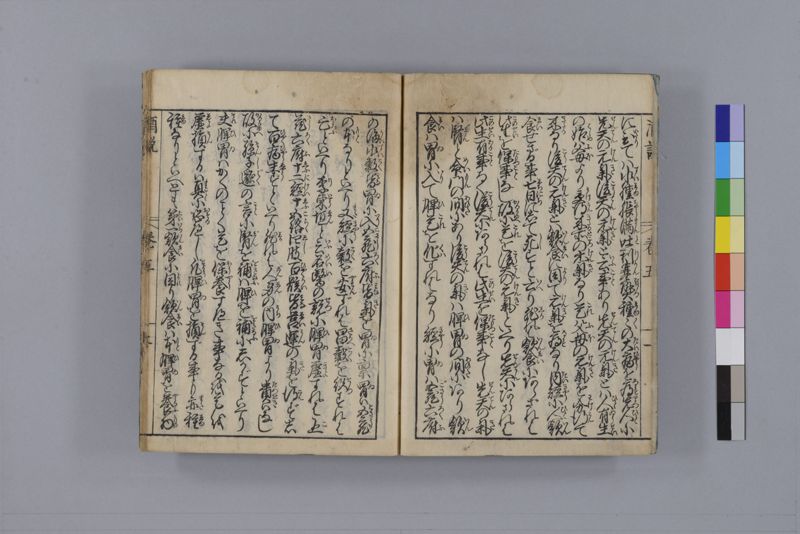
翻刻
【右丁】
に至(いたり)ては水腫(すいしゆ)張満(ちやうまん)吐利(とり)寒熱(かんねつ)種々(しゆ〳〵)の大病(たいひやう)を為(なす)先(まつ)人(ひと)に
先天(せんてん)の元気(けんき)後天(こうてん)の元気(けんき)と云(いふ)事(こと)あり先天(せんてん)の元気(けんき)とは人(ひと)有生(ゐうせい)
の始(はしめ)父母(ふほ)より受(うけ)得(え)来(きたる)所(ところ)の元気(けんき)なり是(これ)父母(ふほ)の元気(けんき)を分(わけ)得(え)て
来(きたる)なり後天(こうてん)の元気(けんき)とは飲食(いんしい)に因(より)て元気(けんき)を為(なす)なり内経(たいきやう)に人(ひと)飲(いん)
食(しい)せざる事 七日(しちにち)にして死(し)すと云(いへ)り然(しか)れはいん飲食(いんしい)にあらざれは
此生(このせい)を保事(たもつこと)なし故(かるかゆへ)に是(これ)を後天(こうてん)の元気(けんき)といへり先天(せんてん)にあらされは
此生(このせい)有事(あること)なく後天(こうてん)にあらされは此生(このせい)を保事(たもつこと)なし先天(せんてん)の気(き)
は腎(じん)と命門(めいもん)の間(あひた)にあり後天(こうてん)の気(き)は脾胃(ひゐ)の間(あひた)にあり飲(いん)
食(しい)は胃(ゐ)に入(いり)て脾(ひ)是(これ)を化(くは)すれはなり経(きやう)に胃(ゐ)は五蔵(ごさう)六府(ろくふ)
【左丁】
の海(かい)水穀(すいこく)皆(みな)胃(ゐ)に入(いり)五蔵(こさう)六府(ろくふ)皆(みな)気(き)を胃(ゐ)に稟(うく)胃(ゐ)は五蔵(こさう)
の本(もと)なりといへり又(また)経(きやう)に穀(こく)を安(やすん)ずれは昌(さかへ)穀(こく)を絶(せつ)すれは
亡(ほろふ)といへり李東垣(りとうゑん)と云(いふ)名医(めいい)の説(せつ)に脾胃(ひゐ)虚(きよ)すれは五(こ)
蔵(さう)六府(ろくふ)十二経(しふにけい)十五絡(しふこらく)四肢(しし)百骸(ひやくかい)皆(みな)営運(ゑいうん)の気(き)を得(え)ずし
て百病(ひやくひやう)生(しやう)ずといへり然(しか)れは人身(じんしん)の内(うち)脾胃(ひゐ)より貴(たつとき)はなし
故(かるかゆへ)に孫子邈(そんしばく)の言(こと)に腎(じん)を補(をきなふ)は脾(ひ)を補(をきなふ)にしかずといへり
夫(それ)脾胃(ひゐ)はかくのことく是を保養(ほうやう)すへき事なるを是を
虚損(きよそん)するは真(まこと)に恐(おそる)へし凡(をよそ)脾胃(ひゐ)を損(そん)ずる事も亦(また)種(しゆ)
種(しゆ)なりといへとも第一(たいいち)飲食(いんしい)に因(よれ)り飲食(いんしい)は本(もと)脾胃(ひゐ)を養(やしなふ)物(もの)
現代語訳
【右丁】
に至っては水腫、張満、吐利、寒熱といった種々の大病を引き起こす。古人に
先天の元気、後天の元気ということがある。先天の元気とは人が生まれる
初めに父母より受け継いできた元気である。これは父母の元気を分け与えられて
やってくるのである。後天の元気とは飲食によって元気を作ることである。内経に人が飲
食をしないこと七日にして死ぬと言われている。そうであれば飲食がなければ
この生命を保つことはない。故にこれを後天の元気と言うのである。先天がなければ
この生命が存在することはなく、後天がなければこの生命を保つことはない。先天の気
は腎と命門の間にあり、後天の気は脾胃の間にある。飲
食は胃に入って脾がこれを消化するからである。経に胃は五臓六腑
【左丁】
の海であり、水穀は皆胃に入り、五臓六腑は皆気を胃に受け、胃は五臓
の本であると言われている。また経に穀を安んずれば昌え、穀を絶すれば
亡ぶと言われている。李東垣という名医の説に脾胃が虚すれば五
臓六腑、十二経、十五絡、四肢百骸は皆営運の気を得ずして
百病が生ずると言われている。そうであれば人身の内で脾胃より貴いものはない。
故に孫思邈の言葉に腎を補うは脾を補うに如かずと言われている。
それ脾胃はこのようにこれを保養すべきことであるのに、これを
虚損するのは真に恐るべきである。およそ脾胃を損ずることもまた種
種であると言えども、第一は飲食によるものであり、飲食は本来脾胃を養う物で
英語訳
[Right page]
In severe cases, they develop various major diseases such as edema, distention, vomiting and diarrhea, and alternating chills and fever. The ancients spoke of
prenatal vital energy and postnatal vital energy. Prenatal vital energy refers to the vital energy that humans
receive from their parents at the beginning of life. This comes from receiving a portion of the parents' vital energy.
Postnatal vital energy refers to creating vital energy through food and drink. The Inner Classic states that humans die
after seven days without food or drink. Therefore, without food and drink,
this life cannot be maintained. Hence this is called postnatal vital energy. Without the prenatal,
this life would not exist, and without the postnatal, this life cannot be maintained. Prenatal energy
resides between the kidneys and the gate of life, while postnatal energy resides between the spleen and stomach. This is because
food and drink enter the stomach and the spleen transforms them. The Classic states that the stomach is the sea of the five organs and six bowels.
[Left page]
All water and grain enter the stomach, and the five organs and six bowels all receive their energy from the stomach. The stomach is
the foundation of the five organs. Also, the Classic states that when grain is at peace, there is prosperity; when grain is cut off,
there is destruction. According to the famous physician Li Dongyuan, when the spleen and stomach are deficient, the five
organs and six bowels, twelve meridians, fifteen collaterals, four limbs and hundred bones all fail to receive nourishing energy, and
a hundred diseases arise. Therefore, nothing in the human body is more precious than the spleen and stomach.
Hence Sun Simiao said that nourishing the kidneys is not as good as nourishing the spleen.
Now, the spleen and stomach should be preserved and nourished in this way, yet
causing their deficiency and damage is truly fearsome. Generally, there are various ways
to damage the spleen and stomach, but the primary cause is through food and drink. Food and drink are originally meant to nourish the spleen and stomach,