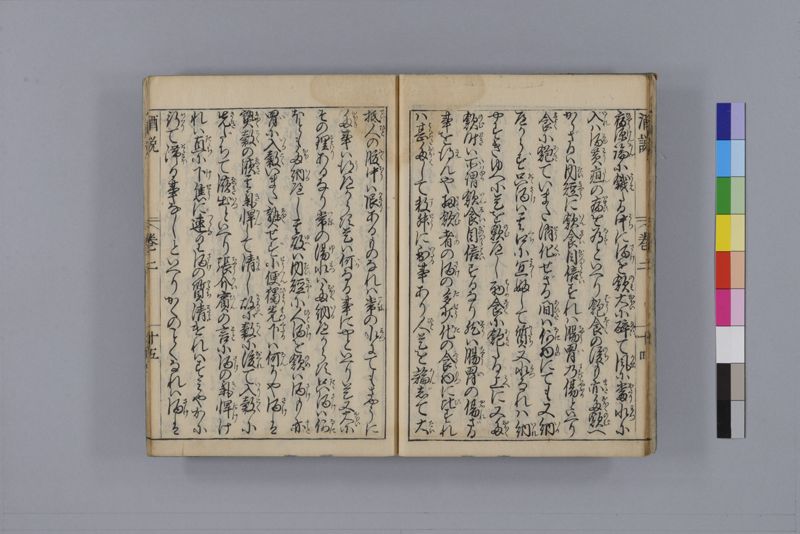
翻刻
【右丁】
病源論(ひやうけんろん)に饑(うえ)たる中(うち)に酒(さけ)を飲(のみ)大(おほい)に醉(ゑひ)て風(かせ)に当(あたり)水(みつ)に
入(いれ)は酒黄疸(しゆわうたん)の病(やまひ)を為(なす)といへり飽食(ばうしよく)の後(のち)も亦(また)多(おほく)飲(のむ)へ
からざるは内経(たいきやう)に飲食(いんしい)自(おのつから)倍(はい)すれは腸胃(ちやうい)乃(すなはち)傷(やふる)といへり
食(しよく)に飽(あき)ていまた消化(せうくは)せざる間(あひた)は何物(なにもの)にても又 納(いる)
へからず只(たゝ)酒(さけ)は其 口(くち)に宜(よろし)ふして質(かたち)又 水(みつ)なれは納(いれ)
やすきゆへに是を飲(のむ)へし初(はしめ)食(しよく)に飽(あき)たる上(うへ)に又 多(おほく)
飲時(のむとき)は所謂(いはゆる)飲食(いんしい)自(おのつから)倍(はい)するなり然(しから)は腸胃(ちやうい)の傷(やふれ)ざる
事を得(え)んや扨(さて)飲(のむ)者(もの)の酒(さけ)の多少(たせう)他(た)の食物(しよくもつ)に比(ひ)すれ
は甚(はなはた)多(おほく)して数升(すせう)に至(いたる)事あり人(ひと)是を論(ろん)じて大(たい)
【左丁】
低(てい)人(ひと)の腹中(ふくちう)は限(かきり)あるものなれは常(つね)の水(みつ)にてもさやうに
多(おほき)事は得(う)へからす是は何(いか)なる事にやといへり是又 大(おほい)に
その理(ことはり)あるなり常(つね)の湯水(ゆみつ)は多(おほく)納(いる)へからす只(たゝ)酒(さけ)は何(なに)
ほとも多(おほく)納(いる)へし其 故(ゆへ)は内経(たいきやう)に人(ひと)酒(さけ)を飲(のめ)は酒(さけ)も亦(また)
胃(い)に入(いる)穀(こく)いまた熟(しゆく)せず小便(せうへん)独(ひとり)先(まつ)下(くたる)は何(なん)ぞや酒(さけ)は
熟穀(しゆくこく)の液(ゑき)其 気(き)悍(かん)して清(きよ)し故(かるかゆへ)に穀(こく)に後(おくれ)て入(いり)穀(こく)に
先(さき)だちて液(ゑき)出(いつ)といへり張介賓(ちやうかいひん)の言(こと)に酒(さけ)の気(き)悍(たけ)け
れは直(たゝち)に下焦(けせう)に連(つらな)り酒(さけ)の質(かたち)清(きよ)けれはすみやかに
行(めくり)て滞(とゝこほ)る事なしといへりかくのことくなれは酒(さけ)は
現代語訳
【右丁】
『病源論』に「飢えている中に酒を飲み、大いに酔って風に当たり水に入れば、酒黄疸の病気になる」と言っている。満腹の後もまた多く飲んではならないのは、『内経』に「飲食が自然に倍加すれば腸胃すなわち傷つく」と言っているからである。食事に満腹してまだ消化しない間は、何物でも又入れてはならない。ただ酒はその口当たりが良く、性質もまた水のようであるから入れやすいために、これを飲むのであろう。初め食事に満腹した上にまた多く飲む時は、いわゆる「飲食が自然に倍加する」のである。そうであれば腸胃が傷つかないことを得ようか。さて飲む者の酒の多少を他の食物に比べれば、甚だ多くして数升に至ることがある。人はこれを論じて「大
【左丁】
体人の腹中は限りがあるものであるから、普通の水でもそのように多いことは得られない。これは何事であろうか」と言っている。これもまた大いにその理由があるのである。普通の湯水は多く入れることはできない。ただ酒は何ほども多く入れることができる。その理由は、『内経』に「人が酒を飲めば、酒もまた胃に入る。穀物がまだ熟さないのに小便だけが先に下るのは何故か。酒は熟した穀物の液で、その気が激しくて清らかである。故に穀物に後れて入り、穀物に先立って液が出る」と言っているからである。張介賓の言葉に「酒の気が激しければ直ちに下焦に連なり、酒の性質が清らかであれば速やかに巡って滞ることがない」と言っている。このようであるから酒は
英語訳
【Right page】
The "Treatise on Disease Origins" states: "If one drinks alcohol while hungry, becomes greatly intoxicated, and then encounters wind or enters water, this causes the disease of alcoholic jaundice." One should also not drink much after eating to fullness, because the "Inner Classic" says: "When food and drink naturally double, the intestines and stomach are then injured." During the time when one is full from eating and has not yet digested, nothing else should be consumed. However, alcohol tastes good in the mouth and its nature is also like water, making it easy to consume, which is why people drink it. When one first becomes full from eating and then drinks much more, this is what is called "food and drink naturally doubling." If this is so, how could the intestines and stomach avoid being injured? Now, when comparing the amount of alcohol that drinkers consume to other foods, it is extremely large, sometimes reaching several shō. People discuss this saying: "Generally,
【Left page】
the human abdomen has limits, so even with ordinary water, such large amounts cannot be consumed. What manner of thing is this?" There is also great reason for this. Ordinary hot water cannot be consumed in large quantities. Only alcohol can be consumed in any amount. The reason is that the "Inner Classic" states: "When a person drinks alcohol, the alcohol also enters the stomach. Why does urine alone descend first while grain has not yet been processed? Alcohol is the liquid of cooked grain; its qi is fierce and clear. Therefore it enters after grain but its liquid emerges before grain." Zhang Jiebin's words state: "Because alcohol's qi is fierce, it directly connects to the lower burner; because alcohol's nature is clear, it circulates rapidly without stagnation." Being thus, alcohol...