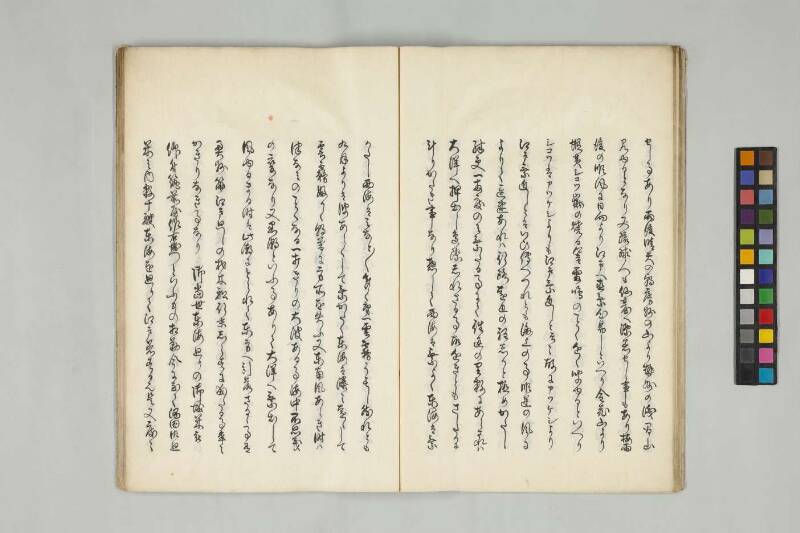
翻刻
【右丁】
セし事あり雨後晴天の朝房州の山より勢州の浅間山#1
見ゆるとなり又琉球人も仙台へ漂着セし事もあり梅雨
後の順風に日向より江戸へ直乗心易しといへり金花山より
蝦夷シコツ嶽の焼る響雷鳴のことく近く聞ゆるといへり
シコツはアツケシよりも江戸乗近しと云々故にアツケシより
江戸乗近しとはいひ伝へつれとも海上の事順逆の風に
よりて遅速あれハ行路遠近の程しかと極めかたし
殊更一両度のみ乗たる事にて往返の里数にあらされハ
大洋へ押出し辺際しれさる事故近きともさしたるに
計りかたき事なり惣して西海は乗よく東海は乗
【左丁】
かたし西海はみなと〳〵多く第一雲霧うすし然れとも
九月よりは波あらくして乗かたく東海は湊々遠くして
雲霧ふかく朝暮に方所を失ふ又東南風あらき時ハ
つなみのことくなる一打きりの大波ある事海中不思義
の変なり又黒潮といふ事ありて大洋へ乗出して
風ゆるまる時は此潮にとられて東方へ引落さるゝ事有
奥州筋江戸廻しの材木船行末しらすに成たる事年々
かきりなき事なり 御当世東海廻りの御城米被
仰付筑前屋作右衛門といふもの相勤今に至て酒田御廻
米之内数十艘東海を廻りて江戸着する也是又度々
現代語訳
【右丁】
したことがある。雨後の晴天の朝、房州の山より伊勢国の朝熊山が見えるということである。また琉球人も仙台へ漂着したことがある。梅雨後の順風で日向より江戸へ直航するのは容易だと言われている。金華山より蝦夷のシコツ岳の燃える響きが雷鳴のように近く聞こえると言われている。シコツはアッケシよりも江戸への航海が近いと云々。そのためアッケシより江戸への航海が近いとは言い伝えられているけれども、海上のことは順風逆風によって速度に違いがあるので、航路の遠近の程度をはっきりと定めることは難しい。特に一、二度だけ航海したことで、往復の距離ではないので、大洋へ押し出して辺りの境界も分からないことなので、近いといっても大した根拠があるわけではなく、計り難いことである。総じて西海は航海しやすく、東海は航海し
【左丁】
にくい。西海は港々が多く、第一に雲霧が薄い。しかし九月からは波が荒くて航海しにくく、東海は港々が遠くて雲霧が深く、朝夕に方角を見失う。また東南風が激しい時は津波のようになる一撃限りの大波があることは海中の不思議な変化である。また黒潮ということがあって、大洋へ乗り出して風が弱まる時は、この潮に捕らえられて東方へ引き落とされることがある。奥州筋の江戸回りの材木船が行方知れずになったことは年々数限りないことである。当世、東海回りの御城米を仰せ付けられ、筑前屋作右衛門という者が相勤め、今に至って酒田御回り米のうち数十艘が東海を回って江戸に着岸している。これもまた度々
英語訳
【Right Page】
have occurred. On clear mornings after rain, Mount Asama in Ise Province can be seen from the mountains of Bōshū. Ryukyu people have also drifted ashore at Sendai. It is said that direct sailing from Hyūga to Edo with favorable winds after the rainy season is easy. The rumbling sound of Mount Shikotsu burning in Ezo is said to be heard as close as thunder from Kinkazan. Shikotsu is said to be closer to Edo by sea than Akkeshi, and so forth. Therefore, it has been said that sailing from Akkeshi to Edo is close, but since maritime matters depend on favorable and contrary winds for speed, it is difficult to definitively determine the degree of distance of sea routes. Especially since this is based on only one or two voyages, and not round-trip distances, when one pushes out into the great ocean where the boundaries are unknown, even if it is said to be close, there is no substantial basis for measurement, making it difficult to calculate. Generally, the western seas are good for sailing, while the eastern seas are difficult
【Left Page】
to navigate. The western seas have many ports and, most importantly, thin clouds and fog. However, from September onward the waves become rough and navigation becomes difficult. The eastern seas have distant ports with deep clouds and fog, causing one to lose direction at dawn and dusk. Also, when southeastern winds are fierce, there are single massive waves like tsunamis - a mysterious phenomenon of the sea. There is also something called the Kuroshio (Black Current), and when one sails out into the great ocean and the wind weakens, one can be caught by this current and pulled eastward. Timber ships from the Ōshū region bound for Edo that disappear without a trace are countless year after year. In the present era, eastern sea route transport of castle rice has been decreed, with one Chikuzenya Sakuemon serving in this capacity. To this day, dozens of ships carrying Sakata rice sail around the eastern sea and arrive at Edo. This also frequently