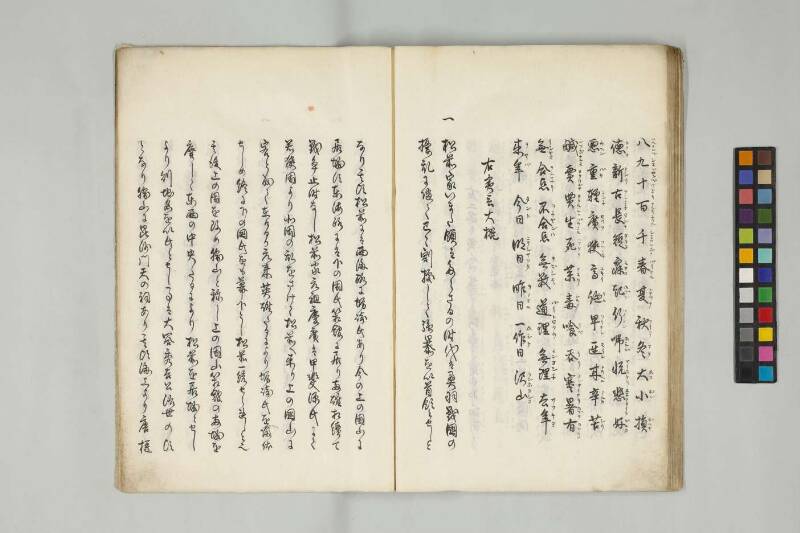
翻刻
【右丁】
八(ツヘナンベ)/九(シネベサンベ)/十(ツンナキ)/百(アシキネツブ)/千(シネカンボフ)/春(バイカル)/夏(シヤツテ)/秋(ツイテ)/冬(マタ)/大(ホロ)/小(ポン)/損(ビルヤ)
徳(トクカ)/新(アシリ)/古(フシコネ)/長(タンナ)/短(タキネ)/寝(モロコ)/起(ホブン)/行(ハイアン)/帰(ホシビ)/悦(ヤイラケリ)/悲(ヱネアタイラ)/好(ピルカ)
悪(ウヘン)/重(バセ)/軽(コシネ)/廣(セツフ)/狭(フツヽネ)/髙(ユキイ)/低(ラム)/早(ツイナシ)/遅(モイレ)/甘(トウヘニ)/辛(アルカ)/苦(シウ)
鹹(シツポナンヌ)/賣(ヨクワンヤ)/買(ヨクルシヽ)/生(パウコル)/死(ハツタリ)/薬(クスリ)/毒(シルク)/喰(イベ)/呑(イリ)/寒(メンナイアリ)/暑(ホブケ)/有(ヲワイハ)
無(イシヤマ)/合点(ヲンネリ)/不合点(ヲチヤンハ)/無数(ヲビシキ)/道理(バイトロクウ)/無理(メンコシネ)/去年(サツキヨ)
来年(ヲヤバ)/今日(タント)/明日(ニテシヤツタ)/昨日(ヲノマニ)/一作日(ホシケ)/澤山(ランホカシコ)
右夷言大概
一 松前家いまた領主たらさるの時代は奥羽戦国の
擾乱に随て己々割拠して強暴を以首領とせしと
【左丁】
なり其頃松前には西海路に蠣崎氏あり今の上の国山に
居城す東海路には下の国氏箱館に居り両雄相続て
戦争止時なし松前家元祖慶広は甲斐源氏にて
若狭国より北国の乱をさけて松前へ来り上の国山に
客と成て在けるか元来英雄たるにより蠣崎氏を帰依
せしめ終に下の国氏をも幕下とし松前一統せられしと也
其後上の国を改め勝山と称し上の国山箱館の両城を
廃して東西の中央たるにより松前を居城とせし
より則地名を以氏とせし事は大閤秀吉公治世の頃
となり勝山に毘沙門天の祠あり其頃海上より唐櫃
現代語訳
【右丁】
八(ツヘナンベ)/九(シネベサンベ)/十(ツンナキ)/百(アシキネツブ)/千(シネカンボフ)/春(バイカル)/夏(シヤツテ)/秋(ツイテ)/冬(マタ)/大(ホロ)/小(ポン)/損(ビルヤ)
徳(トクカ)/新(アシリ)/古(フシコネ)/長(タンナ)/短(タキネ)/寝(モロコ)/起(ホブン)/行(ハイアン)/帰(ホシビ)/悦(ヤイラケリ)/悲(ヱネアタイラ)/好(ピルカ)
悪(ウヘン)/重(バセ)/軽(コシネ)/広(セツフ)/狭(フツヽネ)/高(ユキイ)/低(ラム)/早(ツイナシ)/遅(モイレ)/甘(トウヘニ)/辛(アルカ)/苦(シウ)
鹹(シツポナンヌ)/売(ヨクワンヤ)/買(ヨクルシヽ)/生(パウコル)/死(ハツタリ)/薬(クスリ)/毒(シルク)/食(イベ)/飲(イリ)/寒(メンナイアリ)/暑(ホブケ)/有(ヲワイハ)
無(イシヤマ)/合点(ヲンネリ)/不合点(ヲチヤンハ)/無数(ヲビシキ)/道理(バイトロクウ)/無理(メンコシネ)/去年(サツキヨ)
来年(ヲヤバ)/今日(タント)/明日(ニテシヤツタ)/昨日(ヲノマニ)/一昨日(ホシケ)/沢山(ランホカシコ)
以上がアイヌ語の大要である
一 松前家がまだ領主ではなかった時代は、奥羽の戦国時代の乱に伴って、それぞれが勢力を分割して強い者を首領としていたということである。
その頃松前には西海路に蠣崎氏があり、今の上ノ国町に居城していた。東海路には下国氏が箱館にいて、両雄が相対して
【左丁】
戦争が止むことがなかった。松前家の元祖慶広は甲斐源氏で、若狭国より北国の乱を避けて松前へ来て、上ノ国町に
客として滞在していたが、もとより英雄であったので蠣崎氏を帰依させ、ついに下国氏をも配下とし、松前を統一したということである。
その後上ノ国を改めて勝山と称し、上ノ国町と箱館の両城を
廃して、東西の中央に位置するということで松前を居城とした。
そこで地名を以って氏とした事は、太閤秀吉公の治世の頃の
ことである。勝山に毘沙門天の祠があり、その頃海上より唐櫃が
英語訳
[Right page]
Eight (tsuhénanbe) / Nine (shinebésanbe) / Ten (tsunaki) / Hundred (ashikinetsub) / Thousand (shinekanbof) / Spring (baikal) / Summer (shatte) / Autumn (tsite) / Winter (mata) / Big (horo) / Small (pon) / Loss (birya)
Virtue (tokuka) / New (ashiri) / Old (fushikone) / Long (tanna) / Short (takine) / Sleep (moroko) / Wake (hobun) / Go (haian) / Return (hoshibi) / Joy (yairakeri) / Sorrow (eneataira) / Good (pirka)
Bad (uhen) / Heavy (base) / Light (koshine) / Wide (setsuf) / Narrow (futsune) / High (yukii) / Low (ram) / Fast (tsinashi) / Slow (moire) / Sweet (touheni) / Spicy (aruka) / Bitter (siu)
Salty (shitsuponannu) / Sell (yokuwanya) / Buy (yokurishishi) / Live (paukoru) / Die (hattatari) / Medicine (kusuri) / Poison (shiruku) / Eat (ibe) / Drink (iri) / Cold (mennaiari) / Hot (hobuke) / Have (owaiha)
None (ishiyama) / Understand (onneri) / Not understand (ochanha) / Countless (obishiki) / Reasonable (baitrokuu) / Unreasonable (menkoshine) / Last year (satsukiyo)
Next year (oyaba) / Today (tanto) / Tomorrow (niteshatta) / Yesterday (onomani) / Day before yesterday (hoshike) / Many (rankokashiko)
The above is the outline of the Ainu language
One: During the time when the Matsumae family was not yet the territorial lord, following the turmoil of the Warring States period in Ōshū, various groups divided their territories and made the strongest their leaders.
At that time in Matsumae, on the western sea route there was the Kakizaki clan, who had their castle in what is now Kaminokuni. On the eastern sea route, the Shimonokuni clan was in Hakodate, and these two powers faced each other in
[Left page]
constant warfare. The founder of the Matsumae family, Yoshihiro, was of the Kai Genji lineage and came to Matsumae from Wakasa Province to avoid the turmoil in the northern provinces, staying as a guest in Kaminokuni. Being a natural hero, he made the Kakizaki clan submit to him, and eventually brought the Shimonokuni clan under his control as well, unifying Matsumae.
Later, Kaminokuni was renamed Katsurayama, and both castles of Kaminokuni and Hakodate were abandoned. Since it was located in the center between east and west, Matsumae was made the main castle.
The adoption of the place name as the family name occurred during the reign of Taikō Hideyoshi.
There is a shrine to Bishamonten in Katsurayama, and at that time, a Chinese chest came from the sea...