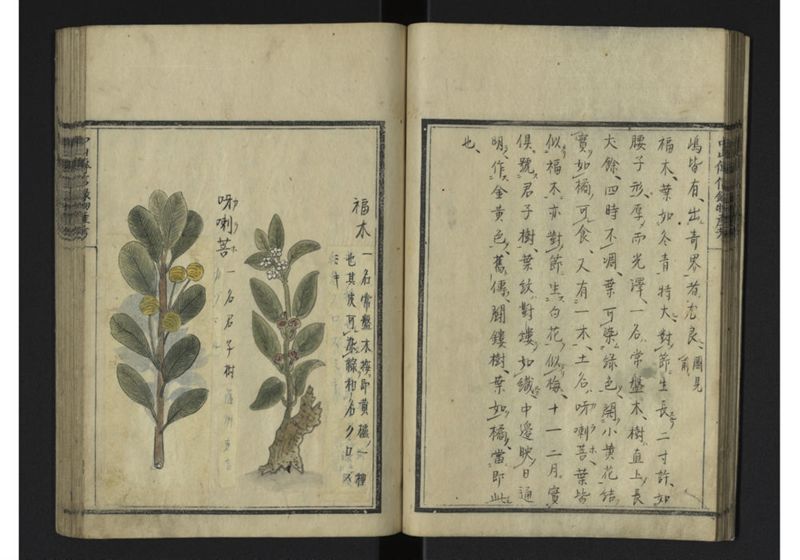
翻刻
島皆有、出 ̄シ_二奇界_一者 ̄ノ尤良 ̄シ、 《割書:図見|_レ前 ̄ニ》
福木、葉如_二冬青_一特大《割書:也》対 ̄シテ_レ節 ̄ニ生長 ̄スルフ二寸許、如_二
腰子形_一、厚 ̄シテ而光沢、一名 ̄ハ常盤木、樹 ̄ハ直上 ̄シテ長
丈余、四時不_レ凋、葉可_レ染 ̄ム_二緑色 ̄ヲ_一、開 ̄ク_二小黄花_一結 ̄フ
_レ実 ̄ヲ如_レ橘 ̄ノ可 ̄シ_レ食、又有_二 一木_一、土名 ̄ハ呀喇菩(カラホ)、葉皆
似 ̄タリ_二福木 ̄ニ_一亦対 ̄シテ_レ節 ̄ニ生 ̄ス_二白花 ̄ヲ_一似_レ梅、十一二月 ̄ニ実
俱 ̄ニ号 ̄ス_二君子樹_一、葉紋 ̄ハ対縷 ̄ニシテ如_レ織 ̄ルカ、中辺映 ̄シテ_レ日通
明 ̄ニシテ作 ̄ス_二金黄色 ̄ヲ_一、旧 ̄ト伝 ̄フ、闘縷樹、葉如 ̄ク_レ橘 ̄ノ、当 ̄ニ_二即此 ̄ナル_一
也、
福木《割書:一名常盤木按 ̄ニ即黄櫨 ̄ノ一種|也其皮可 ̄シ_レ染 ̄ム_レ緑 ̄ヲ和名クロズ》
《割書:ミキ》
呀喇菩(カラホ)《割書:一名君子樹》
現代語訳
島々に皆あり、奇界に生えるものが最も良い。《図は前を見よ》
福木は、葉が冬青(そよご)のようで特に大きく、節に対になって生じ、長さ二寸ほどで、腰子(腎臓)の形のようで、厚くて光沢がある。別名を常盤木という。樹は真っ直ぐに上に伸びて丈余の高さになり、四季を通じて枯れることがない。葉は緑色に染めることができる。小さな黄色い花を開き、実を結んで橘のようで食べることができる。また一つの木があり、土地の名前では呀喇菩(カラホ)という。葉は皆福木に似ていて、やはり節に対になって生じ、白い花を咲かせて梅に似ている。十一、十二月に実を結ぶ。共に君子樹と号する。葉の紋様は対になった筋があって織物のようで、中央部分が日光に映えて透明になり、金黄色を呈する。古くから伝えられているところでは、闘縷樹といい、葉は橘のようで、まさにこれがそれである。
福木《別名常盤木。按ずるに即ち黄櫨の一種である。その皮は緑色に染めることができる。和名はクロズミキ》
呀喇菩(カラホ)《別名君子樹》
英語訳
They are found on all the islands, with those growing in remote areas being of the finest quality. 《See the illustration above》
The fukugi tree has leaves like those of the winterberry holly (soyogo) but particularly large, growing in pairs at the nodes, about two sun in length, shaped like kidneys, thick and glossy. It is also called tokiwa-gi (evergreen tree). The tree grows straight upward to a height of over one jō, and does not wither throughout the four seasons. The leaves can be used to dye green. It produces small yellow flowers and bears fruit like oranges that are edible. There is also another tree, called garabo (karaho) in the local name. All its leaves resemble those of the fukugi, also growing in pairs at the nodes, producing white flowers resembling plum blossoms. It bears fruit in the eleventh and twelfth months. Both are called kunshi-ju (gentleman tree). The leaf patterns have paired veins like woven fabric, and the central part becomes transparent when illuminated by sunlight, taking on a golden-yellow color. According to old traditions, it is called tōru-ju, with leaves like those of oranges, and this is precisely that tree.
Fukugi 《Also called tokiwa-gi. Upon examination, it is a type of yellow sumac. Its bark can be used to dye green. Japanese name: kurozumiki》
Garabo (karaho) 《Also called kunshi-ju (gentleman tree)》