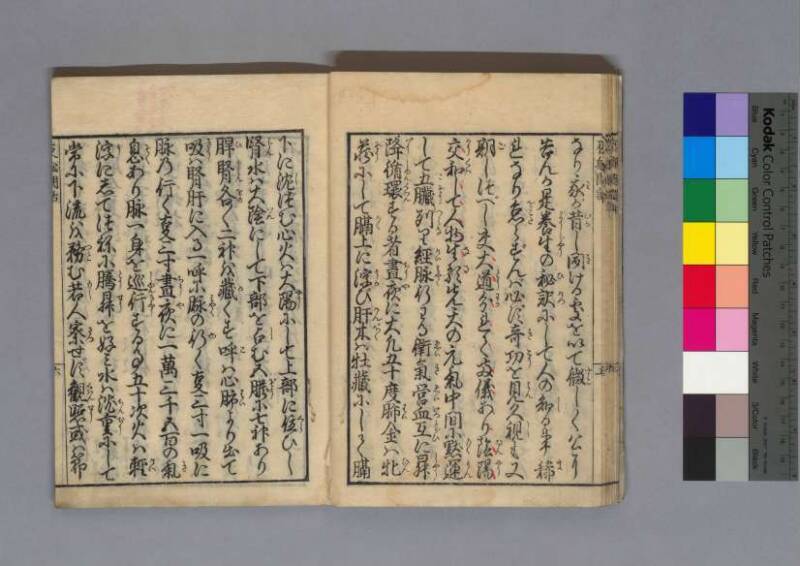
翻刻
【右丁】
なり我(わ)が昔(むか)し聞(き)ける処を以て微(すこ)しく公に
告んか是 養生(ようじやう)の秘訣(ひけつ)にして人の知(し)る事 稀(ま)
れあり怠(をこた)らずんば必ず奇功(きこう)を見(みん)久 視(し)も又
期(ご)しつべし夫大 道(とう)分(わか)れて両儀あり陰陽(ゐんやう)
交和(かうくは)して人物 生類(なる)先天の元気中間に黙運(もくうん)
して五臓(こぞう)列(つらな)り経脈(けいみやく)行わる衛気(ゑいき)営血(ゑいけつ)互(たがひ)に昇(しやう)
降(がう)循環(しゆんくはん)する者 昼夜(ちうや)に大凡五十度 肺(はい)金は牝(ひん)
蔵(ぞう)にして膈(かく)上に浮(うか)び肝木(かんぼく)は牡蔵にして膈
【左丁】
下に沈(し)づむ心火は大 陽(やう)にして上部に位(くら)ひし
腎(じん)水は大 陰(いん)にして下部を占(し)む五 臓(ぞう)に七神あり
脾(ひ)腎(しん)各(をの)〳〵二神を蔵(か)くす呼(こ)は心 肺(はい)より出て
吸(きう)は腎肝に入る一呼に脈(みやく)の行(ゆ)く事三寸一吸に
脈の行く事三寸 昼夜(ちうや)に一万三千五百の気(き)
息(そく)あり脈一身を巡行(しゆんきやう)する事五十次火は軽(けい)
浮(う)【注】にしてつねに騰昇(とうせう)を好み水は沈重(ちんぢう)にして
常に下流を務(つと)む若(もし)人 察(さつ)せず観照(くはんせう)或は節
【注 「浮」の振り仮名「う」は「ふ」ヵ。明治19年の後印は「ふ」と有り】
現代語訳
【右丁】
である。私が昔聞いたところを以って、少しくあなたにお話ししましょうか。これは養生の秘訣であって、人の知ることは稀であります。怠らなければ必ず奇跡的な効果を見るでしょうし、長寿もまた期待できるでしょう。そもそも大道が分かれて両儀があり、陰陽が交和して人物が生まれます。先天の元気が中間で静かに働いて五臓が配列され、経脈が巡ります。衛気・営血が互いに昇降循環するのは昼夜におよそ五十度です。肺金は陰の臓であって横隔膜の上に浮かび、肝木は陽の臓であって横隔膜の
【左丁】
下に沈みます。心火は大陽であって上部に位置し、腎水は大陰であって下部を占めます。五臓には七神があり、脾・腎はそれぞれ二神を蔵します。呼気は心・肺から出て、吸気は腎・肝に入ります。一呼に脈の行くこと三寸、一吸に脈の行くこと三寸です。昼夜に一万三千五百の呼吸があり、脈が全身を巡行することは五十回です。火は軽く浮かんで常に上昇することを好み、水は沈み重くて常に下流へ向かいます。もし人が察せず、観照が或いは節度を
英語訳
【Right page】
I shall tell you a little of what I heard long ago. This is a secret of health cultivation that is rarely known among people. If you do not neglect it, you will surely see miraculous effects, and longevity can also be expected. Originally, the Great Way divided to create the Two Forms (yin and yang), and through the harmonious interaction of yin and yang, all beings are born. The primordial qi of pre-heaven operates silently in the center, arranging the five organs and circulating through the meridians. The protective qi and nutritive blood mutually ascend and descend in circulation approximately fifty times day and night. The lung-metal is a yin organ that floats above the diaphragm, while the liver-wood is a yang organ that sinks below the diaphragm.
【Left page】
The heart-fire is great yang and is positioned in the upper part, while the kidney-water is great yin and occupies the lower part. The five organs contain seven spirits, with the spleen and kidneys each harboring two spirits. Exhalation emerges from the heart and lungs, while inhalation enters the kidneys and liver. With one exhalation, the pulse travels three inches; with one inhalation, the pulse travels three inches. There are 13,500 breaths day and night, and the pulse circulates through the entire body fifty times. Fire is light and floating, always preferring to ascend upward, while water is heavy and sinking, always working toward the lower flow. If a person does not observe carefully, and contemplation perhaps lacks moderation—