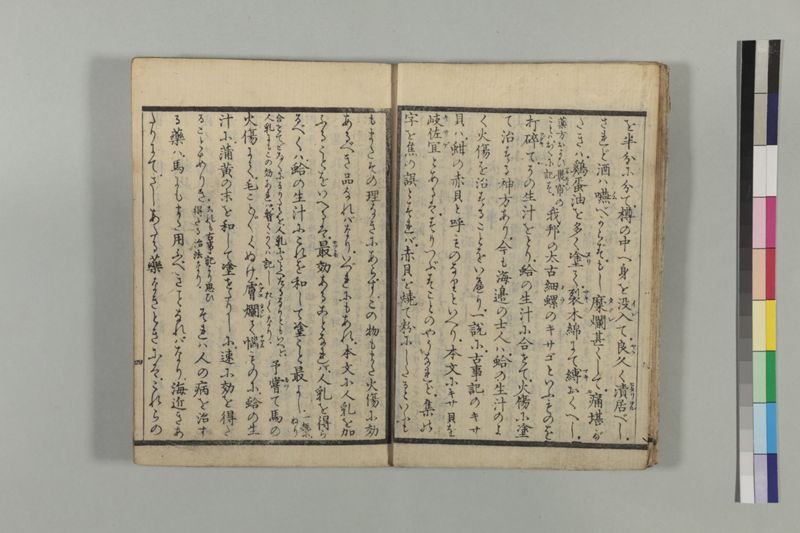
翻刻
【右丁】
を半分に分て、樽の中へ身を没入(イレ)て、良(ヤゝ)久く漬(ヒタリ)居(ヲル)べし、
されど酒は嚥(ノム)べからず、もし糜爛(タヾレ)甚くして、痛堪が
たきは、鶏蛋油を多く塗(ヌリ)て裂(サキ)木綿にて縛(マキ)おくへし、
《割書:薬方およひ裹(マキ)帘(モメン)の|ことは、おくに記す、》我邦の太古 細螺(□ラ)のキサゴといふものを
打 砕(クダキ)て、その生汁をとり、蛤の生汁 に合せて、火傷に塗
て治する神方あり、今も海辺の士人は、蛤の生汁のよ
く火傷を治することをいへり、一説に、古事記のキサ
貝は、蚶の赤貝と呼ものなりといへり、本文にキサ貝を
岐佐宜(キサゲ)とあるは、すりつぶすことのやうなれど、集の
字を焦の誤とすれば赤貝を焼て粉にしたるといふも
【左丁】
もまたその理なきにあらず、この物もまた火傷に効
あるべき品なればなり、いづれにもあれ、本文に人乳を加
ふることをいへるは、最(モツトモ)効あることなれば、人乳を得ら
るべくは、蛤の生汁にこれを和して塗こと最よし、《割書:一説に、|ねり》
《割書:合せてどろ〳〵になりたるを、人乳にたとへたるなりともいへど、|人乳にもこの効あれば、暫くかくは記しおくなり、》予 嘗(カツ)て馬の
火傷にて、毛こと〴〵くぬけ、膚(ハダエ)爛(タヾレ)て悩(ナヤム)ものに、蛤の生
汁に、蒲黄の末を和して塗せたりしに速に効を得た
ることありき、《割書:これも古事記より思ひ|得たる治法なり、》それは人の病を治す
る薬は、馬にもまた用ふべきことなればなり、海近きあ
たりにて、さしあたる薬なきときには、これらの
現代語訳
【右丁】
を半分に分けて、樽の中へ身を浸して、やや長く浸かっているべきである。
しかし酒は飲んではならない。もし皮膚のただれが甚だしくて、痛みに堪えられないときは、鶏卵油を多く塗って裂いた木綿で巻いておくべきである。
《薬方および包帯用木綿のことは、後に記す》わが国の太古、細螺のキサゴというものを打ち砕いて、その生汁を取り、蛤の生汁と合わせて、火傷に塗って治す神効ある方法がある。今も海辺の人々は、蛤の生汁がよく火傷を治すことを言っている。一説に、古事記のキサ貝は、蚶の赤貝と呼ぶものだという。本文にキサ貝を「岐佐宜(キサゲ)」とあるのは、すりつぶすことのようであるが、「集」の字を「焦」の誤りとすれば、赤貝を焼いて粉にしたということも
【左丁】
また理がないわけではない。この物もまた火傷に効果があるべき品だからである。いずれにしても、本文に人乳を加えることを言っているのは、最も効果があることなので、人乳を得ることができれば、蛤の生汁にこれを混ぜて塗ることが最もよい。《一説に、練り合わせてどろどろになったものを、人乳に例えたのだとも言うが、人乳にもこの効果があるので、しばらくこのように記しておく》私はかつて馬の火傷で、毛がことごとく抜け、皮膚がただれて苦しんでいるものに、蛤の生汁に蒲黄の末を混ぜて塗ったところ、速やかに効果を得たことがあった。《これも古事記より思い得た治法である》それは人の病を治す薬は、馬にもまた用いるべきことだからである。海の近くで、差し迫った薬がないときには、これらの
英語訳
【Right page】
Dilute it by half, immerse the body in the barrel, and soak for quite a long time.
However, one must not drink the wine. If the skin festering is severe and the pain unbearable, apply abundant chicken egg oil and wrap with torn cotton cloth.
《The medicinal recipes and bandaging cotton are described later》In ancient times in our country, there was a divine method of crushing small sea snails called kisago, extracting their raw juice, mixing it with raw clam juice, and applying it to burns for treatment. Even now, people living by the sea say that raw clam juice effectively treats burns. One theory states that the kisa shells mentioned in the Kojiki refer to what we call ark shells or red clams. The text reads kisa shells as "kisage," which seems to mean crushing them, but if we consider the character "shū" (集) as a mistake for "shō" (焦), then it could mean burning red clams to powder.
【Left page】
This interpretation is not without reason, as this substance would also be effective for treating burns. In any case, the text mentions adding human milk, which is most effective, so if human milk can be obtained, mixing it with raw clam juice for application is best. 《One theory suggests that the muddy mixture created by kneading together was compared to human milk, but since human milk also has this effect, I record it this way for now》I once treated a horse's burns where all the hair had fallen out and the skin was festering and suffering, by applying a mixture of raw clam juice and powdered cattail pollen, and quickly obtained good results. 《This is also a treatment method derived from the Kojiki》This is because medicines that treat human ailments can also be used for horses. When near the sea and lacking immediate medicines, these [remedies]