翻刻
【右丁】
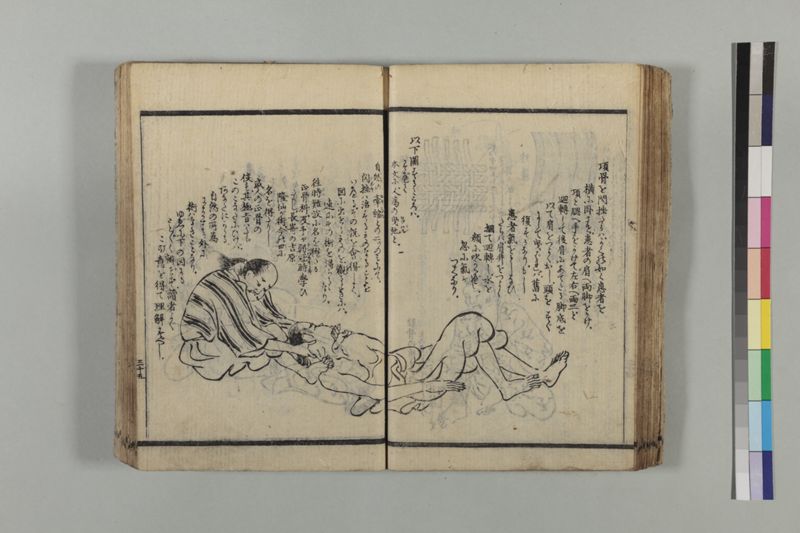
項骨を閃挫たるは、かくの如く患者を
横に臥させ、患者の肩へ両脚をかけ、
項と腮へ手をかけて、左右へ粮両三ど
迴転して後肩にあてたる脚底を
以て肩をつよくおし、頭をすぐ
にして曳ぱれば、旧に
復するなり、もし
患者気をうしなひ
たらば、肩井をつよく
掴て迴転し、水を
顔に吹かくべし、
忽に気が
つくなり、
以下図するところは、
すべて
本文に、人為の曳弛(ヒツハル)と、
【左丁】
自然の率縮(ヒキシメル)との二ッのみにて、
閃挫(クジキ)は治するものなることを
いへる、その説を会得して、
図に出せるものを、観(ミ)るときには、
速にその術を得らるゝなり、
往時難波に名を得たる
正骨科、及予が弱冠(トシワカキ)時(トキ)学ひ
たりし、長崎の吉原
隆仙が術、今の世に
名を得たりし
或人の正骨の
技も、其極旨はたゞ
このこなたにひけば、
何なたにかゝる
自然の所為
にまかする外に
術はなきことなり、
ゆゑに下の図にも
こと〴〵く弁ぜず、読者よく
この意を得て理解すべし、
現代語訳
【右丁】
頸椎を脱臼した場合は、このように患者を
横に寝かせ、患者の肩に両脚をかけ、
首と顎に手をかけて、左右に二、三度
回転させた後、肩に当てた足の裏で
肩を強く押し、頭をまっすぐ
にして引っ張れば、元の状態に
戻るのである。もし
患者が気を失った
場合は、肩井(つぼ)を強く
つかんで回転し、水を
顔に吹きかけるべきである。
たちまち意識が
戻るのである。
以下図示するところは、
すべて
本文に、人為的な牽引と、
【左丁】
自然な収縮との二つだけで、
脱臼は治療できるものであることを
述べている。その理論を理解して、
図に示されたものを見れば、
速やかにその技術を習得できるのである。
往時大阪で名声を得た
整骨科医、および私が若い頃に学んだ
長崎の吉原
隆仙の技術、現代において
名声を得ている
ある人の整骨の
技術も、その要点はただ
こちら側に引けば、
反対側にかかる
自然の作用に
任せる以外に
技術はないということである。
ゆえに下の図においても
詳細には説明せず、読者はよく
この意味を理解すべきである。
英語訳
【Right page】
When the cervical vertebrae are dislocated, lay the patient on their side like this,
place both legs against the patient's shoulder,
place hands on the neck and jaw, rotate left and right two or three times,
then push the shoulder strongly with the soles of the feet placed against the shoulder,
straighten the head and pull—
this will restore it to its original position. If
the patient loses
consciousness,
grasp the Kensei acupoint firmly,
rotate, and spray water
on the face.
Consciousness will
return immediately.
What is illustrated below
demonstrates entirely
the principle stated in the main text that artificial traction and
【Left page】
natural contraction are the only two methods
needed to treat dislocations.
By understanding this theory
and observing what is shown in the diagrams,
one can quickly master these techniques.
The renowned orthopedic practitioners of old Osaka,
and the techniques of Yoshihara
Ryusen of Nagasaki, whom I studied under
in my youth, as well as
certain contemporary practitioners
who have gained fame for
orthopedic techniques—
the essential principle is simply
that if you pull in one direction,
you rely on the natural forces
acting in the opposite direction.
There is no other technique
beyond this.
Therefore, the diagrams below
do not explain every detail—readers should
understand this principle well.