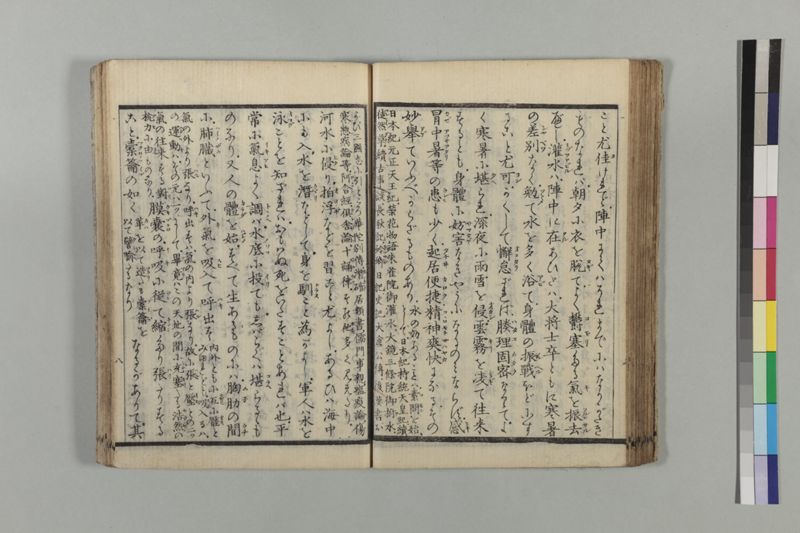
翻刻
【右丁】
こと尤 佳(ヨ)けれど、陣中にてはそれまでにはなりがたき
ものなれば、朝夕に衣を脱(ヌギ)て、よく欝塞(コモリ)たる気(キ)を振去(フルヒサル)
べし、潅水(ミヅヲアビル)は、陣中に在(アル)あひだは、大将士卒ともに寒暑
の差別(シヤベツ)なく、勉(ツトメ)て水を多く浴(アビ)て、身体の振戦(フルヘル)ほどにす
ること尤 可(ヨシ)、かくして懈怠(オコタラ)ざれば、腠理(ハタエ)固密(カタク)なりて、よ
く寒暑に堪(タヘ)られ、深夜に雨雪を侵(オカシ)、雲 霧(キリ)を凌(シノギ)て往来
するとも、身体に妨害(サマタゲ)なきやうになるのみならず、感(ヒキ)
冒(カゼ)中暑(アツサアタリ)等の患(ウレヒ)も少く、起居(タチヰ)便捷(カロク)、精神(コヽロモチ)爽快(サハヤカ)になる、その
妙 挙(アゲ)ていふべからざるものあり、《割書:水の効あることは、素問(ソモン)を始、|として、日本紀持統天皇紀、続》
《割書:日本紀元正天皇紀、栄花物語朱雀院御潅水、大鏡三条院御 拊(フ)水、|徒然草(ツレ〳〵グサ)、続古事談、長秋記、蛉螂(カケロウ)日記、史紀大倉公伝、後漢書、お》
【左丁】
《割書:よび三国志に引ところ華陀別伝、潜確(センカク)居類書、儒門事親、瘟疫論、傷|寒総病論等、阿含(アゴン)経、俱舎論、十 誦律(ジユリツ)、その他(ホカ)多く見えたり、》
河水に侵(ヒタ)り、拍浮(オヨギ)などを習こと尤よし、あるひは海中
にも入、水を潜(クヾリ)などして、身を馴(ナラス)こと為がよし、軍人は水を
泳(オヨグ)ことを知ざれは、おもはぬ死をいたすことあれば也、平
常に気息(イキアヒ)よく調(トヽノヘ)ば、水 ̄ノ底(ソコ)に投(イリ)ても、しばらくは堪(コラヘ)らるゝも
のなり、又人の体(カラダ)を始(ハジメ)、すべて生あるものには、胸肋(ムネ)の間(ウチ)
に、肺臓(ハイノザウ)といふて、外気(キ)を吸(スヒ)入て呼(ハキ)出す《割書:内外ともに互(タガヒ)に圧(オス)と|みゆれども、吸(スヒ)入るは、》
《割書:気の外より張(ハル)なり、呼(ハキ)出すは、気の内より張(ハル)なり、故に張(ハル)と圧(オス)との二ッ|の運動(ハタラキ)は、その元は一ッにして、畢竟(ツマリ)はこの天地の間に充塞(ミナキリ)たる浩然(カウゼン)の》
《割書:気の往来する対(ツリ)|抗力(アヒ)に由(ヨル)ものなり、》膜嚢(ウキブクロ)の、呼吸(イキ)に従(ツレ)て縮(チヾミ)たり張(ハリ)たりする
こと、橐籥(フクロノフイゴ)の如く《割書:革(カハ)を以て造(ツクリ)たる橐籥(フイゴ)を|以て譬喩(タトヘ)たるなり》なるがありて、其
現代語訳
【右丁】
ことは最もよいけれど、陣中ではそこまではできないものであるから、朝夕に衣を脱いで、よく籠もった気を振り払うべきである。水を浴びることは、陣中にいる間は、大将も士卒も共に寒暑の区別なく、努めて水を多く浴びて、身体が震えるほどにすることが最もよい。このように怠らなければ、肌理が固く密になって、よく寒暑に耐えられ、深夜に雨雪を犯し、雲霧を凌いで往来しても、身体に支障がないようになるだけでなく、風邪や暑気あたり等の患いも少なく、起居が軽やかで、精神も爽快になる。その妙は言い尽くせないものがある。《割書:水の効果があることは、素問を始めとして、日本紀持統天皇紀、続日本紀元正天皇紀、栄花物語朱雀院御灌水、大鏡三条院御拊水、徒然草、続古事談、長秋記、蜻蛉日記、史記大倉公伝、後漢書、および三国志に引く所の華陀別伝、潜確居類書、儒門事親、瘟疫論、傷》
【左丁】
《割書:寒総病論等、阿含経、俱舎論、十誦律、その他多く見えたり》
河水に浸かり、水泳などを習うことは最もよい。あるいは海中にも入り、水に潜るなどして、身を慣らすことがよい。軍人は水泳を知らなければ、思わぬ死を遂げることがあるからである。平常に呼吸をよく調えれば、水の底に入っても、しばらくは耐えられるものである。また人の体をはじめ、すべて生あるものには、胸肋の間に、肺臓といって、外気を吸い入れて吐き出す《割書:内外ともに互いに押すとみえるけれども、吸い入れるのは、気の外より張るのであり、吐き出すのは、気の内より張るのである。故に張ると押すとの二つの運動は、その元は一つにして、つまりはこの天地の間に充満している浩然の気の往来する対抗力によるものである》膜嚢があって、呼吸に従って縮んだり張ったりすることが、ふいごの如く《割書:革を以て造ったふいごを以て譬えたのである》あって、その
英語訳
【Right page】
This is most excellent, but since such measures are difficult to achieve in military camps, one should remove clothing morning and evening to properly dispel stagnant qi. Regarding pouring water over oneself, while in camp, both generals and soldiers alike should strive to bathe frequently in water regardless of hot or cold weather, to the extent that the body trembles - this is most beneficial. If one does not neglect this practice, the skin texture becomes firm and dense, enabling one to withstand cold and heat well. Even when traveling through rain and snow in the deep night, or enduring clouds and fog, there will be no hindrance to the body. Moreover, ailments such as colds and heat stroke will be fewer, movement will be light and agile, and the spirit will become refreshing. The marvelous effects are beyond description. ※Note: The effectiveness of water is documented in many sources beginning with the Suwen, including the Chronicles of Japan (Empress Jito), Continued Chronicles of Japan (Emperor Genmei), Tale of Flowering Fortunes (Emperor Suzaku's water ablutions), the Great Mirror (Emperor Sanjo's water ablutions), Essays in Idleness, Continued Ancient Tales, Choshuki, and
【Left page】
※Note: Kagerou Diary, Records of the Grand Historian (Biography of Lord Okura), Book of the Later Han, as well as the Biography of Hua Tuo cited in the Records of the Three Kingdoms, Senkan-kyo Ruisho, Confucian Gate Affairs, Treatise on Epidemic Diseases, Comprehensive Theory of Cold Damage and other diseases, Agama Sutra, Abhidharmakosa, Dasasahasrika Vinaya, and many others.
Immersing in river water and learning to swim is most excellent. Or even entering the sea and diving underwater to accustom the body is beneficial. Since military personnel who cannot swim may meet unexpected death, this is important. If one normally regulates breathing well, even when entering the bottom of water, one can endure for some time. Moreover, in human bodies and all living things, there exists within the chest cavity what is called the lungs, which draw in external air and expel it ※Note: Though it appears that both internal and external forces push against each other, inhalation occurs when qi expands from outside, while exhalation occurs when qi expands from inside. Therefore, these two movements of expansion and compression originate from one source - namely, the opposing force of the vast qi that fills heaven and earth as it flows back and forth - there are membrane sacs that contract and expand with breathing, like bellows ※Note: This is a metaphor using bellows made of leather, and their