翻刻
【右丁】
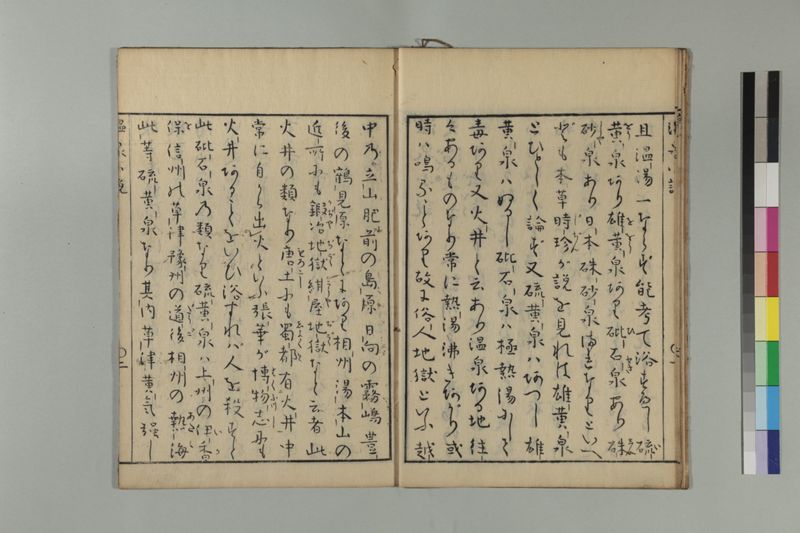
且温-泉一ならず能考て浴すへし硫(い)-
黄(をう)-泉あり雄(を)-黄(をう)-泉あり砒(ひ)-石(せき)-泉あり硃(しん)-
砂(しや)-泉あり日-本硃-砂-泉まれなりといへ
ども本草 時(じ)-珍(ぢん)が説を見れは雄-黄-泉
とひとしく論ず又硫-黄-泉はあつし雄-
黄-泉はぬるし砒-石-泉は極熱湯にして
毒あり又火-井と云あり温泉ある地往-
々あるものなり常に熱-湯沸きあがり或
時は鳴ることあり故に俗-人地獄といふ越-
【左丁】
中の立-山肥-前の島-原日-向の霧-島豊-
後の鶴-見-原なとにあり相-州湯-本-山の
近-所にも《振り仮名:鍛-冶|かぢや》《振り仮名:地-獄|ぢごく》《振り仮名:紺-屋|こうや》《振り仮名:地-獄|ぢごく》なと云は此
火井の類なり唐(もろ)-土(こし)にも蜀(しよく)-都(と)有_二火-井_一 中
常に自から出_レ火といふ張-華が博(はく)-物(ふつ)-志(し)にも
火-井あることをいひ浴すれば人を殺すと
此砒-石-泉の類なり硫-黄-泉は上-州の伊(い)-香(か)
保(を)信-州の草-津予-州の道(だう)-後(ご)相-州の熱(あた)-海(み)
此-等硫-黄-泉なり其-内草-津黄-気強し
現代語訳
【右丁】
また温泉は一様ではないので、よく考えて入浴すべきである。硫黄泉があり、雄黄泉があり、砒石泉があり、朱砂泉がある。日本では朱砂泉は珍しいと言われるが、本草時珍の説を見ると雄黄泉と同じように論じている。また硫黄泉は熱く、雄黄泉はぬるく、砒石泉は極めて熱い湯で毒がある。また火井というものがある。温泉がある土地にはしばしばあるものである。常に熱湯が噴き上がり、時には音を立てることがある。ゆえに一般の人は地獄という。越
【左丁】
中の立山、肥前の島原、日向の霧島、豊後の鶴見原などにある。相州湯本山の近所にも鍛冶屋地獄、紺屋地獄などというのは、この火井の類である。中国にも蜀の都に火井があり、常に自然に火が出ると言う。張華の博物志にも火井があることを言い、浴すれば人を殺すとある。これは砒石泉の類である。硫黄泉は上州の伊香保、信州の草津、予州の道後、相州の熱海、これらは硫黄泉である。その中でも草津は硫黄の気が強い。
英語訳
【Right page】
Moreover, hot springs are not uniform, so one should carefully consider before bathing. There are sulfur springs, realgar springs, arsenopyrite springs, and cinnabar springs. In Japan, cinnabar springs are said to be rare, but according to Li Shizhen's writings on materia medica, they are discussed similarly to realgar springs. Sulfur springs are hot, realgar springs are lukewarm, and arsenopyrite springs are extremely hot water with poison. There are also what are called "fire wells." These are often found in lands where hot springs exist. Hot water constantly gushes up, and sometimes they make sounds. Therefore, common people call them "hell." In Etchu
【Left page】
at Mount Tateyama, in Hizen at Shimabara, in Hyuga at Kirishima, in Bungo at Tsurumi-hara, and so forth. Near Mount Yumoto in Sagami Province, places called "Blacksmith Hell" and "Dyer Hell" are types of these fire wells. In China too, in the capital of Shu there are fire wells, where fire naturally emerges constantly. Zhang Hua's "Records of Diverse Matters" also mentions the existence of fire wells, stating that bathing in them kills people. These are types of arsenopyrite springs. Sulfur springs include Ikaho in Kozuke Province, Kusatsu in Shinano Province, Dogo in Iyo Province, and Atami in Sagami Province. Among these, Kusatsu has particularly strong sulfurous vapors.