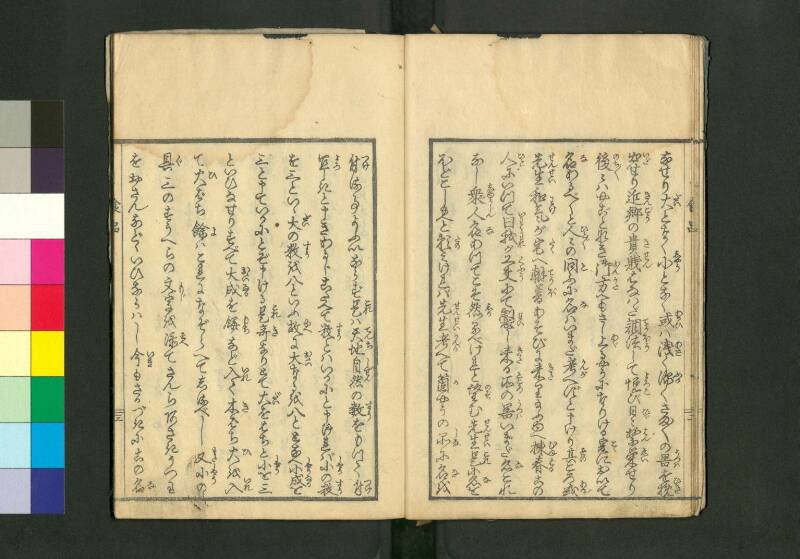
翻刻
【右丁】
なせり大(だい)となく小(しやう)となく或(あるひ)は浅(あさ)く深(ふか)くさま〳〵の器(うつは)を挽(ひき)
出(いだ)せり近郷(きんごう)の貴賎(きせん)はなはだ調法(てうほう)して悦(よろこ)び日々(ひゞ)繁栄(はんゑい)せり
後々(のち〳〵)はやごとなき御方(おんかた)へもさし上(あぐ)るやうになりける爰(こゝ)において
名(な)あるべくと人々(ひと〴〵)の問(と)ふに名(な)はいまだ考(かんが)へずと申けり其(その)ころ或(ある)
先生(せんせい)和気(わけ)が宅(たく)へ朝暮(てうぼ)あそびに来(きた)り給ふゆへ棟春(むねはる)この
人(ひと)にいつて曰(いわく)我(われ)が工夫(くふう)にて製(せい)し来(きた)る所(ところ)の器(うつは)いまだ名(な)これ
なし衆人(しゆうじん)名(な)あつてこそ然(しか)るべけれと望(のぞ)む先生(せんせい)是(これ)に名(な)を
ほどこし給へと頼(たの)みければ先生(せんせい)考(かんが)へて箇(か)やうの品(しな)に名(な)を
【左丁】
付(つけ)る事よふいならず是(これ)は天地(てんち)自然(しぜん)の数(すう)をもつて付(つけ)
宜(よろ)しきと申きあるじこたへて数(すう)とはいかにとも申ければ小(しやう)の数(すう)
を三といゝ大(だい)の数(すう)を八といふ故(ゆへ)に大(おゝい)なるを八ととなへ小(しやう)成(なる)を
三と申ていかにとぞ申ける是(これ)奇(き)なりとて大(だい)をはちと小(しやう)を三
といひなせりすべて大成(おゝいなる)を餅(もち)など入(いれ)て木(き)ばち火(ひ)を入(いれ)
て火(ひ)ばち余(よ)はこれになぞらへてしるべし又(また)小(しやう)の
具(ぐ)三のすうへらの文字(もじ)を添(そへ)てさんらあさきうつわ
をおさんなどゝいひならはし今(いま)もさかづきにこの名(な)
現代語訳
【右丁】
なした。大きいのも小さいのも、あるいは浅いのも深いのも、様々な器を轆轤で挽き出した。近郷の身分の高い人も低い人も、はなはだ重宝がって喜び、日々繁栄した。後々は、身分の高い御方へも差し上げるようになった。ここにおいて名前があるべきだと人々が問うと、名前はまだ考えていないと申した。その頃、ある先生が和気の家に朝夕遊びに来られるので、棟春はこの人に言って曰く、「私が工夫して製作してきた器に、まだ名前がない。人々は名前があってこそ然るべきだと望む。先生がこれに名前を付けてください」と頼んだ。先生が考えて、「このような品に名前を
【左丁】
付けることは容易ではない。これは天地自然の数をもって付けるのが宜しい」と申した。主人が答えて「数とはどういうことですか」と申したところ、「小の数を三といい、大の数を八というゆえに、大きなるものを八と唱え、小さなるものを三と申してはいかがでしょうか」と申した。これは面白いとて、大を「はち」と小を「三」と言いなした。すべて大きなるものは餅などを入れて「木鉢」、火を入れて「火鉢」、その他はこれに倣って知るべし。また小の道具は、三の数に「皿」の文字を添えて「さんら」、浅き器を「おさん」などと言い習わし、今も酒杯にこの名前
英語訳
【Right Page】
created them. He turned out various vessels on the lathe, both large and small, some shallow and some deep. People of all social classes in the neighboring areas found them extremely useful and were delighted, prospering day by day. Eventually, he even began presenting them to people of high rank. At this point, people asked if there should be names for these items, but he replied that he had not yet thought of names. Around that time, a certain teacher regularly visited Wake's house in the mornings and evenings, so Muneharu spoke to this person, saying: "The vessels I have devised and crafted still have no names. People wish that they should properly have names. Please give names to these items." The teacher considered this and said, "Naming such items is not easy. It would be best to use the numbers of natural heaven and earth."
【Left Page】
The master replied, "What do you mean by numbers?" The teacher said, "Since we call the number for small things 'three' and the number for large things 'eight,' how about calling large things 'eight' and small things 'three'?" Finding this interesting, they established calling large items "hachi" (eight) and small items "three." Generally, for large items: containers for rice cakes became "ki-bachi" (wooden bowls), containers for fire became "hi-bachi" (braziers), and others should be understood by following this pattern. For small utensils, they added the character for "plate" to the number three to make "sanra," and shallow vessels were called "osan," and so forth. Even now, sake cups bear this name...