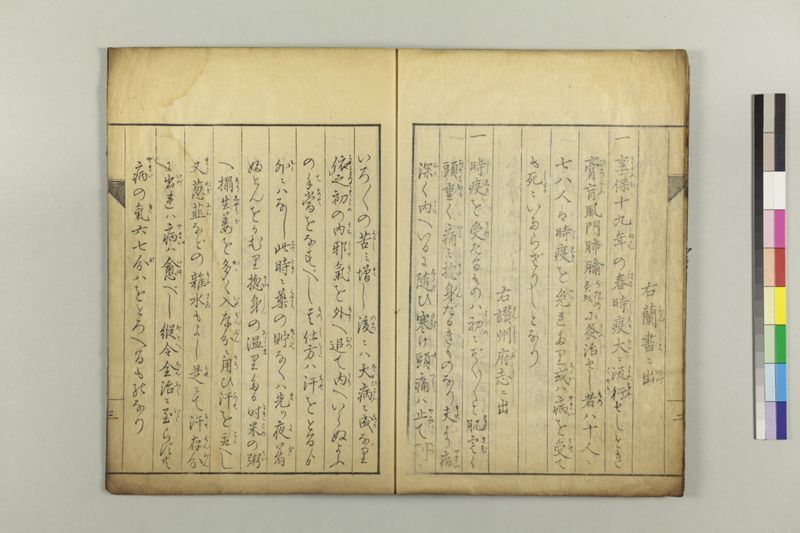
翻刻
右/蘭書(らんしよ)に出(いづ)
一 享保(きよふほ)十九/年(ねん)の春(はる)時疫(じゑき)大(おふい)に流行(りふこふ)【「はやり」左ルビ】せしとき
膏盲(ひろこふ)風門肺腧《割書:かたの|灸処》に灸治(きふじ)せし者(もの)は十人に
七八人は時疫(じゑき)を免(のが)れたり或(あるい)は病(やまい)を受(うけ)て
も死(しする)にいたらざりしとなり
右/讃州府志(さんしうふし)に出
一 時疫(じゑき)を受(うけ)たるものは初(はじめ)にぞく〳〵と肌(はだ)寒(さむ)く
頭(あたま)重(おも)く痛(いた)み惣身(そふしん)だるきものなり夫(それ)より病(やまい)
深(ふか)く内(うち)へいるに随(したが)ひ寒(さむ)け頭痛(づつう)は止(やみ)て別(べつ)に
いろ〳〵の苦(くるし)み増(ま)し後(のち)には大病(たいひよふ)に成(なる)なり
依_レ之(これによつて)初(はじめ)の内(うち)邪気(しやき)を外(そと)へ追(おつ)て内(うち)へいらぬよふ
の手当(てあて)をなすべし其(その)仕方(しかた)は汗(あせ)をとるゟ
外(ほか)にはなし此時(このとき)に薬(くすり)の貯(たくはへ)なくは先(ま)つ夜着(よぎ)
ふとんをかむり惣身(そふしん)の温(あたゝま)りたる時(とき)米(こめ)の粥(かい)
へ搨生姜(すりしやうが)を多(おゝ)く入(いれ)存分(ぞんぶん)に用(もち)ひ汗(あせ)を取(とる)へし
又(また)葱(ねぎ)韮(にら)などの雑水(そふすゐ)もよし是(これ)にて汗(あせ)存分(ぞんふん)
に出(いづ)れは病(やまい)は愈(いゆ)べし縦令(たとへ)全治(ほんふく)に至(いた)らす共
病(やまい)の気(き)六七/分(ぶ)はをとろへるものなり
現代語訳
右は蘭書に出ている
一、享保十九年の春、時疫が大いに流行した時、膏盲・風門・肺兪(肩の灸処)に灸治を施した者は十人のうち七~八人は時疫を免れた。あるいは病気にかかっても死に至らなかったという。
右は『讃州府志』に出ている
一、時疫にかかった者は初めにぞくぞくと肌寒く、頭が重く痛み、全身がだるいものである。それより病が深く内部に入るにしたがって、寒気・頭痛は止んで別にいろいろな苦しみが増し、後には大病になるのである。これによって初めのうちに邪気を外へ追って内部に入らないような手当てをなすべきである。その方法は発汗させる以外にはない。この時に薬の蓄えがなければ、まず夜着・蒲団をかぶって全身が温まった時、米の粥にすりおろした生姜を多く入れて十分に用い、発汗させるべきである。また、葱・韮などの雑炊もよい。これで汗が十分に出れば病気は治るであろう。たとえ全治に至らずとも、病気の気は六~七分は衰えるものである。
英語訳
The above appears in Dutch medical texts
1. In the spring of Kyōhō 19 (1734), when epidemic disease was greatly prevalent, among those who received moxibustion treatment at the Kōkō, Fūmon, and Haiyu acupoints (moxibustion points on the shoulders), seven to eight out of ten people avoided the epidemic disease. Or even if they contracted the illness, they did not die.
The above appears in the "Sanshū Fushi" (Gazetteer of Sanuki Province)
1. Those who contract epidemic disease initially feel chills throughout the body, heaviness and pain in the head, and general fatigue. As the disease penetrates deeper into the body, the chills and headache cease, but various other sufferings increase, eventually developing into serious illness. Therefore, in the initial stage, one should provide treatment to expel the pathogenic qi outward and prevent it from entering the interior. The method for this is nothing other than inducing sweating. If there are no medicines stored at this time, first cover yourself with nightwear and bedding, and when the whole body becomes warm, add plenty of grated ginger to rice porridge and use it sufficiently to induce sweating. Also, broths with scallions and Chinese chives are good. If sufficient sweating occurs with this, the disease should be cured. Even if complete recovery is not achieved, the disease qi will be weakened by six to seven parts.