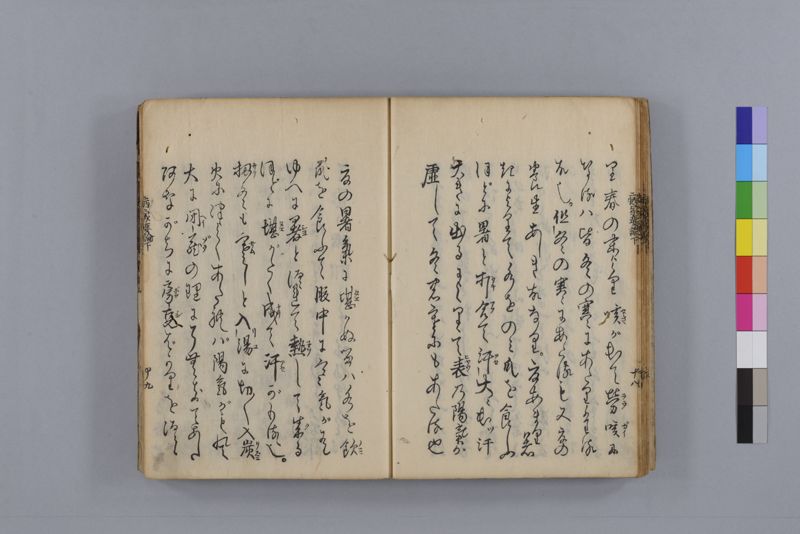
翻刻
【右丁】
り春の末より咳(セキ)が出て労咳(ラウガイ)に
なるは皆冬の寒にあたりたる
故也。但-冬の寒にあたるも又夏の
養生あしき故なり。夏あまり暑
きによりて水をのみ瓜を食ふ
ほどに暑と打合(ウチアフ)て汗(アセ)-大 ̄ニ出 ̄ツ汗
大きに出るによりて表(ヒヤウ)の陽気が
虚して冬の寒にもあたる也
【左丁】
夏の暑気に堪(タエ)かぬるは水を飲(ノミ)
瓜を食ふて腹中に寒気が有
ゆへに暑(シヨ)とつれて熱(ネツ)して来(ク)る
ほどに堪(タエ)がたく成(ナリ)て汗(アセ)がもるゝ也。
扨(サテ)冬も寒(サム)しと入 ̄リ-湯(ユ)に切〳〵入 ̄リ炭(スミ)
火につよくあたれば陽気がもれて
大に閉(ヘイ)-蔵(ゾウ)の理にそむきてあた
あながちに房(ボウ)-事(ジ)ばかりをつゝ
現代語訳
【右丁】
である。春の末から咳が出て労咳(肺結核)になるのは、すべて冬の寒さにあたったためである。ただし、冬の寒さにあたるのも、また夏の養生が悪いためである。夏があまりに暑いので水を飲み瓜を食べるほどに、暑さと打ち合って汗が大いに出る。汗が大量に出ることによって体表の陽気が虚して、冬の寒さにもあたるのである。
【左丁】
夏の暑気に耐えられないのは、水を飲み瓜を食べて腹中に寒気があるゆえに、暑さと連れて熱して来るほどに堪えがたくなって汗がもれるのである。さて冬も寒いといって入湯に頻繁に入り、炭火に強くあたれば陽気がもれて、大いに閉蔵の理に背いて、あたら無駄に房事ばかりを続け
英語訳
【Right page】
Indeed. Coughs that emerge from late spring and develop into consumptive cough (tuberculosis) are all due to exposure to winter cold. However, being affected by winter cold is also due to poor health maintenance in summer. Because summer is excessively hot, one drinks water and eats melons to such a degree that, combined with the heat, sweat pours out abundantly. Due to this profuse sweating, the yang energy of the body surface becomes deficient, making one susceptible to winter cold as well.
【Left page】
The inability to endure summer heat occurs because drinking water and eating melons creates cold energy in the abdomen, which, combined with the heat, generates fever that becomes unbearable and causes sweat to leak out. Now, in winter too, saying it is cold and frequently taking hot baths, or strongly exposing oneself to charcoal fires causes yang energy to leak out, greatly violating the principle of containment and storage, and wastefully continuing only sexual activities