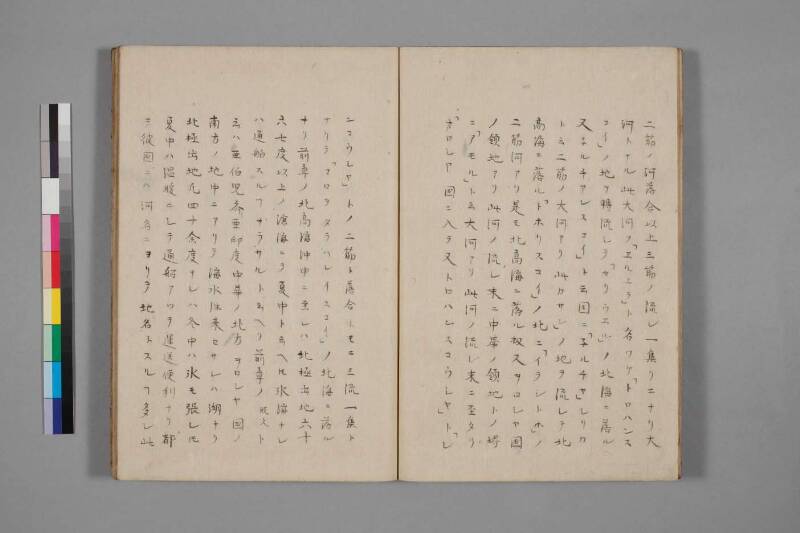
翻刻
【右丁】
二筋ノ河落合以上三筋ノ流レ一集リニナリ大
河トナル此大河ヲ「ヱルエテ」ト名ツケ「トロハンス
コイ」ノ地ヲ転流シテ「セリウヱル」ノ北海ニ落ル
又チルチアンスコイ」ト云国ニ「ネルチヤ」シリカ
ト云二筋ノ大河アリ此カサン」ノ地ヲ流レテ北
髙海ニ落ル「トホリスコイ」ノ北ニ「イラシトホ」ノ
二筋河アリ是モ北髙海ニ落ル扨又ヲロシャ国
ノ領地アリ此河ノ流レ末ニ中華ノ領地トノ堺
ニ「アモル」ト云大河アリ此河ノ流レ末ニ至タリ
「オロシヤ国ニ入テ又トロハンスコウシヤ」ト「レ
【左丁】
ンコウシヤ」トノ二筋ト落合トモニ三流一集ト
ナリテ「コロヲタラハンイスコイ」ノ北海ニ落ル
ナリ前章ノ北髙海沖中ニ至レハ北極出地六十
六七度以上ノ滄海ニテ夏中ト云ヘ𪜈氷海ナレ
ハ通舶スルヿナラサルト云ヘリ前章ノ[脱文]ト
云ハ亜伯児斉亜印度中華ノ北方ヲロシヤ国ノ
南方ノ地中ニアリテ海水往来セサレハ湖ナリ
北極出地凡四十余度ナレハ冬中ハ氷モ張レ𪜈
夏中ハ温暖ニシテ通船アツテ運送便利ナリ都
テ彼国ニハ河名ニヨリテ地名トスルヿ多シ此
現代語訳
【右丁】
(前頁より続き)二筋の河が合流し、以上三筋の流れが一つに集まって大河となる。この大河を「ヱルエテ(エニセイ川)」と名付け、「トロハンスコイ(トボリスク?)」の地を転流して「セリウヱル(?)」の北海(北極海)に注ぎ込む。また「チルチアンスコイ(?)」という国に「ネルチャ(ネルチャ川)」と「シリカ(シルカ川)」という二筋の大河がある。これが「カサン(?)」の地を流れて北高海(北極海)に注ぎ込む。「トホリスコイ(トボリスク)」の北に「イラ(イルティシュ川)」と「シトホ(?)」の二筋の河があり、これもまた北高海(北極海)に注ぎ込む。さて、またロシア国の領地があり、この河の流れの末端において、中華(中国)の領地との境に「アモル(アムール川)」という大河がある。この河の流れの末に至り、「オロシヤ国に入りて、また「トロハンスコウシヤ(トゥングースカ川)」と「レ
【左丁】
ンコウシヤ(?)」との二筋と合流し、ともに三つの流れが一つに集まって、「コロヲタラハンイスコイ(?)」の北海(北極海)に注ぎ込む。前章に記した北高海(北極海)の沖合に至っては、北極出地(北緯)六十六・七度以上の大海であり、夏の間といえども氷海であるため、船が通行することはできないと言われている。前章の〔脱文〕というのは、亜伯児斉亜(ペルシア)・印度(インド)・中華(中国)の北方、ロシア国の南方の地中にあって、海水の往来がないため湖である。北極出地(北緯)凡そ四十余度であるため、冬の間は氷が張ることもあるが、夏の間は温暖であって船の往来があり、輸送に便利である。おおよそ彼の国(ロシア)においては、河の名前によって地名とすることが多い。この
英語訳
[Right folio]
(Continued from previous page) Two rivers converge, and the three streams thus combined become one great river. This great river is named "Eruete" (the Yenisei River), flowing through the land of "Torohanasukoi" (Tobolsk?) before emptying into the Northern Sea (Arctic Ocean) of "Seriueru" (unknown). In the country called "Chiruchianasukoi" (unknown), there are two great rivers called "Nerucha" (Nercha River) and "Shirika" (Shilka River). These flow through the land of "Kasan" (Kazan?) before emptying into the Northern High Sea (Arctic Ocean). To the north of "Tohorisukoi" (Tobolsk), there are two rivers called "Ira" (Irtysh River) and "Shitoho" (unknown), which also empty into the Northern High Sea (Arctic Ocean). Furthermore, within Russian territory, at the terminus of this river's flow, on the border with Chinese territory, there is a great river called "Amoru" (the Amur River). Reaching the end of this river's flow, it enters Russian territory and then converges with two streams called "Torohansukousha" (Tunguska River?) and "Re-
[Left folio]
-nkousha" (unknown), and all three streams join together, emptying into the Northern Sea (Arctic Ocean) of "Korootarahanisukoi" (unknown). As for the open waters of the Northern High Sea (Arctic Ocean) mentioned in the preceding chapter, it is said that, being seas at latitudes of 66 to 67 degrees or above from the North Pole, they are frozen seas even in summer, making navigation impossible. What is referred to as [missing text] in the preceding chapter exists within the territory south of Russia and north of Persia, India, and China, and because there is no flow of seawater into it, it is a lake. As it lies at approximately forty-some degrees of northern latitude, while ice may form in winter, the summers are warm, navigation is possible, and it is convenient for transport. In general, in that country (Russia), place names are often derived from the names of rivers. This...