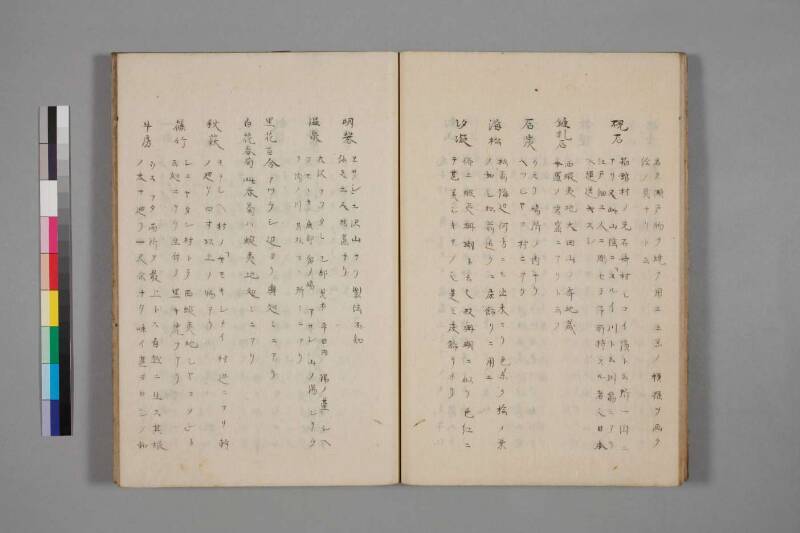
翻刻
【右丁】
《割書:名ク瀬戸物ヲ焼テ用ユ土器ノ模様ヲ画ク|絵ノ具ナリト云》
硯石 《割書:箱館村ノ先石崎村ミコイ浜ト云所一円ニ|アリ又此山陰ニ「スルイ川ト云川筋ニアリ》
《割書:江戸細工人ニ彫セテ予所持スル者也日本|ヘ運送ヤスシ》
鍾乳石 《割書:西蝦夷地大田山ノ寄地蔵|安置ノ岩窟ニアリト云フ》
石炭 《割書:クスリ場所ノ内ナリ|ヘツシヤフ村ニアリ》
海松 《割書:松前海辺何方ニモ出来セリ色赤ク桧ノ葉|ノ如シ松前近クニ床飾リニ用ユ》
汐凝 《割書:俗ニ蝦夷珊瑚ト云也枝珊瑚ニ似リ色紅ニ|テ甚美シキモノ也是モ床飾リナリ》
【左丁】
明礬 《割書:エサシ」ニ沢山ナリ製法不知|依之土人捨置ナリ》
温泉 《割書:大沢カツタミ 乙部 見市 平田内 湯ノ台 シヘ|ツセヽキ 鹿部 留ノ場 アサシ 山ノ湯 シリウ》
《割書:テ 陶ノ川 其外マヽ所々ニアリ|》
黒花百合 アツケシ辺ヨリ奥処々ニアリ
白花春菊 此春菊ハ蝦夷地処々ニアリ
秋萩 《割書:モナシヘ村ノ「ヤモキシナイ村辺ニアリ幹|ノ廻リ四寸以上ノ物アリ》
篠竹 《割書:シエヤタン村トテ西蝦夷地シヤコタン」ト|云処ニアリ生付テ黒キ虎フアリ》
牛房 《割書:ウス フタ 両所ヲ最上トス自然ニ生ス其根|ノ太サ廻リ一尺余ナリ味イ甚ヨロシク和》
現代語訳
## 産物のこと(続き)
**碗青(続き)**
(前頁より続く)と名付けた。瀬戸物を焼く際に用いる土器の模様を描く絵の具であるという。
**硯石**
箱館村の先にある石崎村の「ミコイ浜」と呼ばれる一帯にある。また、この山の陰にある「スルイ川」という川筋にもある。江戸の細工人に彫らせて私が所持しているものである。日本(本州)への運搬も容易である。
**鍾乳石**
西蝦夷地の大田山の麓にある、地蔵を安置した岩窟にあると言われている。
**石炭**
クスリ場所(釧路地方)の内にある、ヘツシャフ村にある。
**海松(みる)**
松前の海辺のどこにでも産出する。色は赤く、檜の葉のようである。松前の近くでは床飾りとして用いられている。
**汐凝(しおこごり)**
俗に「蝦夷珊瑚」と呼ばれるものである。枝珊瑚に似ており、色は紅で、非常に美しいものである。これも床飾りとして用いられる。
**明礬(みょうばん)**
エサシ(江差)に豊富にある。製法は知られていないため、土人(アイヌの人々)はそのまま捨て置いている。
**温泉**
大沢・カツタミ・乙部・見市・平田内・湯ノ台・シヘツ・セヽキ・鹿部・留ノ場・アサシ・山ノ湯・シリウテ・陶ノ川、そのほか至る所にある。
**黒花百合**
アッケシ(厚岸)辺りより奥の各地にある。
**白花春菊**
この春菊は蝦夷地各地にある。
**秋萩**
モナシヘ村の「ヤモキシナイ村」辺りにある。幹の周囲が四寸以上のものがある。
**篠竹(しのだけ)**
「シエヤタン村」とて、西蝦夷地の「シャコタン」と呼ばれる場所にある。生えついていて、黒い虎斑(とらふ)のあるものがある。
**牛蒡(ごぼう)**
ウス(有珠)・フタ(噴火湾周辺か)の両所を最上(最良)とする。自然に生えている。その根の太さは周囲一尺余りもある。味は非常によく、日本(本州)の——(次頁へ続く)
英語訳
## On Local Products (continued)
**Wansei / Bowl-Blue (continued from previous page)**
——and named it accordingly. It is said to be a pigment used for painting patterns on pottery before firing.
**Inkstone**
Found throughout the area of "Mikoi Beach" in Ishizaki Village, beyond Hakodate Village. There are also deposits along the riverbed of a river called "Surui River," in the shadow of this mountain. I had some carved by craftsmen in Edo and keep them in my possession. They are easy to transport to Japan (the mainland).
**Stalactites**
Said to be found in a rock cave where a Jizō (stone guardian deity) is enshrined, at the foot of Ōta Mountain in Western Ezo.
**Coal**
Found in Hetsushafu Village, within the Kushiro (Kusuri) district.
**Sea Lettuce / Miru (Codium)** *(海松)*
Produced all along the coastlines of Matsumae. The color is red and resembles the leaves of a hinoki cypress. Near Matsumae, it is used as a decorative ornament in the tokonoma (display alcove).
**Shiokogori (Sea Coral)** *(汐凝)*
Commonly called "Ezo Coral." It resembles branching coral, is crimson in color, and is an exceptionally beautiful object. It too is used as a decorative ornament.
**Alum** *(明礬)*
Found in abundance in Esashi. The method of processing it is unknown, and therefore the indigenous people (Ainu) leave it as it is, unused.
**Hot Springs** *(温泉)*
Found at: Ōsawa, Katsutami, Otobe, Miichi, Hiratauchi, Yunotai, Shibetsu, Seseki, Shikabe, Tomenosaba, Asashi, Yama-no-yu, Shiriute, Suenokawa — and many other locations throughout the region.
**Black-Flowered Lily** *(黒花百合)*
Found in various places inland from the Akkeshi area and beyond.
**White-Flowered Garland Chrysanthemum** *(白花春菊)*
This type of chrysanthemum is found throughout Ezo.
**Autumn Bush Clover** *(秋萩)*
Found around "Yamokishinai Village" near Monashibe Village. Some specimens have trunks with a circumference of over four sun (approximately 12 cm).
**Dwarf Bamboo** *(篠竹)*
Found in a place called "Shieyatan Village" in a location in Western Ezo known as "Shakotan." The bamboo that grows there has black tiger-stripe markings.
**Burdock Root** *(牛蒡)*
The finest quality comes from Usu and Futa. It grows wild naturally. The roots have a circumference of over one shaku (approximately 30 cm). The taste is excellent, and compared to that of Japan (the mainland)——(continues on next page)