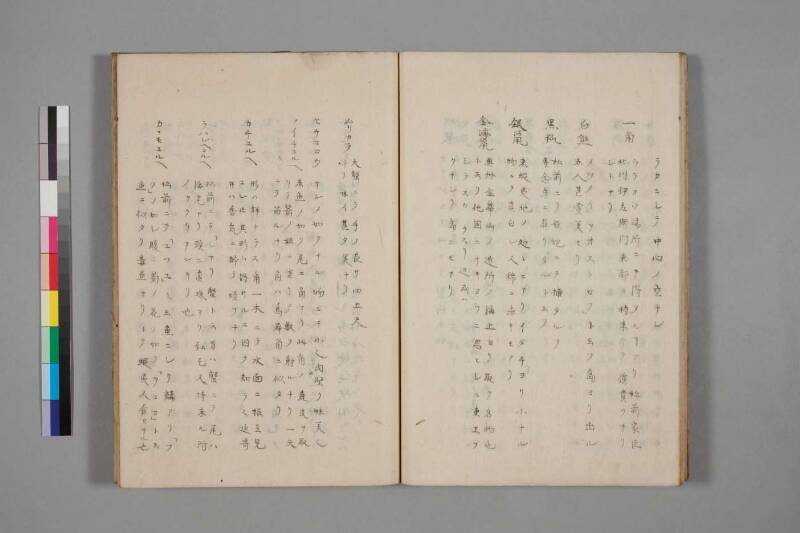
翻刻
【右丁】
《割書:ラカニシテ中心ノ空ナシ|》
一角 《割書:ウラカワ場所ニテ得タルヿアリ松前家臣|北川伊左衛門東都ニ持来リテ価貴クナリ》
《割書:シトナリ|》
白熊 《割書:メツノイ」ヲオストロフ」ト云フ島ヨリ出ル|赤人甚賞美セリ》
黒狐 《割書:松前ニテ鉄砲ニテ捕タルヲ|専念寺ニ葬リタルト云フ》
銀鼠 《割書:東蝦夷地ノ処々ニアリイタチヨリ小ナル|物ニテ真白シ又稀ニ赤キモアリ》
金海鼠 《割書:奥州金華山ノ近所ノ海上ヨリ取ヲ名物也|ト云リ他国ニナキヨフニ思ヒシニ東エゾ》
《割書:シラスカ クスリ辺或ハ|クナシリ島ニモアリ》
【左丁】
ムリカラ 《割書:大蟹ニテ手ノ長サ四五尺|計リ味イ甚タ美ナリ》
セチコロウ 《割書:アンノ如クナル物ニテ小也肉堅ク味美也|》
アイチユルヘ《割書:赤魚ノ如ク尾ニ角アリ此角ノ麁皮ヲ取|リテ箭ノ根ニ塗リテ獣ヲ射ルナリ一矢》
《割書:ニテ留ルナリ角ハ烏犀角ニ似タリ|》
カチユルヘ 《割書:形ハ詳ナラス角一本ニテ水面ニ浪立見|ユレ𪜈其形ハ得サルニ因テ知ラス近寄》
《割書:トキハ香気ニ酔テ煩フナリ|》
ラハンヘコルヘ《割書:松前ニテ「シヤリ蟹ト云首ハ蟹ニテ尾ハ|海老ナリ頭ニ真珠アリ紅毛人持来ル所》
《割書:ノヲクリカンキリ也|》
カヽモユルヘ《割書:松前ニテ「ユツユ」ト云魚ニシテ鱗アリ「フ|ク」ノ如シ腹ニ菊ノ花ノ如ク「ヲユセ」ト云》
《割書:魚ニ似タリ毒魚ナリトテ蝦夷人食セサル也|》
現代語訳
## 産物のこと(続き)
**牛蒡(続き)**
(前頁より続く)らかにして、中心が空洞でない。
**一角(いっかく)**
ウラカワ(浦河)場所にて入手したことがある。松前の家臣・北川伊左衛門が江戸に持参したところ、価格が非常に高くなったとのことである。
**白熊(しろくま)**
「メツノイ」(別名「オストロフ」とも呼ばれる島)より産出する。(訳注:ロシア人・赤毛人が)非常に賞賛して珍重している。
**黒狐(くろきつね)**
松前にて鉄砲で捕獲したものを、専念寺に葬ったと言われている。
**銀鼠(ぎんねずみ)**
東蝦夷地の各地にある。鼬(いたち)より小さい生き物で、真っ白である。また、稀に赤いものもある。
**金海鼠(きんなまこ)**
奥州の金華山の近くの海で採れるものが名物であると言われており、他の国にはないように思っていたが、東蝦夷地のシラスカ・クスリ(釧路)辺り、あるいはクナシリ(国後)島にもある。
---
**ムリカラ**(アイヌ語)
大きな蟹で、脚の長さは四、五尺ほど。味は非常に美味である。
**セチコロウ**(アイヌ語)
餡(あん)のような物で小さい。肉は堅く、味は美味である。
**アイチユルヘ**(アイヌ語)
赤魚(あかうお)のような姿で、尾に角がある。この角の粗皮を削り取って矢の根(矢じり)に塗り、獣を射るのに用いる。一矢で仕留めることができる。角は烏犀角(からすいかく)に似ている。
**カチユルヘ**(アイヌ語)
形は詳しくわからない。角が一本で、水面に波を立てながら現れるのが見えるが、その姿は捉えることができないため、よくわからない。近づくと、香気に酔って苦しむことになる。
**ラハンヘコルヘ**(アイヌ語)
松前では「シャリ蟹」と呼ばれる。頭は蟹で、尾は海老のような生き物である。頭に真珠がある。紅毛人(オランダ人)が持ち来るところの「クリカンキリ」(ドリンク容器か)と同じものである。
**カヽモユルヘ**(アイヌ語)
松前では「ユツユ」と呼ばれる魚で、鱗がある。フク(河豚)のようである。腹に菊の花のような模様があり、「ヲユセ」という魚にも似ている。毒魚であるとして、蝦夷人(アイヌの人々)は食べない。
英語訳
## On Local Products (continued)
**Burdock Root (continued from previous page)**
——the flesh is tender and the center is not hollow.
**Narwhal Horn** *(一角)*
There have been instances of obtaining one in the Urakawa district. A retainer of the Matsumae domain, Kitagawa Izaemon, brought one to Edo (the capital), where it fetched an extremely high price.
**Polar Bear** *(白熊)*
Produced from an island called "Metsunoj" (also known as "Ostrov"). The *akabito* (Russians/red-haired people) prize it very highly.
**Black Fox** *(黒狐)*
It is said that one caught by gun in Matsumae was given a burial at Sennenji Temple.
**Silver Mouse / Ermine** *(銀鼠)*
Found in various places throughout Eastern Ezo. It is a creature smaller than a weasel and pure white. Rarely, reddish ones are also found.
**Golden Sea Cucumber** *(金海鼠)*
It was said that the famous variety was harvested from the sea near Kinkasan in Ōshū (northern Honshū), and I had thought it was not found elsewhere — but it also exists in Eastern Ezo, around Shirasuka and Kushiro (Kusuri), and even on Kunashiri Island.
---
**Murikara** *(ムリカラ)* [Ainu term]
A large crab with legs measuring roughly four to five *shaku* (approximately 120–150 cm) in length. The taste is exceptionally delicious.
**Sechikoro** *(セチコロウ)* [Ainu term]
A small creature resembling a type of paste or jelly. The flesh is firm and the taste is good.
**Aichiyuruhe** *(アイチユルヘ)* [Ainu term]
Resembles a red fish (*akauo*), with a horn at the tail. The rough outer layer of this horn is scraped off and applied to arrowheads, with which animals are shot. A single arrow is enough to bring down the prey. The horn resembles the *karasu-i-kaku* (black rhinoceros horn).
**Kachiyuruhe** *(カチユルヘ)* [Ainu term]
Its form is not well known. It has a single horn and is seen creating waves on the water's surface, but since its body cannot be caught or observed, its true nature is unknown. When one approaches it, one becomes intoxicated and overcome by its fragrance.
**Rahanhekoruhe** *(ラハンヘコルヘ)* [Ainu term]
Called "*Shari-gani*" (Shari Crab) in Matsumae. It is a creature with the head of a crab and the tail of a shrimp (*ebi*). There is a pearl in its head. It is the same as what the *Kōmōjin* (Dutch/Europeans) bring, known as "*Kurikankiri*."
**Kakamoyuruhe** *(カヽモユルヘ)* [Ainu term]
Called "*Yutsuyu*" in Matsumae; it is a fish with scales that resembles a *fuku* (pufferfish). Its belly has a pattern resembling a chrysanthemum flower, and it also resembles a fish called "*Oyuse*." It is considered a poisonous fish, and the Ezo people (Ainu) do not eat it.