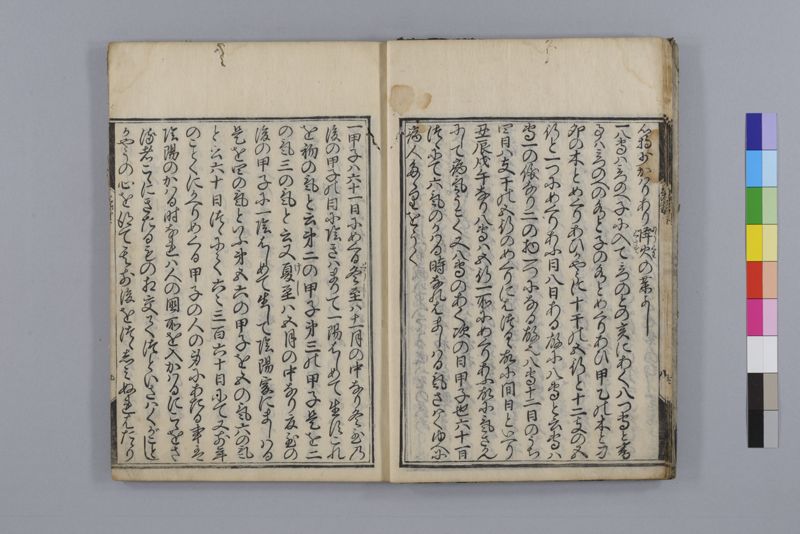
翻刻
【右丁】
心持少かはりあり降火(かうくわ)【左に「くたす」と傍記】の薬よし
一 八専はみつのへ子に入てみつのとの亥にあく八つ専と書
事はみつのへの水と子の水とめくりあひ甲乙の木と刁【寅】
卯の木とめくりあひかやうに十干の五行と十二支の五
行と一つにめくりあふ日八日ある故に八専と云専は
専一の儀なり二の物一つになる故也八専十二日のうち
四日は支干の五行のめくりにはつるゝ故に間日といへり
丑辰戌午なり八専は五行一所にめくりあふ故に気さかん
にして病気うこく又八専のあく次の日甲子也六十一日
つゝにて六気のかはる時なれはましはる気さはくゆへに
病人たゝりをうく
【左丁】
一 甲子は六十一日にめくる冬至(とうし)は十一月の中なり冬至の
後の甲子の日に陰きはまりて一陽はしめて生すこれ
を初の気と云第二の甲子第三の甲子是を二
の気三の気と云又 夏至(けし)は五月の中なり夏至の
後の甲子に一陰はしめて生して陰陽爰にましはる
是を四の気といふ第五六の甲子を五の気六の気
と云六十日つゝにて六々三百六十日にて又前年
のことくにかへりめくる甲子の人の身にあたる事は
陰陽のかはる時なれは人の国所を入かはるにこゝをさ
る者こゝにきたるもの相交てつといさはくがことし
かやうの心を得て其前後をつゝしみぬれはたゝり
現代語訳
【右丁】
心持ちが少し変わりがある。降火(かうくわ)【左に「くだす」と傍記】の薬がよい。
一 八専は壬子(みずのえね)に入って癸亥(みずのとい)に明ける。八つ専と書くことは、壬(みずのえ)の水と子の水とが巡り合い、甲乙の木と寅卯の木とが巡り合い、このように十干の五行と十二支の五行とが一つに巡り合う日が八日あるゆえに八専という。専は専一の意味である。二つの物が一つになるからである。八専十二日のうち四日は支干の五行の巡りから外れるゆえに間日という。丑・辰・戌・午である。八専は五行が一箇所に巡り合うゆえに気が盛んになって病気が動く。また八専の明ける次の日は甲子である。六十一日ずつで六気の変わる時であるから、入れ替わる気が騒ぐゆえに病人は祟りを受ける。
【左丁】
一 甲子は六十一日に巡る。冬至は十一月の中である。冬至の後の甲子の日に陰が極まって一陽が初めて生じる。これを初の気という。第二の甲子、第三の甲子、これを二の気、三の気という。また夏至は五月の中である。夏至の後の甲子に一陰が初めて生じて陰陽がここに入れ替わる。これを四の気という。第五、六の甲子を五の気、六の気という。六十日ずつで六×六の三百六十日で、また前年のように帰り巡る。甲子が人の身に当たることは、陰陽の変わる時であるから、人が国所を入れ替わるように、ここを去る者、ここに来る者が相交わって特に騒がしいのと同じである。このような心得を得て、その前後を慎んでいれば祟りは
英語訳
【Right Page】
The mindset is slightly different. Medicine for "descending fire" (降火) [with "kudasu" (to lower) written as a marginal note] is good.
1. Hassen (Eight Exclusives) begins on mizunoe-ne (壬子) and ends on mizunoto-i (癸亥). It is written as "Eight Exclusives" because there are eight days when the water of mizunoe (壬) and the water of ne (子) cycle together, the wood of kinoe-kinoto (甲乙) and the wood of tora-u (寅卯) cycle together, and thus the Five Elements of the Ten Heavenly Stems and the Five Elements of the Twelve Earthly Branches unite as one. "Sen" (専) means exclusive or single-minded - because two things become one. Of the twelve days of Hassen, four days fall outside the cycling of the Five Elements of stems and branches, so they are called "interval days" (間日). These are ushi, tatsu, inu, and uma (丑・辰・戌・午). Because the Five Elements converge in one place during Hassen, qi becomes vigorous and illnesses are stirred up. Also, the day after Hassen ends is kinoe-ne (甲子). Since it occurs every sixty-one days when the six qi change, the alternating qi becomes turbulent, causing patients to suffer afflictions.
【Left Page】
1. Kinoe-ne cycles every sixty-one days. The winter solstice falls in the middle of the eleventh month. On the kinoe-ne day after the winter solstice, yin reaches its extreme and one yang begins to emerge. This is called the "first qi." The second kinoe-ne and third kinoe-ne are called the "second qi" and "third qi." Also, the summer solstice falls in the middle of the fifth month. On the kinoe-ne after the summer solstice, one yin begins to emerge and yin-yang alternate here. This is called the "fourth qi." The fifth and sixth kinoe-ne are called the "fifth qi" and "sixth qi." With sixty days each, six times six makes 360 days, and it returns and cycles like the previous year. When kinoe-ne affects the human body, it is a time when yin-yang change, so just as when people exchange places - those who leave here and those who come here interact and become especially turbulent. If one understands this principle and exercises caution before and after these periods, afflictions will