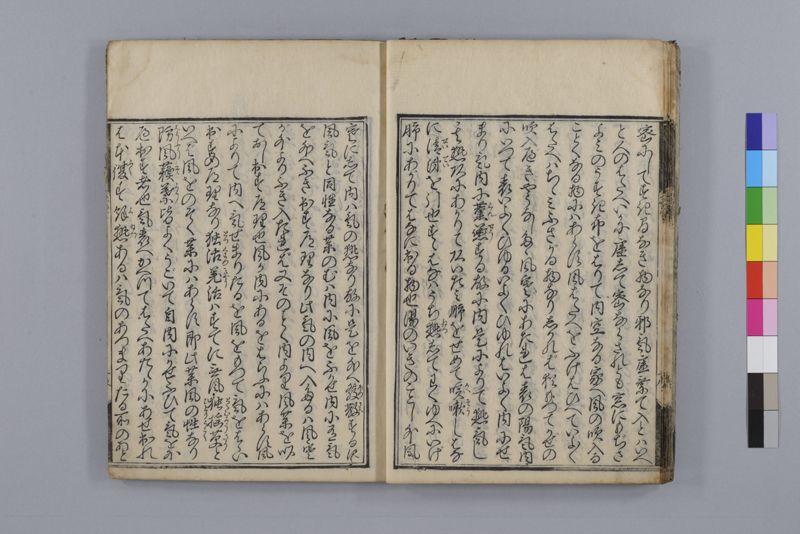
翻刻
【右丁】
密にしてすき間なき物なり邪気虚乗て入とはいへ
と人のはたへいかに虚して密ならされとも窓にもぢさ
よみのうすき布をはりて内空なる家へ風の吹入る
ことくなる物にはあらす風はたへをふけはひへていよ〳〵
はたへはちゝみふさがる物なりしかれば猶もつてかぜの
吹入べきやうなしたゝ風寒にあたれは表の陽気内
にいつて表いよ〳〵ひゆるいよ〳〵ひゆれはいよ〳〵内にせ
まり気内に薫蒸(くんせう)する故に内是によりて熱気し
其熱頭にあがりて頭いたみ肺をせめて咳嗽(かいそう)しはな
に清涕(せいてい)を引也すゝはなはうち熱(ねつ)してわくゆへにいげ
肺にあがりてはなに出る物也湯のいきのことし外風
【左丁】
寒にして内は気の熱なり故に是を外へ発散(ほつさん)するに
風気と同性なる薬のむは内に風をふかせ内に有気
を外へふき出す道理なり此気の内へ入たるは風寒
が外よりふき入たれば又そのことく内より風薬を以
ておし出す道理也風か内にあるをはらふにはあらす風
によりて内へ気せまりたるを風をもつて気をはらい
出すの道理なり独活(とつくわつ)羌(きやう)活はすてに無風 独揺草(とくひようさう)【「ひ」は衍字ヵ】【左に「ひとりうこく」と傍記】と
いへば風をのそく薬にはあらす即此薬風の性なり
防風(はうふう)蘇葉(そよう)皆よくうごいて自内にかせふひて気を外
へ出す者也気表へかへつてはたへあたゝかにあせ出れ
は本 復(ふく)す余熱(よねつ)あるは気のあつまりたる所のあと
現代語訳
【右丁】
密にして隙間のないものである。邪気が虚に乗じて入るとはいうけれども、人の肌がいかに虚して密でなくなったとしても、窓に薄い布を張って内部が空になった家へ風が吹き入るようなものではない。風が肌を吹けば冷えていよいよ肌は縮み塞がるものである。したがってなおさら風が吹き入るはずがない。ただ風寒に当たれば表の陽気が内に入って、表がいよいよ冷える。いよいよ冷えればいよいよ内に迫り、気が内に薫蒸するゆえに内はこれによって熱気する。その熱が頭に上がって頭痛がし、肺を攻めて咳嗽し、鼻に清涕を引く。鼻汁は内部が熱して湧くゆえに、その湯気が肺に上がって鼻に出るものである。湯の息のようなものである。外は風
【左丁】
寒にして内は気の熱である。ゆえにこれを外へ発散するのに、風気と同性の薬を服用するのは、内に風を吹かせ内にある気を外へ吹き出す道理である。この気が内へ入ったのは風寒が外より吹き入ったからであり、またそのように内より風薬を以って押し出す道理である。風が内にあるのを払うのではなく、風によって内へ気が迫ったのを風を持って気を払い出すの道理である。独活・羌活はすでに無風独揺草といえば、風を除く薬ではなく、すなわちこの薬は風の性質である。防風・蘇葉はみなよく動いて内に風を吹かせて気を外へ出すものである。気が表へ返って肌が温かに汗が出れば本復する。余熱があるのは気の集まった所の跡
英語訳
【Right Page】
It is dense and without gaps. Though we say that pathogenic qi takes advantage of deficiency to enter, even if a person's skin becomes deficient and loses its density, it is not like wind blowing into a house through thin cloth stretched over windows with an empty interior. When wind blows on the skin, it cools and the skin increasingly contracts and closes up. Therefore, there is even less way for wind to blow in. It is simply that when exposed to wind and cold, the surface yang qi enters inward, and the surface becomes increasingly cold. As it becomes increasingly cold, it increasingly presses inward, and because qi steams within, the interior becomes heated by this. That heat rises to the head causing headaches, attacks the lungs causing coughing, and draws clear nasal discharge to the nose. Nasal discharge occurs because the interior heats up and bubbles forth, so the steam rises to the lungs and comes out through the nose. It is like the steam from hot water. Outside is wind
【Left Page】
and cold, while inside is heat from qi. Therefore, to disperse this outward, taking medicines of the same nature as wind qi is the principle of blowing wind internally and blowing out the qi that exists within. This qi entered inward because wind and cold blew in from outside, and likewise it is the principle of pushing it out from within using wind medicines. It is not about dispelling wind that exists within, but the principle of using wind to dispel outward the qi that was pressed inward by wind. Duhuo and Qianghuo are already called "grass that sways without wind," so they are not medicines that remove wind, but rather these medicines have the nature of wind. Fangfeng and Suye all move well, blow wind internally, and expel qi outward. When qi returns to the surface and the skin warms and sweats emerge, recovery occurs. Residual heat is the aftermath of where qi had gathered