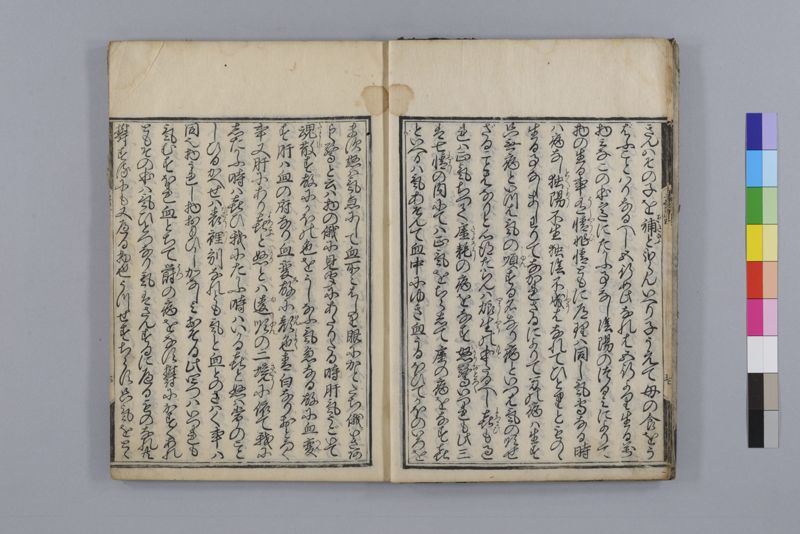
翻刻
【右丁】
きんはその子を補(おきなふ)とやらんいへり子うえて母の食をう
ばふことはりなるへし五行如此なれは五行より生る万
物みなこの本意にたかふ事なし陰陽のつるみによりて
物の生る事 有情(うしやう)非(ひ)情ともに道理は同し気専なる時
は病なし独陽(とくよう)不生独陰不 成(しやう)はなれてひとりとものゝ
生る事なしましわりてなかれさるによりて万の病は生す
只無病といつは気の順(しゆん)する名なり病といつは気の順せ
ざることはなりと心得たらんは養(やう)【羪】生(しやう)の本(もと)たるへし喜(よろこひ)も過
れは正気ちつて虚耗(きよろう)の病をなす怒(いかり)驚(おとろく)いつれも此三
は七 情(しやう)の内にては正気をちらして虚の病をなす喜
といへるは気あそんて血中にゆき血うるほひてかほのいろを
【左丁】
ます怒は気急にして血所々はしり眼にかとたち俄《割書:ニ|》いきあ
らく驚と云は物の俄に見聞にあたりたる時肝気うごいて
魂(たましひ)散す故にかほの色をうしなふ気急なる故に血 変(へん)
す肝は血の府なり血 変《割書:ス|》故に顔色(かんしよく)青白なりおとろく
事又肝にあり喜(よろこふ)と怒(いかり)とは違順(ゐしゆん)の二 境(きやう)に依て我に
したかふ時は喜ひ我にたかふ時はいかる喜と怒は常のこと
しひるかへせは表裡(ひやうり)別なれとも気と血とのさはく事は
同也物うれし物おもひしかなしみおそる此四つはいつれも
気むすほれ血とちて欝(うつ)の病をなす欝にかす〳〵あれ
ともその本は気ひとつなり気はさんするにへるものなれ共
欝するにも又へる物也うつせすちらす只気をとゝ
現代語訳
【右丁】
近はその子を補うとやらん言えり。子飢えて母の食を奪うことは道理なるべし。五行かくの如くなれば、五行より生じる万物みなこの本意に違うことなし。陰陽の交わりによって物の生じること、有情非情ともに道理は同じ。気が正常な時は病なし。独陽不生独陰不成、離れて独り一つものの生じることなし。交わりて流れざるによりて万の病は生ず。ただ無病というは気の順調する名なり。病というは気の順調せざることの名なりと心得たらんは養生の本たるべし。喜びも過ぎれば正気散って虚耗の病をなす。怒り驚き、いずれもこの三つは七情の内にては正気を散らして虚の病をなす。喜びというは気遊んで血中に行き、血潤いて顔の色を
【左丁】
増す。怒りは気急にして血所々走り、眼に角立ち俄かに息荒し。驚きというは物の俄かに見聞に当たりたる時、肝気動いて魂散ず。故に顔の色を失う。気急なる故に血変ず。肝は血の府なり。血変ずる故に顔色青白なり。驚くこともまた肝にあり。喜ぶと怒るとは違順の二境に依りて、我に従う時は喜び、我に違う時は怒る。喜びと怒りは常のこと。詳しく返せば表裏別なれども、気と血との騒ぐことは同じなり。物憂し、物思い、悲しみ、恐る、この四つはいずれも気結ばれ血滞りて鬱の病をなす。鬱にかず数あれども、その本は気一つなり。気は散ずるにも減るものなれど、鬱するにもまた減る物なり。鬱せず散らず、ただ気を留
英語訳
【Right Page】
It is said that the close ones supplement their children. When children are hungry and take their mother's food, this should be reasonable. Since the Five Elements are thus, all things born from the Five Elements do not deviate from this original intention. Regarding the birth of things through the union of yin and yang, the principle is the same for both sentient and non-sentient beings. When qi is normal, there is no disease. "Solitary yang cannot generate, solitary yin cannot form" - nothing can be born alone and separate. Because they unite but do not flow, myriad diseases arise. "No disease" is merely the name for when qi flows smoothly. "Disease" is the name for when qi does not flow smoothly - understanding this should be the foundation of health cultivation. Even joy, when excessive, scatters proper qi and creates diseases of depletion. Anger and fright - all three of these among the seven emotions scatter proper qi and create diseases of depletion. Joy means qi plays and goes into the blood, the blood becomes moist and increases the color of the face.
【Left Page】
Anger makes qi urgent so blood rushes everywhere, eyes become fierce and breathing suddenly becomes rough. Fright means when things suddenly come to one's sight or hearing, liver qi moves and the soul scatters. Therefore one loses facial color. Because qi is urgent, blood transforms. The liver is the repository of blood. Because blood transforms, the facial color becomes pale. Being frightened also belongs to the liver. Joy and anger depend on the two states of accordance and opposition - when things accord with us we rejoice, when things oppose us we become angry. Joy and anger are ordinary matters. Looking closely, though they are different as inside and outside, the agitation of qi and blood is the same. Melancholy, worry, sadness, fear - these four all cause qi to bind and blood to stagnate, creating diseases of depression. Though there are countless types of depression, their root is qi alone. Qi diminishes when it scatters, but it also diminishes when it becomes depressed. Neither depressing nor scattering, simply retaining qi