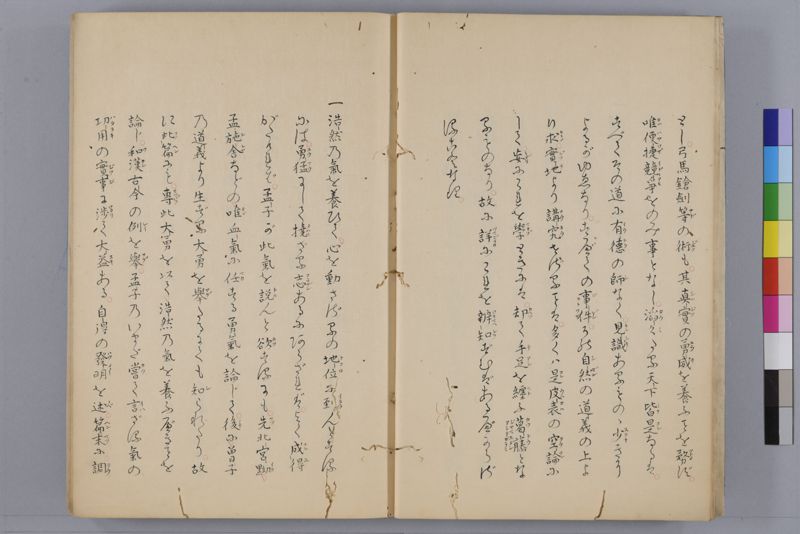
翻刻
【右丁】
とし。弓馬鎗剣 等(ナド)の術(ジユツ)も。其《振り仮名:真-実|シンジツ》の《振り仮名:勇-威|ユウヰ》を養ふことを務(ツトメ)ず。
唯(タヾ)《振り仮名:便-捷|ハヤワザ》《振り仮名:競-争|イドミアヒ》をのみ事となし。《振り仮名:滔-々|タウ〳〵 》たる天-下 皆是(ミナコレ)なるは。
すべてその道に《振り仮名:有-徳|イウトク》の師(シ)なく。《振り仮名:見-識|ケンシキ》あるものゝ少(スクナ)きに
よるがゆゑなり。すべての《振り仮名:事-件|ジゲン|コトワザ》。その《振り仮名:自-然|シゼン》の道-義の上よ
り求(モトメ)。《振り仮名:実-地|ジツチ》より《振り仮名:講-究|コウキウ》せざることは。多くは是(コレ)《振り仮名:皮-表|ウハカハ》の《振り仮名:空-論|クウロン》に
して。妄(ミダリ)にこれを学(マナブ)ときには。却(カヘツ)て手足(テアシ)を纏(マト)ふ《振り仮名:葛-藤|カツトウ|ジヤマホダシ・アシテガラミ》とな
るものなり。故に詳(ツマビラカ)にこれを《振り仮名:弁-知|ワキマヘシラ》ずむばあるべからざ
ることなり。
【左丁】
一浩-然の気を養ひて、心を動さざるの《振り仮名:地-位|トコロ》に到(イタラ)んとする
には。《振り仮名:勇-猛|ユウマウ》にして撓(タハマ)ざる志(コヽロザシ)あるにあらざれば。よく《振り仮名:成-得|ナシエ》
がたければ。孟-子が此気を説(トカ)んと欲(ホツ)するにも。先(マツ)《振り仮名:北-宮-黝| イウ|》、
《振り仮名:孟-施-舎| シシヤ》などの、唯(タヾ)血-気に任(マカ)する勇-気を論じて。後(ノチ)に、曽-子
の道-義より生ずる大-勇を挙(アゲ)たるにても知(シ)られたり。故
に《振り仮名:此-篇|コノヘン》にも。専(モツパラ)此大-勇を以て、浩-然の気を養ふべきことを
論じ。和漢(ワカン)古-今の例(レイ)を挙(アゲ)。孟-子のいまだ嘗(カツ)て言(イハ)ざる気の
《振り仮名:功-用|ハタラキ》の《振り仮名:実-事|ジツジ》に渉(ワタリ)て《振り仮名:大-益| エキ》ある。自-得の《振り仮名:発-明|ハツメイ》を述(ノベ)。《振り仮名:篇-末|ヘンマツ》に。調(テウ)
現代語訳
【右丁】
として、弓馬槍剣などの術も、その真実の勇威を養うことに努めず、ただ早業や競争のみを事とし、滔々たる天下皆これなるのは、すべてその道に有徳の師がなく、見識ある者が少ないためである。すべての事柄を、その自然の道義の上から求め、実地から講究しないことは、多くは表面的な空論であって、妄りにこれを学ぶときには、かえって手足を縛る葛藤となるものである。故に詳しくこれを弁別し理解しなければならないことである。
【左丁】
一、浩然の気を養って、心を動かさない境地に到ろうとするには、勇猛で撓まない志がなければ、よく成し遂げることは難しい。孟子がこの気を説こうと欲するにも、まず北宮黝、孟施舎などの、ただ血気に任せる勇気を論じて、後に、曾子の道義から生ずる大勇を挙げたことからも知られる。故にこの篇でも、専らこの大勇をもって、浩然の気を養うべきことを論じ、和漢古今の例を挙げ、孟子がいまだかつて言わなかった気の功用の実事に及んで大いに益ある、自得の発見を述べ、篇末に、調
英語訳
【Right page】
As such, the arts of archery, horsemanship, spear, and sword do not strive to cultivate true courage and dignity, but only focus on quick techniques and competition. That this torrential tendency pervades the entire realm is because there are no virtuous teachers in these ways and few people with true insight. When all matters are not sought from the foundation of natural moral principles and not investigated through actual practice, they mostly become superficial empty theories, and when one carelessly studies these, they instead become entanglements that bind one's hands and feet. Therefore, one must thoroughly distinguish and understand these matters.
【Left page】
One: To cultivate hao-ran qi and reach the state where the mind remains unmoved, one must have a courageous and unyielding will, for without it, success is difficult to achieve. When Mencius wished to explain this qi, he first discussed the courage of Beigong Yu and Meng Shishe, who relied merely on blood and spirit, and then presented the great courage of Zengzi that arises from moral principles, as can be understood from this approach. Therefore, this section also focuses on using this great courage to cultivate hao-ran qi, presents examples from Japanese and Chinese history both ancient and modern, touches upon the practical applications of qi that Mencius never spoke of, describes discoveries of great benefit through self-realization, and at the end of the section, regu-