翻刻
【右丁】
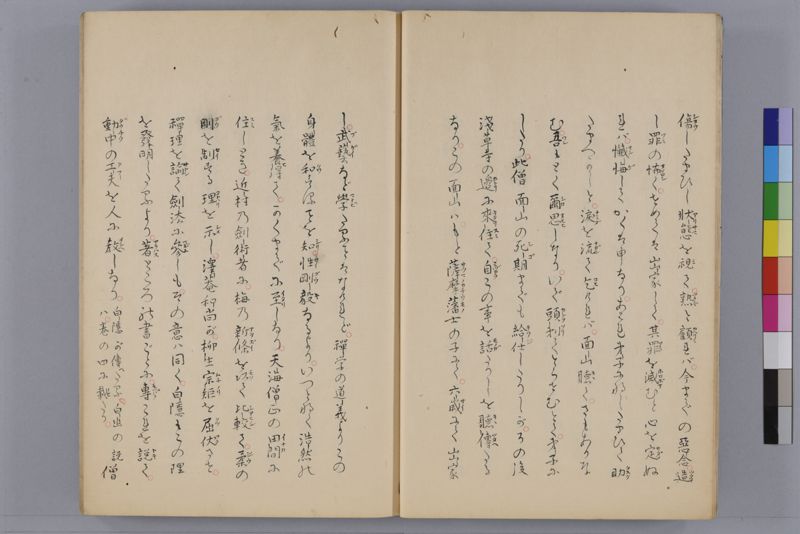
傷(シヨウ)したまひし《振り仮名:状⁻態|アリサマ》を視(ミ)て。熟(ツク〴〵)と顧(カヘリミ)れば。今までの悪⁻念。造(ツクリ)
し罪(ツミ)の怖(オソロシ)く。せめては出⁻家して。其 罪(ツミ)を滅(ホロボサ)むと心を定(サダメ)ぬ
れば。懺(サン)⁻悔(ゲ)してかくは申なり。あはれ弟⁻子になしたまひて助(タスケ)
たまへかしと。涙(ナミダ)を流(ナガシ)て乞(コヒ)ければ。面⁻山 聴(キヽ)て。さもありな
む。吾(ワレ)もとく爾(シカ)思(オモヒ)しなり。いで頭(カシラ)₋剃(ソリ)てとらせむとて。弟⁻子に
したり。此僧面⁻山の死(シ)₋期(ゴ)までも給(キウ)⁻仕(ジ)したりしが。その後
浅⁻草⁻寺の辺(ホトリ)に来(キタリ)₋住(スミ)て。自(ミヅカラ)この事を話(モノガ)たりしを聴(キヽ)₋伝(ツタヘ)たる
なり。この面⁻山はもと《振り仮名:薩⁻摩藩士|サツマノカチウモノ》の子にて。六⁻歳(サイ)にて出⁻家
【左丁】
し。武(ブ)⁻芸(ゲイ)など学(マナビ)たることはなけれど。禅⁻学の道⁻義よりこの
身⁻体を和(クワ)することを知(シリ)。性(セイ)剛(ゴウ)⁻毅(キ)なるより。いつとなく浩⁻然の
気を養 ̄ヒ得て。かくまでに至(イタリ)しなり。天⁻海僧⁻正の《振り仮名:田₋間|イナカ》に
住(スミ)しとき。近⁻村の剣⁻術⁻者に。梅の《振り仮名:新₋条|アヲズイ》を以(モツ)て《振り仮名:比₋較|シアヒシ》て。柔(ジウ)の
剛(ゴウ)を制(セイ)する理(コトハリ)を示(シメ)し。沢⁻菴和⁻尚が。柳₋生 宗(ムネ)₋矩(ノリ)を屈伏(クツフク)させ。
禅⁻理を諭(サトシ)て剣⁻法に参(マジエ)しも。その意は同く。白⁻隠もこの理
を発⁻明したるより。著(アラハス)ところの書ごとに。専(モツパラ)これを説(トキ)て。
動(ダウ)⁻中(チウ)の工(ク)⁻夫(フー)を人に教(ヲシヘ)しなり。《割書:白⁻隠が伝へたる、白⁻幽の説|は。巻の四に載(ノセ)たり。》僧
現代語訳
【右丁】
傷心されたありさまを見て、つくづくと振り返ってみれば、今までの悪念や造った罪が恐ろしく、せめては出家して、その罪を滅ぼそうと心を定めたので、懺悔してこのように申し上げるのです。どうか弟子にしてくださって、お助けください」と、涙を流して乞うたので、面山はこれを聞いて、「それもよかろう。私も早くからそう思っていた。さあ、髪を剃って出家させよう」と言って、弟子にした。この僧は面山の死期まで給仕したが、その後浅草寺のあたりに来て住み、自らこの事を話したのを聞き伝えたのである。この面山はもと薩摩藩士の子で、六歳で出家
【左丁】
し、武芸などを学んだことはないけれど、禅学の道義よりこの身体を和することを知り、性格が剛毅であることから、いつとなく浩然の気を養い得て、このような境地に至ったのである。天海僧正が田舎に住んでいたとき、近村の剣術者に梅の新条を使って比較して、柔が剛を制する理を示し、沢庵和尚が柳生宗矩を屈伏させ、禅理を諭して剣法に参じさせたのも、その意は同じである。白隠もこの理を発明したことから、著すところの書ごとに、専らこれを説いて、動中の工夫を人に教えたのである。《割書:白隠が伝えた白幽の説は、巻の四に載せてある。》僧
英語訳
【Right page】
Seeing his state of grief and sorrow, and reflecting deeply upon it, I realized how terrifying my evil thoughts and the sins I had committed were. I resolved to become a monk to at least destroy those sins, so I confess and speak thus. Please take me as your disciple and save me," he pleaded with tears flowing. Menzan heard this and said, "That would be good. I too have thought this for some time. Come, let me shave your head and make you a monk," and he made him his disciple. This monk served Menzan until his death, but afterward came to live near Sensoji Temple, where he himself told this story, which was heard and passed down. This Menzan was originally the son of a Satsuma domain samurai, who became a monk at age six,
【Left page】
and though he never learned martial arts, through the moral principles of Zen learning he came to know how to harmonize his body. Because of his resolute and firm character, he naturally cultivated the qi of vastness and reached such a state. When the monk Tenkai lived in the countryside, he demonstrated to nearby village swordsmen using fresh plum branches the principle that softness overcomes hardness. When Zen master Takuan made Yagyu Munenori submit and taught him to incorporate Zen principles into swordsmanship, the intent was the same. Since Hakuin also elucidated this principle, in every book he wrote, he specifically explained this and taught people the practice of cultivation in movement. 《Interlinear note: The teachings of Hakuyu transmitted by Hakuin are recorded in volume four.》 Monks