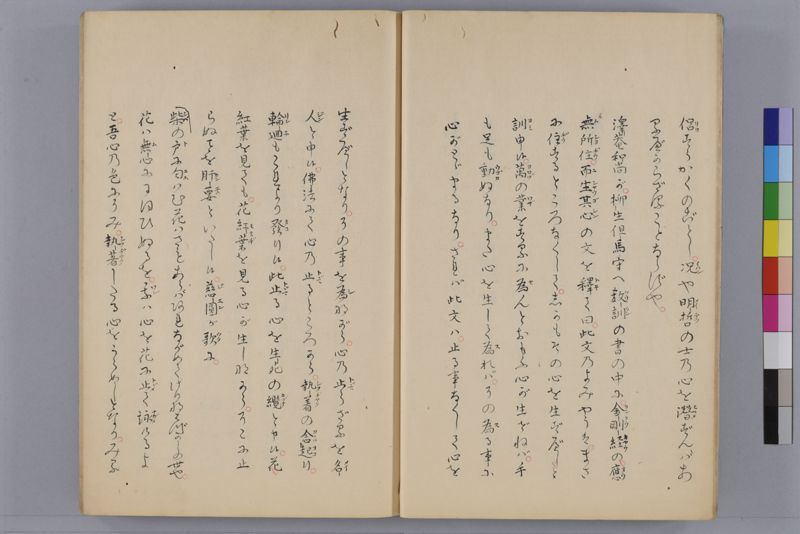
翻刻
【右丁】
侶(リヨ)すらかくのごとし。況(イハン)や明(メイ)⁻哲(テツ)の仕の心を潜(ヒソメ)ずんばあ
るべからざることならずや。
沢⁻菴和⁻尚が。柳₋生但⁻馬守へ教(ケウ)⁻訓(クン)の書の中に。《振り仮名:金⁻剛⁻経|コンコウキヤウ》の、応(オウ)
無所住(ムシヨヂウ)。而生其心(ニシヤウゴシン)の文を釈(トキ)て曰。此文のよみやうは。まさ
に住(ヂウ)するところなくして。しかもその心を生ずべし、と
訓(ヨミ)申候。万(ヨロズ)の業(ワザ)をするに為(セ)んとおもふ心が生ぜねば。手
も足も動(ウゴカ)ぬなり。また心を生して為(ス)れば。その為(ス)る事に
心がとゞまるなり。されば此文は。止る事なくして心を
【左丁】
生ずべしとなり。その事を為(シ)ながら。心の止(トヾマ)らざるを名(メイ)⁻
人(ジン)と申候。仏⁻法にて心の止(トヾマ)るところから。執(シフ)⁻着(ヂヤク)の念(コヽロ)₋起(オコ)り。
《振り仮名:輪⁻廻|リンネ》もこれより発(オコ)り候。此 止(トヾマ)る心を生⁻死の纜(キヅナ)と申候。花、
紅葉を見ても。花《振り仮名:紅₋葉|モミヂ》を見る心が生しなから。そこに止
らぬことを肝(カン)⁻要(エウ)といたし候。慈(ジ)⁻円(エン)が歌(ウタ)に。
〽柴(シバ)の戸(ト)に匂(ニホ)はむ花はさもあらばあれながめてけりなはづかしの世や。
花は無(ム)⁻心ににほひぬるを。我(ワレ)は心を花に止(トヾメ)て詠(ナガメ)けるよ
と。吾心の色にそみ。《振り仮名:執⁻着|シフヂヤク》したる心をうらめしとなり。みる
現代語訳
【右丁】
僧侶でさえこのようである。まして明哲な士が心を潜めないでいられようか、そんなことはないのである。
沢庵和尚が柳生但馬守への教訓の書の中で、金剛経の「応無所住而生其心」の文を解釈して言うには、「この文の読み方は、まさに住するところなくして、しかもその心を生ずべし、と読み申します。あらゆる業をするのに、しようと思う心が生じなければ、手も足も動かないのです。また心を生じてそれを行えば、その行う事に心が留まってしまうのです。だからこの文は、留まることなくして心を
【左丁】
生ずべし、ということなのです。その事を行いながら、心の留まらないのを名人と申します。仏法では心の留まるところから執着の念が起こり、輪廻もこれより発するのです。この留まる心を生死の絆と申します。花や紅葉を見ても、花や紅葉を見る心が生じながら、そこに留まらないことを肝要とします。慈円の歌に、『柴の戸に匂わん花はさもあらばあれ眺めてけりな恥ずかしの世や』とあります。花は無心に匂っているのに、我は心を花に留めて眺めたよ、と。わが心の色に染み、執着した心を恨めしく思うのです。見る
英語訳
【Right page】
Even monks are like this. How much more should wise and enlightened men not fail to cultivate their minds?
In Zen master Takuan's letter of instruction to Yagyu Tajima-no-kami, he interprets the passage from the Diamond Sutra "Ōmu-sho-jū ni-shō-go-shin" (応無所住而生其心), saying: "The way to read this passage is: 'One should generate the mind without dwelling anywhere.' In performing any task, if the mind to do it does not arise, neither hands nor feet will move. Yet if one generates the mind and acts, the mind becomes attached to that action. Therefore this passage means: one should generate the mind without stopping or dwelling.
【Left page】
To perform an action while the mind does not dwell on it - this is what we call a master. In Buddhist teaching, from the places where the mind dwells arise thoughts of attachment, and from this samsara (the cycle of rebirth) originates. This dwelling mind is called the bond of life and death. Even when viewing flowers and autumn leaves, though the mind that sees flowers and leaves arises, the key is not to dwell there. In a poem by Jien: 'Let the flowers that would perfume my humble gate be as they may - how shameful that I gazed upon them in this world.' The flowers bloom mindlessly in their fragrance, yet I fixed my mind on the flowers and gazed at them. My heart is stained with attachment, and I resent this clinging mind. To see