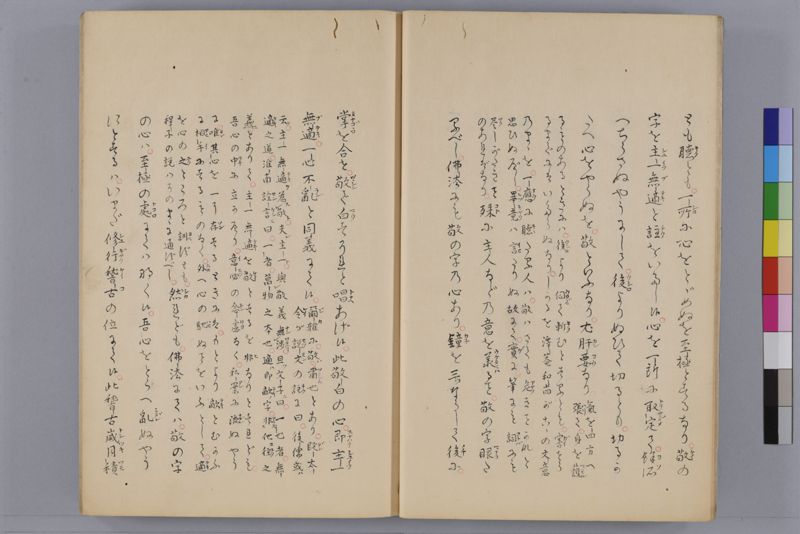
翻刻
【右丁】
とも聴(キク)とも。一⁻所(シヨ)に心をとゞめぬを至⁻極とするなり。敬(ケイ)の
字を主(シユ)⁻一(イツ)無(ブ)⁻適(テキ)と註(チウ)をいたし候。心を一⁻所に取(トリ)₋定(サダメ)て。余所(ヨソ)
へちらさぬやうにして。後(ウシロ)よりぬひて切るとも。切るか
たへ心をやらぬを。敬といふなり。尤 肝(カン)⁻要(ヨウ)なり《割書:気を₋四方へ|張(ハリ)て。身を護(マモル)》
《割書:るものあるときには。後(ウシロ)より伺(ウカヾヒ)て斬(キラ)むとするとも。害(ガイ)せら|るまでにはいたらぬなり。しかるを沢⁻菴和⁻尚がこゝの文⁻意》
《割書:のまゝを。一⁻応(オウ)に聴(キヽ)たる人は。敬はさても危(アヤフ)きことかなと|思ひぬべし。畢(ヒツ)⁻竟(キヤウ)は言(イヒ)たりぬ故にて。実(ゲ)に筆にも詞(コトバ)にも》
《割書:尽(ツク)しがたきこと|のあればなり》殊(コト)に主⁻人などの意を承(ウケタマハ)ること。敬の字 眼(マナコ)た
るべし。仏⁻法にも敬の字の心あり。鐘(カネ)を三ッならして後(ノチ)に。
【左丁】
掌(タナゴヽロ)を合せ。敬(ツヽシン)で白(マウ)すそれと唱(トナヘ)あげ候。此敬⁻白の心。即(スナハチ)主(シユ)⁻一(イツ)
無(ブ)⁻適(テキ)。一⁻心不⁻乱(ラン)と同⁻義にて候。《割書:爾(ジ)⁻雅(カ)に。敬 ̄ハ、粛(ツヽシム)也とあり。段(ダン)⁻太⁻|令(レイ)が説(セツ)⁻文(モン)の註(チウ)に曰。後⁻儒或 ̄ハ》
《割書:云 ̄ク。主⁻一無⁻適(テキ) ̄ヲ為 ̄ス_レ敬 ̄ト。夫 ̄レ主⁻一 ̄ト。與_レ敬義 無(ナシ)_レ渉(ワタルコト)。且 ̄ツ文ー子 ̄ニ曰。一₋也者。無⁻|敵(テキ)之道。淮⁻南 詮(セン)⁻言(ケン) ̄ニ曰。一₋者。万⁻物之本也。適 ̄ハ即 敵(テキ) ̄ノ字。非(アラズ)_二他 ̄ニ往(ユク)之》
《割書:義 ̄ニ_一、とありて。主⁻一無⁻適(テキ)を敬(ケイ)とするを非(ヒ)なりとすれども。|吾心の中(ウチ)に立かへり。意(イ)⁻必(ヒツ)の念(ネン)⁻慮(リヨ)なく。私⁻案(アン)に流(ナガレ)ぬやう》
《割書:に。唯(タヾ)其₋心を一に存(ソン)するときには。もとより敵(テキ)とむかふ|に相(アヒ)₋手(イ)にするものなく。外(ホカ)へ心の馳(ハセ)ぬことをいふとして。適(テキ)》
《割書:を心の之(ユク)ところと訓(ヨマ)ずとも。|程⁻子の説はそのまゝに通ずべし。》然(シカ)れども。仏⁻法にては。敬の字
の心は。至⁻極の処(トコロ)にてはなく候。吾₋心をとらへ乱(ミダレ)ぬやう
にとするは。いまだ修(シウ)⁻行(ギヤウ) 稽(ケイ)⁻古(コ)の位にて候。此稽⁻古 歳月(トシツキ)₋積(ツモ)
現代語訳
【右丁】
見るとも聞くとも、一箇所に心を留めないのを至極とするのである。敬の字を主一無適と注釈している。心を一箇所に取り決めて、他所へ散らさないようにして、後ろから縫って切るとも、切る方へ心をやらないのを敬というのである。もっとも肝要なことである《割書:気を四方へ張って、身を護るものがあるときには、後ろから狙って斬ろうとしても、害されるまでには至らないのである。しかるに沢庵和尚がここの文意のままを、一応に聞いた人は、敬はさても危険なことかなと思うだろう。畢竟は言葉足らずゆえであって、実に筆にも詞にも尽くしがたいことがあるからである》。特に主人などの意を承ることについては、敬の字が眼目となるべきである。仏法にも敬の字の心がある。鐘を三つ鳴らした後に、
【左丁】
掌を合わせ、敬んで申すそれと唱え上げる。この敬白の心は、すなわち主一無適、一心不乱と同義である。《割書:爾雅に「敬とは、粛(つつしむ)也」とある。段太令の説文の注に曰く「後儒或いは云う。主一無適を敬と為すと。夫れ主一と、敬と義渉ること無し。且つ文子に曰く。一也者、無敵之道。淮南詮言に曰く。一者、万物之本也。適は即ち敵の字。他に往くの義に非ず」とあって、主一無適を敬とするのを非なりとするけれども、わが心の中に立ち返り、意必の念慮なく、私案に流れぬように、ただその心を一に存するときには、もとより敵と向かうに相手にするものなく、外へ心の馳せぬことを言うとして、適を心の行くところと読まずとも、程子の説はそのまま通ずべし。》しかれども、仏法においては、敬の字の心は至極の処ではない。わが心を捉え乱れぬようにとするのは、いまだ修行稽古の位である。この稽古歳月積み
英語訳
【Right page】
Whether seeing or hearing, not fixing the mind in one place is the ultimate principle. The character "kei" (敬, reverence) is annotated as "shu-itsu mu-teki" (主一無適, maintaining unity without deviation). To fix the mind in one place and not let it scatter elsewhere - even if attacked and cut from behind, not sending the mind toward the cutting - this is called "kei" (reverence). This is most essential. 《Commentary: When one extends qi in all directions to protect the body, even if someone tries to strike from behind, one will not be harmed. However, those who hear Zen master Takuan's meaning only superficially might think that "kei" is indeed a dangerous thing. Ultimately, this is due to insufficient explanation, as there are truly things that cannot be fully expressed in writing or words.》 Especially in receiving the intentions of one's lord, the character for reverence should be the key point. In Buddhist teaching too, there is the mind of reverence. After striking the bell three times,
【Left page】
one puts palms together and chants reverently "I respectfully speak." This mind of reverent address is synonymous with "shu-itsu mu-teki" (maintaining unity without deviation) and "isshin furan" (single-minded concentration). 《Commentary: In the Erya it says "Kei means to be respectful." In Duan Tailing's commentary on the Shuowen it states: "Later Confucians say that 'shu-itsu mu-teki' constitutes reverence. But 'shu-itsu' (maintaining unity) has no connection with the meaning of reverence. Moreover, the Wenzi says: 'Unity is the Way without enemies.' The Huainan's Quan Yan says: 'Unity is the foundation of all things.' 'Teki' is the character for 'enemy,' not the meaning of 'going elsewhere.'" Though this criticizes making "shu-itsu mu-teki" into reverence, when we return to our own minds, without willful thoughts and without flowing into private schemes, when we simply maintain the mind as one, naturally there is nothing to oppose as an enemy, meaning the mind does not race outward. Even without reading "teki" as "where the mind goes," Master Cheng's explanation should be understood as is.》 However, in Buddhist teaching, the mind of reverence is not the ultimate stage. Trying to control one's mind so it doesn't become disturbed is still at the level of practice and training. This training accumulated over months and years