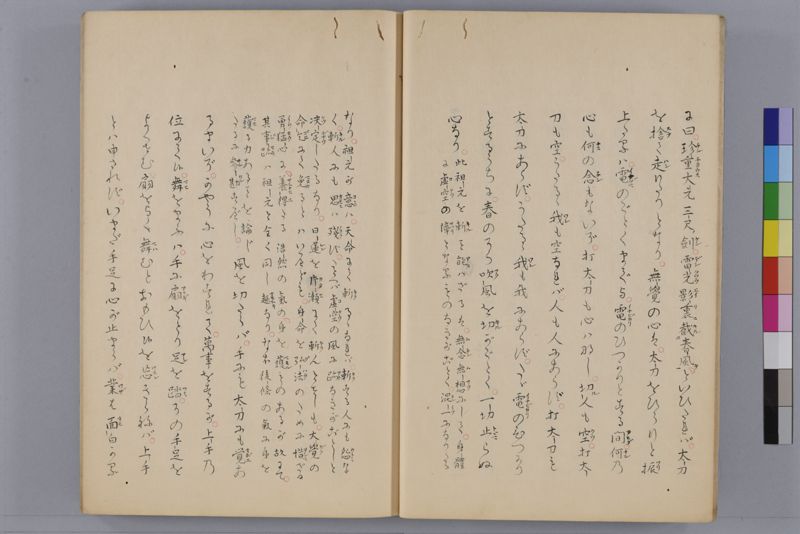
翻刻
【右丁】
に曰。珍(チン)⁻重(チヨウス)大⁻元三⁻尺 ̄ノ剣(ケン)。《振り仮名:雷⁻光|デンクワウ》《振り仮名:影⁻裏|エイリ》 ̄ニ截(キル)_二春⁻風 ̄ヲ_一といひたれば。太刀
を捨(ステ)て走(ハシ)りたりとなり。無⁻覚の心は。太⁻刀をひらりと振(フリ)
上たるは。電(イナヅマ)のごとくまでと。電(イナビカリ)のひつかりとする間(アヒダ)。何(ナン)の
心も何(ナニ)の念(ネン)もないぞ。打太⁻刀も心はなし。切 ̄ル₋人も空(クウ)。打太⁻
刀も空。うたるゝ我(ワレ)も空なれば人も人にあらず。打太⁻刀も
太⁻刀にあらず。うたるゝ我(ワレ)も我にあらず。たゞ電(イナビカリ)のひつかり
とするうちに。春のそら吹(フク)₋風を切(キル)がごとく。一⁻切 止(トヾマ)らぬ
心なり。《割書:此祖⁻元を斬(キル)こと能(アタ)はざるは。無(ム)⁻念(ネン)無(ム)⁻想(サウ)にして。身⁻体|に虚(コ)⁻空(クウ)の障(サハリ)となるものなきがごとく。混(コン)⁻一(イツ)になりたる》
【左丁】
《割書:なり。祖⁻元が意(コヽロ)は。天⁻命にて截(キラ)るゝなれば。斬(キラ)する人にも怨(ウラミ)な|く。斬(キル)人にも思(オモヒ)は残(ノコラ)ず。たとへば虚(コ)⁻空(クウ)の風に跡(アト)なきがごとしと》
《割書:決(ケツ)⁻定(ヂヤウ)したるなり。日⁻蓮(レン)を片(カタ)⁻瀬(セ)にて斬(キラ)んとせしも。大⁻覚(ガク)の|命₋乞(ゴヒ)にて免(マヌカ)るとはいへども。身⁻命を弘(グ)⁻法(ハウ)のために惜(オシマ)ざる》
《割書:勇(イウ)⁻猛(モウ)⁻心に、養(ヤシナヒ)₋得(エ)たる浩⁻然の気の、身を護(マモル)ものあるが故にて。|其 事(ジ)⁻跡(セキ)は祖⁻元と全く同し趣(オモムキ)なり。なほ後⁻条の気に身を》
《割書:護(マモ)る力あることを論じ|たるに参(サン)⁻勘(カン)すべし。》風を切たらば。手にも太⁻刀にも覚(オボエ)あ
るまいぞ。かやうに心をわすれて。万⁻事をするが。上⁻手の
位にて候。舞(マヒ)をまふは。手に扇(アフギ)をとり足(アシ)を踏(フミ)。その手₋足を
よくせむ、扇をよく舞(マハ)むとおもひ候を忘(ワスレ)きらねば。上⁻手
とは申されず。いまだ手足に心が止まらば。業(ワザ)は面(オモ)₋白かる
現代語訳
【右丁】
と言った。「珍重す大元三尺の剣、雷光影裏に春風を截る」と言ったところ、太刀を捨てて走り去ったという。無覚の心は、太刀をひらりと振り上げたのは、稲妻のようであったと。稲光がひらめく間、何の心も何の念もないぞ。打つ太刀も心はなし。切る人も空。打つ太刀も空。打たれる我も空なれば、人も人ではなく、打つ太刀も太刀ではなく、打たれる我も我ではない。ただ稲光がひらめくうちに、春の空に吹く風を切るがごとく、一切とどまらぬ心である。《割書:この祖元を斬ることができないのは、無念無想にして、身体に虚空の障りとなるものがないかのごとく、混一になったためである。
【左丁】
祖元の意は、天命で斬られるのであれば、斬る人にも怨みはなく、斬る人にも思いは残らない。たとえば虚空の風に跡がないようなものだと決定したのである。日蓮を片瀬で斬ろうとした時も、大覚の命乞いで免れたとはいえども、身命を弘法のために惜しまない勇猛心に、養い得た浩然の気が身を護るものがあるゆえであって、その事跡は祖元と全く同じ趣である。なお後条の気に身を護る力があることを論じたところを参考すべきである。》風を切ったならば、手にも太刀にも覚えがあるまいぞ。このように心を忘れて万事をするのが、上手の位である。舞を舞うのは、手に扇を取り足を踏み、その手足をよくしよう、扇をよく舞おうと思うことを忘れきれなければ、上手とは申されない。いまだ手足に心が留まれば、業は面白くなく
英語訳
【Right page】
He said: "I treasure the three-foot sword of Great Yuan; in the lightning's shadow I cut the spring wind." Upon saying this, he threw down his sword and ran away. Mugaku's mind was such that when he raised his sword in a flash, it was like lightning. In the moment of that lightning flash, there is no mind, no thought whatsoever. The striking sword has no mind. The person being cut is empty. The striking sword is empty. The self being struck is also empty, so the person is not a person, the striking sword is not a sword, and the self being struck is not a self. Just as the lightning flashes, like cutting the wind that blows in the spring sky, it is a mind that never stops anywhere. 《Commentary: That this Sogen could not be cut down was because he had become unified, in a state of no-thought and no-conception, as if there were nothing in his body to obstruct the void.
【Left page】
Sogen's intention was that if he were to be cut by heaven's decree, he would bear no grudge against the one cutting him, nor would any thought remain toward the cutter. It would be like the wind in the void leaving no trace - this was his determination. When they tried to execute Nichiren at Katase, though he was spared by Daikaku's plea for his life, it was because the vastly flowing qi he had cultivated in his brave heart that did not begrudge his life for the propagation of the dharma had the power to protect his body. The circumstances were exactly the same as with Sogen. One should refer to the later discussion of the power of qi to protect the body.》 If you cut the wind, there would be no sensation in either hand or sword. To do all things while forgetting the mind in this way is the position of mastery. In performing dance, one takes a fan in hand and steps with the feet - if one cannot completely forget the thought of wanting to move those hands and feet well, or to dance the fan well, one cannot be called a master. If the mind still lingers on the hands and feet, the performance will not be interesting.