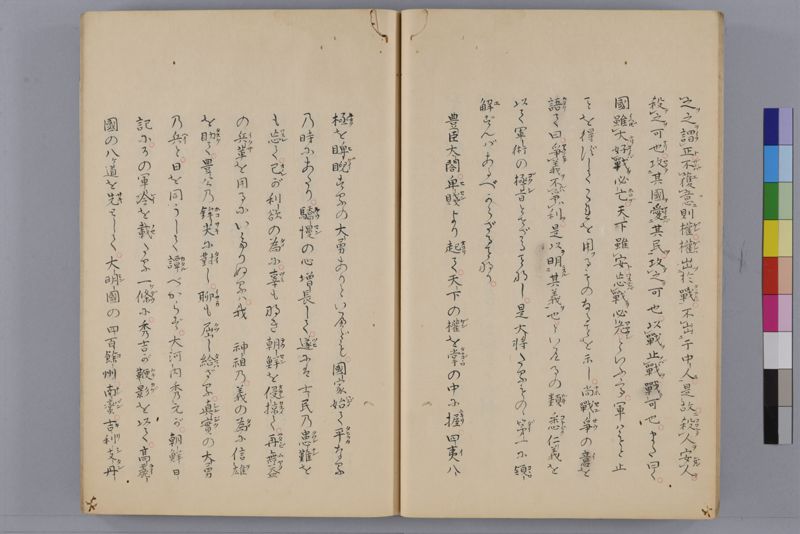
翻刻
【右丁】
_レ之 ̄ヲ之 ̄ヲ謂(イフ)_レ正 ̄ト。不(ザレバ)_レ獲(エ)_レ意 ̄ニ則 権(ゲン)。権(ゲン) ̄ハ出 ̄ツ_二於 戦(タヽカヒニ)_一。不_レ出_二于中⁻人 ̄ニ_一。是₋故 ̄ニ。殺(コロシテ)_レ 人 ̄ヲ安 ̄ンゼバ_レ 人 ̄ヲ。
殺 ̄テ_レ之 ̄ヲ可 也(ナリ)。攻(セメ) ̄テ_二其国 ̄ヲ_一愛(アイ) ̄セバ_二其民 ̄ヲ_一。攻 ̄テ_レ之 ̄ヲ可也。以_レ戦 ̄ヲ止 ̄メバ_レ戦 ̄ヲ。戦 ̄テ₋可也。また曰く。
国 雖(イヘドモ)_レ大 ̄ナリ。好(コノメ) ̄バ_レ戦 ̄ヲ必₋亡(ホロブ)。天⁻下雖_レ安 ̄ト。忘(ワスルレ) ̄バ_レ戦 ̄ヲ必₋危(アヤウシ)、といふて。軍はもと止
ことを得ずしてこれを用 ̄フるものなることを示し。尚(ナホ)戦(セン)⁻争(サウ)の意(イ)を
語(カタリ)て曰。争(アラソヒ) ̄テ_レ義 ̄ヲ不 ̄ルハ争 ̄ハ_レ利 ̄ヲ。是以 ̄テ明 ̄ニスル_二其義 ̄ヲ_一也、といへるの類(ルヰ)。悉(コト〴〵ク)仁⁻義を
以て軍⁻術の極(ゴク)⁻旨(シ)とせざることなし。是大⁻将たるものゝ第(ダイ)⁻一に領(コヽロ)₋
解(エ)ずんばあるべからざることなり。
豊₋臣太⁻閤。卑(ヒ)⁻賤(セン)より起(オコリ)て。天⁻下の権(ゲン)を掌(タナゴヽロ)の中に握(ニキリ)。四⁻夷(イ)八⁻
【左丁】
極(キヨク)を睥(ヒ)⁻睨(ゲイ)するの大⁻勇ありといへども。国⁻家 始(ハジメ)て平(タヒラカ)なる
の時にあたり。驕(ケウ)⁻慢(マン)の心増⁻長して。遂(ツヒ)には士⁻民の患(クワン)⁻難(ナン)を
も忘(ワスレ)て。己(オノレ)が利⁻欲の為(タメ)に。辜(ツミ)もなき朝(テウ)⁻鮮(セン)を侵(オカシ)₋掠(カスメ)て。再(フタヽビ)無(ム)⁻益(ヤク)
の《振り仮名:兵⁻革|イクサ》を用るにいたりぬるは。我 神祖の。義の為(タメ)に信₋雄(ヲ)
を助(タスケ)て。豊⁻公の鉾(ホコ)⁻尖(サキ)に対(タイ)し。聊(イサヽカ)も屈(クツ)し給(タマハ)ざる。真(シン)⁻実(ジツ)の大⁻勇
の兵(ヘイ)と。日を同うして譚(カタル)べからず。大₋河₋内秀₋元が。朝⁻鮮日⁻
記に。その《振り仮名:軍⁻令| レイ| ブレ》を載(ノセ)たる一 ̄ケ条(デウ)に。秀吉が鞭(ムチ)₋影(カゲ)を以て。高⁻麗(ライ)⁻
国の八ヶ道を先(サキ)として。大⁻明(ミン)⁻国の四⁻百⁻余⁻州。南(ナン)⁻蛮(バン)。《振り仮名:吉⁻利⁻支⁻丹⁻|キリシタン》
現代語訳
【右丁】
これを正という。意に適わなければ則ち権謀を用いる。権謀は戦いから出るものであり、凡人から出るものではない。この故に、人を殺して人を安んずるなら、これを殺してもよい。その国を攻めてその民を愛するなら、これを攻めてもよい。戦いをもって戦いを止めるなら、戦ってもよい。また曰く、「国は大きくとも、戦いを好めば必ず滅ぶ。天下が安らかでも、戦いを忘れれば必ず危うい」といって、軍はもとやむを得ずしてこれを用いるものであることを示し、なお戦争の意義を語って「義を争うのであって利を争うのではない。これをもってその義を明らかにするのである」といったような類は、ことごとく仁義をもって軍術の極意としないものはない。これは大将たるものが第一に理解しなければならないことである。
豊臣太閤は、卑賤の身より起こって、天下の権を掌の中に握り、四夷八
【左丁】
極を睥睨する大勇があるといえども、国家がようやく平和になった時にあたり、驕慢の心が増長して、ついには士民の患難をも忘れて、己が利欲のために、罪もない朝鮮を侵略し、再び無益な戦争を用いるに至ったのは、我が神祖が、義のために上杉景勝を助けて、豊公の鉾先に対し、いささかも屈し給わない真実の大勇の兵と、同日に論ずべきではない。大河内秀元が朝鮮日記に、その軍令を載せたる一ヶ条に、秀吉が鞭影をもって、高麗国の八ヶ道を先として、大明国の四百余州、南蛮、キリシタン
英語訳
【Right page】
This is called righteousness. If one's intentions are not achieved, then one employs stratagem. Stratagem comes from warfare, not from ordinary people. Therefore, if killing people brings peace to people, it is acceptable to kill them. If attacking a country means loving its people, it is acceptable to attack it. If using war stops war, it is acceptable to fight. It also says, "Even if a country is large, if it loves war it will surely perish. Even if the world is at peace, if war is forgotten it will surely be in danger," showing that military force is originally something used only when unavoidable. Furthermore, speaking of the meaning of warfare, it says "One contends for righteousness, not for profit. This is to clarify that righteousness." Such examples all make benevolence and righteousness the ultimate principles of military arts without exception. This is what a great general must understand first and foremost.
Toyotomi Taikō rose from humble origins, grasped the power of the realm in the palm of his hand, and had the great courage to look down upon the four barbarian lands and eight
【Left page】
extremities. However, when the nation had just become peaceful, his heart of arrogance grew, and he finally forgot even the troubles of warriors and people, invading innocent Korea for his own profit and greed, leading to another useless war. This cannot be spoken of in the same breath as our Divine Ancestor's troops of true great courage, who, for the sake of righteousness, assisted Uesugi Kagekatsu and did not yield in the slightest to Toyotomi's spear point. In Ōkōchi Hidenobu's Korean diary, in one article recording his military orders, with Hideyoshi's whip-shadow, starting with Korea's eight provinces, then the four hundred and some provinces of the Great Ming country, the southern barbarians, Christians