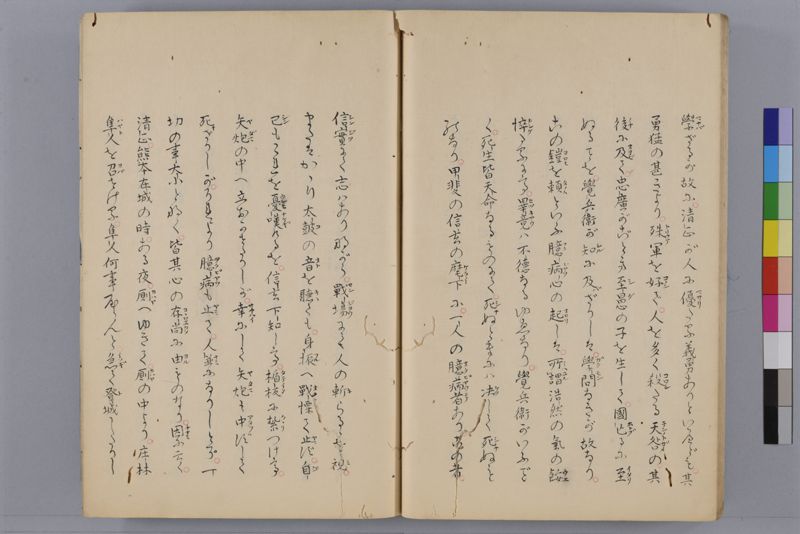
翻刻
【右丁】
学(マナバ)ざるが故に。清-正が人に優(マサリ)たる義⁻勇ありといへども。其
勇⁻猛の甚きより。殊(トリワケ)軍を好(コノン)で。人を多く殺(コロシ)たる天咎(テンノトガメ)の。其
後(ノチ)に及(オヨビ)て。忠-広がごとき至(シ)⁻愚(グ)の子を生して。国-亡(ホトブ)るに至(イタリ)
ぬることを。覚-兵-衛が知(シル)に及 ̄バざりしは。学(ガク)⁻問(モン)なきが故なり。
この鎧(ヨロヒ)を頼(タノム)といふ臆(ヲク)⁻病(ビヤウ)⁻心の起(オコリ)しは。《振り仮名:所_レ謂|イハユル》浩⁻然の気の餒(ウエ)
悴(カシケ)たるにて。畢(ヒツ)⁻竟(キヤウ)は不⁻徳なるゆゑなり。覚兵衛がいふごと
く。死⁻生皆天⁻命なるものにて。死(シナ)ぬときには決(ケツ)して死(シナ)ぬも
のなり。甲⁻斐の信⁻玄の《振り仮名:麾⁻下|ケライ》に。一⁻人の臆(ヲク)⁻病(ビヤウ)⁻者(モノ)あり。この者。
【左丁】
信(シン)⁻実(ジツ)にて志はありながら。戦(セン)⁻場(ジヨウ)にて人の斬(キ)らるゝを視(ミ)。
またはかゝり太⁻鼓(コ)の音(オト)を聴(キヽ)ても。身-振(フル)へ《振り仮名:戦⁻慄|オノ□□》て止(ヤマ)ず。自(ジ)⁻
己(シン)もこれを憂(ウレヒ)-嘆(ナゲキ)けるを。信⁻玄下⁻知して。楯(タテ)-板(イタ)に紮(クヽリ)つけて。
矢炮(ヤダマ)の中へ立おかせたりしが。幸(サイハイ)にして矢炮(ヤタマ)も中(アタラ)ずして
死 ̄ナざりしが。それより臆(ヲク)⁻病(ビヤウ)も止(ヤミ)て。人-並(ナミ)になりしとぞ。一⁻
切の事大⁻小となく。皆其心の《振り仮名:存⁻尚|コヽロエカタ》に由(ヨル)ものなり。因(チナミ)に云く。
清-正熊-本在⁻城の時。ある夜。厠(カハヤ)へゆきて。厠(カハヤ)の中より。庄⁻林
《振り仮名:隼-人|ハヤト》を召(ヨバ)せける。隼-人何事やらんと急(イソギ)て登(ト)⁻城したりし
現代語訳
【右丁】
学ばなかったがゆえに、清正が人に優れた義勇があるといっても、その勇猛が激しすぎて、特に戦争を好んで、人を多く殺した天の咎めが、その後に及んで、忠広のような至愚の子を生んで、国が滅びるに至ったことを、覚兵衛が知るに及ばなかったのは、学問がないがゆえである。この鎧を頼みとするという臆病心の起こったのは、いわゆる浩然の気が衰え萎えたのであって、結局は不徳であるゆえである。覚兵衛が言うように、死生はすべて天命であって、死なない時には決して死なないものである。甲斐の信玄の家来に、一人の臆病者がいた。この者は
【左丁】
信実で志はあるものの、戦場で人の斬られるのを見、またはかかり太鼓の音を聞いても、身震いして戦慄が止まない。自分もこれを憂い嘆いていたのを、信玄が知って、楯板に縛りつけて、矢玉の中に立たせておいたところ、幸いにして矢玉も当たらずして死ななかったが、それより臆病も止んで、人並みになったということである。一切のこと大小となく、すべてその心の持ちようによるものである。ついでに言うと、清正が熊本に在城の時、ある夜、厠へ行って、厠の中から庄林隼人を呼ばれた。隼人は何事やらと急いで登城したところ
英語訳
【Right page】
Because he did not study [the Way of the sages], even though Kiyomasa possessed righteous courage superior to others, his excessive valor led him to particularly favor warfare and kill many people. The divine retribution for this later resulted in the birth of an extremely foolish son like Tadahiro, leading to the destruction of his domain. That Kakubei did not comprehend this was due to his lack of learning. This cowardly mentality of relying on armor arose from what is called the withering and weakening of the "vast-flowing qi," which ultimately stems from lack of virtue. As Kakubei said, life and death are all matters of heavenly mandate - when one is not meant to die, one absolutely will not die. Among the retainers of Shingen of Kai, there was one coward. This man
【Left page】
was sincere and had ambition, yet when he saw people being cut down on the battlefield or heard the sound of the attack drums, he would tremble and shudder uncontrollably. He himself grieved and lamented this condition. When Shingen learned of this, he had the man tied to a shield-board and positioned him in the midst of arrows and bullets. Fortunately, no arrows or bullets struck him and he did not die. From that point on, his cowardice ceased and he became like any ordinary soldier. In all matters, large and small, everything depends on one's state of mind. Incidentally, when Kiyomasa was residing at Kumamoto Castle, one night he went to the privy, and from within the privy he summoned Shōbayashi Hayato. Hayato, wondering what the matter could be, hurriedly climbed up to the castle.