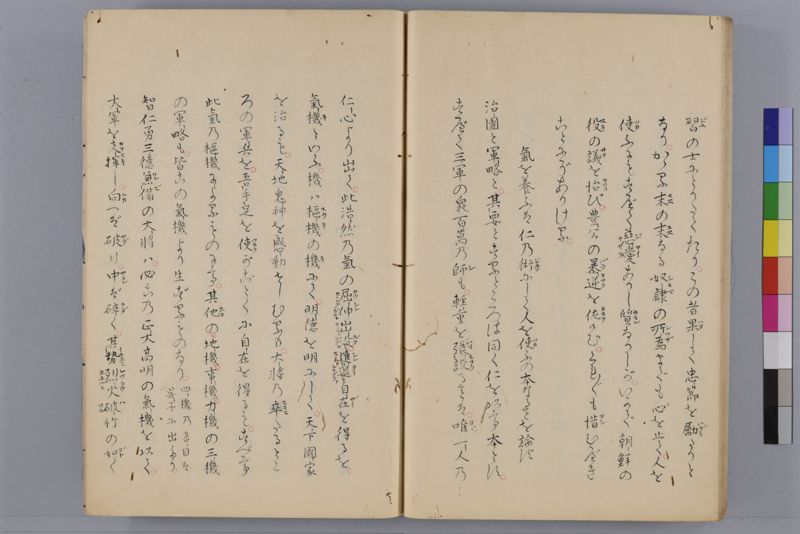
翻刻
【右丁】
習(ジユ)の士にとりたてたり。この者 果(ハタ)して忠⁻節を励(ハゲミ)たりと
なり。かゝる末(スヱ)の末(スヱ)なる《振り仮名:奴⁻隷|シモベ》の《振り仮名:所⁻為|シワザ》までも心を止て。人を
使(ツカ)ふにもすべく《振り仮名:慈⁻愛|ジアイ|ナサケ 》ありし質(ウマレ)なりしが。いかで朝⁻鮮の
役(エキ)の議(サタ)を怡(ヨロコ)び。豊⁻公の暴(バウ)⁻逆(キヤク)を佐(タスケ)けむ。くれ〴〵も惜(ヲシ)むべき
ことにぞありける。
気を養ふは仁の術(ジユツ)にして人を使(ツカ)ふの本なることを論ず
治⁻国と軍⁻略と。其-要とするところは同く仁を以て本とす。
すべて三⁻軍の衆百⁻万の師(シ)も。軽⁻重を《振り仮名:張-設|ハリモフク》ることは。唯(タヾ)一⁻人の
【左丁】
仁⁻心より出て。此浩⁻然の気の《振り仮名:屈⁻伸|クツシン|カヽムトノビルト》 《振り仮名:出⁻没| ボツ|カヽルトヒクト》。《振り仮名:進⁻退|シンタイ|スヽムトシリゾクト》 自⁻在(ザイ)を得るを、
気⁻機(キ)といふ。機は枢(スウ)⁻機(キ)の機(キ)にて。明⁻徳を明にして。天⁻下国⁻家
を治るも。天⁻地鬼⁻神を感⁻動せしむるも。大⁻将の率(ヒキヒ)たるとこ
ろの軍⁻兵を吾-手-足を使(ツカフ)がごとくに自⁻在を得るも。すべて
此気の枢⁻機によるものにて。其 他(ホカ)の、地⁻機、事⁻機、力⁻機の三⁻機
の軍⁻略も。皆この気⁻機より生ずるものなり。《割書:四⁻機の各⁻目は。|呉⁻子に出たり。》
智仁勇三⁻徳《振り仮名:兼⁻備|ケンビ》の大⁻将は。必この正⁻大高⁻明の気⁻機を以て。
大⁻軍を《振り仮名:支⁻揮|カケヒキ》し。向(ムカ)へば破(ヤブ)り。中(アタレ)ば砕(クダ)く。其-勢(イキホヒ)《振り仮名:烈⁻火|レツクワ|ホユルヒ 》《振り仮名:破⁻竹|ハ |ワル 》の如(ゴト)く
現代語訳
【右丁】
習の士に取り立てた。この者は果たして忠節を励んだということである。このような最下級の奴隷の行為までも心に留めて、人を使うにも十分な慈愛があった生まれつきであったのに、どうして朝鮮の役(朝鮮出兵)の議論を喜び、豊臣公の暴逆を助けたのであろうか。本当に惜しむべきことであった。
気を養うは仁の術であって人を使う根本であることを論ず
治国と軍略とは、その要とするところは同じく仁を以て根本とする。
すべて三軍の衆、百万の軍も、軽重を配置することは、ただ一人の
【左丁】
仁心より出て、この浩然の気の屈伸、出没、進退が自在を得ることを気機という。機は枢機の機であって、明徳を明らかにして天下国家を治めるのも、天地鬼神を感動させるのも、大将の率いるところの軍兵を自分の手足を使うように自在を得るのも、すべてこの気の枢機によるものであって、その他の地機、事機、力機の三機の軍略も、皆この気機より生ずるものである。《四機の各項目は呉子に出ている》
智仁勇三徳を兼備した大将は、必ずこの正大高明な気機を以て大軍を指揮し、向かえば破り、当たれば砕く。その勢いは烈火や破竹のごとく
英語訳
【Right page】
retainer. This man indeed proved to be loyal and devoted. Despite having such compassionate nature that he paid attention even to the actions of the lowest servants and had sufficient benevolence in employing people, why did he rejoice in the discussions of the Korean campaign and assist in the tyrannical rebellion of Lord Toyotomi? This was truly regrettable.
On the argument that cultivating qi is the art of benevolence and the foundation of employing people
Governing a country and military strategy both have the same essential foundation: benevolence.
In general, whether commanding the masses of three armies or millions of soldiers, the deployment of light and heavy forces comes from the benevolent heart of just one person,
【Left page】
and when this vast qi achieves freedom in its expansion and contraction, emergence and withdrawal, advance and retreat, this is called "qi-ji" (vital mechanism). "Ji" means the pivotal mechanism, and whether clarifying bright virtue to govern the realm and nation, moving heaven, earth, ghosts and spirits, or achieving mastery over the army led by a general as if using one's own hands and feet - all depend on this pivotal mechanism of qi. The other three mechanisms of military strategy - geographical advantage (chi-ji), situational advantage (ji-ji), and force advantage (ryoku-ji) - all arise from this qi-ji.《The details of the four mechanisms appear in the Wuzi》
A great general who possesses the three virtues of wisdom, benevolence, and courage necessarily commands large armies with this upright, great, and brilliant qi-ji, breaking whatever he faces and crushing whatever he strikes. His momentum is like raging fire or splitting bamboo