翻刻
【右丁】
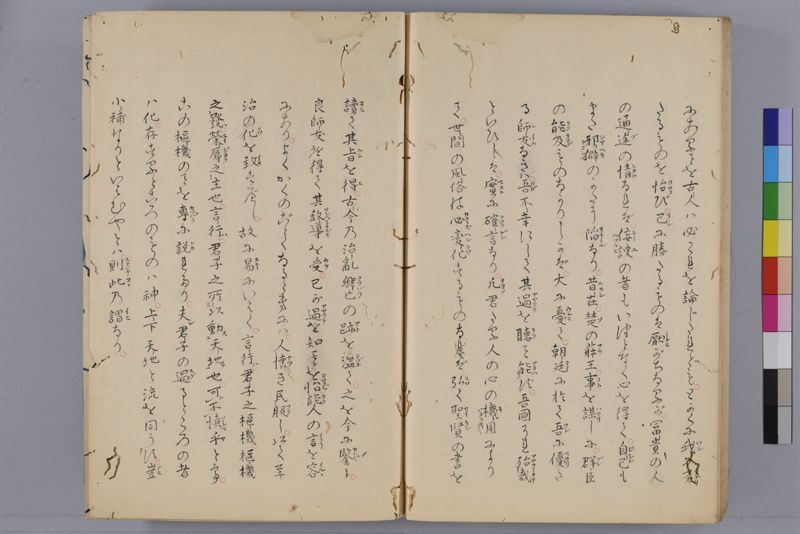
にあることを古⁻人は必これを論じたれども。とかくに我(ワレ)に劣(オトリ)
たるものを怡(ヨロコ)び。己(オノレ)に勝たるものは厭(イトヒ)がちなるが。富⁻貴の人
の通⁻途(ヅ)の情(シヨウ)なれば。《振り仮名:佞⁻諛|ネイユ|ヘツラヒ 》の者もいつとなく心を得て。《振り仮名:自⁻己|ジシン》も
また《振り仮名:邪⁻僻|ジヤヘキ|ヨコシマ 》のかたに陥(オチイル)なり。《振り仮名:昔⁻在|ムカシ》。楚(ソ)の荘(サウ)⁻王。事(コト)を謀(ハカリ)しに。群(グン)⁻臣
の能(ヨク)-及(オヨブ)ものなかりしかば。大に憂(ウレヒ)て。朝⁻廷(テイ)に於て吾(ワレ)に優(マサリ)た
る師(シ)⁻友(イウ)なきは。吾(ワガ)不⁻幸にして其 過(アヤマチ)を聴(キク)こと能(アタハ)ず。吾国それ殆(アヤフイ)-哉(カナ)
といひしは。実(マコト)に確(クワク)⁻言(ゲン)なり。凡(オヨソ)君たる人の心の《振り仮名:機⁻用|キ |ハタラキ 》により
て。世⁻間の風⁻俗は必(カナラズ)変(ヘン)⁻化(クワ)するものなれば。弘(ヒロ)く聖賢(セイケン)の書を
【左丁】
読(ヨミ)て其 旨(ムネ)を得(エ)。古⁻今の治⁻乱 興(コウ)⁻亡(バウ)の跡(アト)を温(タヅネ)て。之を今に鑑(カンガ)み。
良師⁻友を得て其 教(ヲシヘ)⁻導(ミチビキ)を受(ウケ)。己が過(アヤマチ)を知ことを怡(ヨロコビ)。能(ヨク)人の言(イフコト)を容(イルヽ)
にあり。よくかくのごとくなるときには。人 懐(ナツ)き民-服(フク)し。以て至⁻
治の化(クワ)を致(イタ)すべし。故に易(エキ)にいはく。言⁻行 ̄ハ。君⁻子之枢⁻機。枢⁻機
之-発 ̄ハ。栄(エイ)⁻辱(ジヨク)之-主也。言⁻行 ̄ハ。君⁻子之所_三⁻以動 ̄ス_二 天⁻地 ̄ヲ_一也。可 ̄ン_レ不_レ慎(ツヽシマ)乎(ヤ)とて。
この枢⁻機のことを専(モツパラ)に説(トカ)れたり。夫 ̄レ君⁻子の過(スグ)るところの者
は化。存するところのものは神。上⁻下天⁻地と流を同うす。豈(アニ)
小⁻補なりといはむやとは。則(スナハチ)此(コヽ)の謂(イヒ)なり。
現代語訳
【右丁】
にあることを古人は必ずこれを論じたけれども、とかく我に劣ったものを喜び、己に勝ったものは嫌いがちになるのが、富貴の人の通常の情であるから、へつらう者もいつとなく心を得て、自分もまた邪な方に陥るのである。昔、楚の荘王が事を謀ったときに、群臣で能く及ぶ者がなかったので、大いに憂えて、朝廷において我に優った師友がないのは、我が不幸であって、その過ちを聞くことができず、我が国はそれゆえ危ういであろうか、と言ったのは、実に確かな言葉である。およそ君たる人の心の働きによって、世間の風俗は必ず変化するものであるから、広く聖賢の書を
【左丁】
読んでその旨を得て、古今の治乱興亡の跡を尋ねて、これを今に鑑み、良い師友を得てその教え導きを受け、己が過ちを知ることを喜び、よく人の言うことを受け入れることにある。よくこのようになるときには、人は懐き民は服し、もって至治の教化を致すことができる。故に易に言う。言行は、君子の枢機である。枢機の発するところは、栄辱の主である。言行は、君子が天地を動かすところのものである。慎まないでよいだろうか、として、この枢機のことを専ら説かれた。それ君子の過ぎるところの者は化し、存するところのものは神である。上下天地と流れを同じくする。どうして小さな補いだと言えようか、とは、則ちここの謂いである。
英語訳
【Right page】
Although ancient people necessarily discussed that it lies in this, since it is the common sentiment of wealthy and noble people to be inclined to rejoice in those inferior to themselves and to dislike those superior to themselves, flatterers also gradually win their hearts, and they themselves also fall into wickedness. In the past, when King Zhuang of Chu was planning affairs, since none of his retainers could match him, he greatly worried and said, "That I have no teachers and friends superior to me in court is my misfortune, and I cannot hear of my faults. Is my country therefore in danger?" This was truly a reliable statement. Since the customs of the world necessarily change according to the workings of the mind of those who are rulers, one should broadly read the books of sages and worthies
【Left page】
to obtain their essence, investigate the traces of order and disorder, rise and fall throughout history, and reflect on them in the present, obtain good teachers and friends to receive their instruction and guidance, rejoice in knowing one's own faults, and be good at accepting what people say. When one can truly become like this, people will be attracted and the populace will submit, and one can thereby achieve the transformation of perfect governance. Therefore, the Book of Changes says: "Words and actions are the pivot and trigger of the gentleman. The release of the pivot and trigger is the master of honor and disgrace. Words and actions are what the gentleman uses to move Heaven and Earth. Can one not be careful?" - thus this matter of the pivot and trigger is specially explained. That which the gentleman passes through transforms, and that which he preserves becomes divine. He shares the same flow as above and below, Heaven and Earth. How could this be called a small supplement? This is precisely what is meant here.