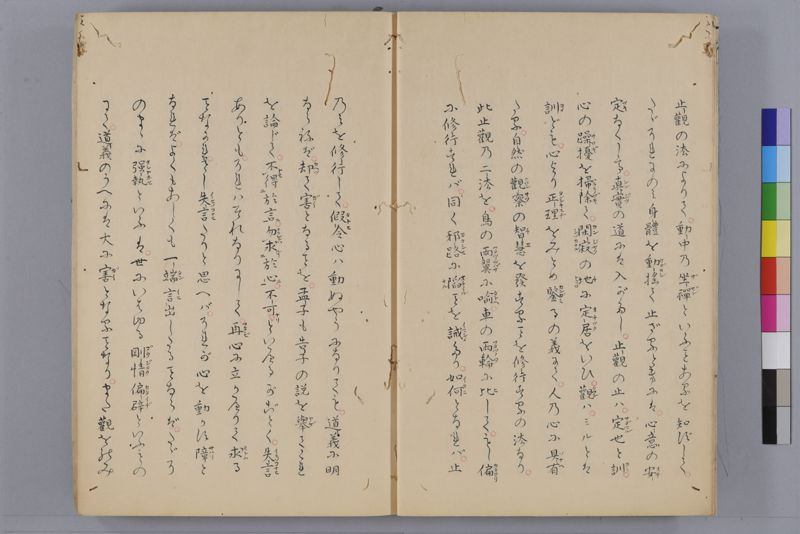
翻刻
【右丁】
止⁻観の法によりて。動⁻中の坐(ザ)⁻禅(ゼン)といふことあるを知ずして。
たゞそれにのみ身⁻体を《振り仮名:動⁻揺|ウゴカシ》て止ざるときには。心⁻意の安(オチ)⁻
定(ツキ)なくして。真(シン)⁻実(ジツ)の道には入がたし。止⁻観の止は。定(サダマル)也と訓(ヨミ)。
心の《振り仮名:躁⁻擾|サワギ》を《振り仮名:掃-除|ハラヒノゾキ》て。《振り仮名:閑⁻寂|カンジヤク|シヅカナル》の《振り仮名:地|チ|トコロ》に《振り仮名:定⁻居|オチツク》をいひ。観(クワン)は。ミルとは
訓(ヨメ)ども。心より《振り仮名:正⁻理|タヾシキスヂ》をみとめ鑑(カンガミ)るの義にて。人の心に《振り仮名:具⁻有|ソナヘ》
たる。自⁻然の観(クワン)⁻察(サツ)の智(チ)⁻慧(ヱ)を発することを修⁻行するの法なり。
此止観の二⁻法を。鳥の《振り仮名:両-翼|フタツノツバサ》に喩(タトヘ)。車の《振り仮名:両-輪|フタツノワ》に比(ヒ)して。もし偏(カタヨリ)
に修⁻行すれば。同く《振り仮名:邪⁻路|ヨコシマ》に《振り仮名:陥|オチイル|ナル》ことを誡(イマシメ)たり。如何(イカニ)となれば。止
【左丁】
のみを修⁻行して。《振り仮名:仮-令|タトヒ》心は動ぬやうになりても。道⁻義に明
ならねば。却(カヘツ)て害(ガイ)となることを。孟⁻子も告⁻子の説を挙(アゲ)てこれ
を論じて。不 ̄トモ_レ得_二於言 ̄ニ_一。勿(ナカレ) ̄トハ_レ求 ̄ルコト_二 於心 ̄ニ_一。不⁻可 ̄ナリ、といへるがごとく。《振り仮名:失⁻言|イヒソコナヒ》
ありとも。それはそれなりにして。再(フタヽビ)心に立かへりて求(モトム)る
ことなかれ。もし《振り仮名:失⁻言|イヒソコナヒ》たりと思へば。それが心を動かす障(サハリ)と
なれば。よくもあしくも一⁻端(タン)言(イヒ)⁻出したることならば。たゞそ
のまゝに《振り仮名:強⁻執|オシトホセ》といふは。世にいはゆる剛(ゴウ)⁻情(ジヨウ)《振り仮名:偏⁻辟|カタイヂ》といふもの
にて。道⁻義のうへには大に害(ガイ)となることなり。また観をのみ
現代語訳
【右丁】
止観の法によって、「動中の坐禅」ということがあるのを知らずに、ただそれ(武芸)にのみ身体を動かして止まないときには、心意の安定がなくして、真実の道には入りがたい。止観の「止」は、「定まる」と読み、心の騒擾を掃い除いて、閑寂の地に定居することをいい、「観」は、「見る」とは読むけれども、心より正理を認め鑑みるの義で、人の心に具わっている、自然の観察の智慧を発することを修行する法である。この止観の二法を、鳥の両翼に喩え、車の両輪に比して、もし偏りに修行すれば、同じく邪路に陥ることを戒めた。なぜかというと、止
【左丁】
のみを修行して、たとえ心は動かないようになっても、道義に明らかでなければ、かえって害となることを、孟子も告子の説を挙げてこれを論じて、「言を得ざるも、心に求むることなかれ、不可なり」と言ったように、失言があっても、それはそれなりにして、再び心に立ち返って求めることはするな。もし失言したと思えば、それが心を動かす障りとなれば、良くも悪くも一旦言い出したことならば、ただそのままに強執というのは、世にいわゆる剛情偏辟というもので、道義の上には大いに害となることである。また観のみを
英語訳
【Right page】
Without knowing that there is such a thing as "meditation in motion" through the method of śamatha-vipaśyanā, if one only keeps moving the body in those practices (martial arts) without stopping, there will be no stability of mind and intention, making it difficult to enter the true Way. "Śamatha" (止) in śamatha-vipaśyanā is read as "to settle," meaning to sweep away and remove the agitation of the mind and settle in a place of tranquility. "Vipaśyanā" (観), though read as "to see," means to recognize and contemplate correct principles from the heart, and is a method of cultivating the natural wisdom of observation that is inherent in the human mind. These two methods of śamatha-vipaśyanā are compared to the two wings of a bird and the two wheels of a cart, warning that if one practices them in a biased manner, one will equally fall into erroneous paths. This is because, if one practices only śamatha
【Left page】
and even if the mind becomes unmoved, if one is not clear about moral principles, it will instead become harmful. Mencius also discussed this by citing Gaozi's theory, saying "Though you may not succeed in your words, do not seek in your heart - this is impermissible." Even if there are misspoken words, let them be as they are, and do not return to the heart again to seek. If you think you have misspoken, it becomes an obstacle that disturbs the mind. Whether good or bad, once something has been said, simply persisting stubbornly is what the world calls obstinate prejudice, which greatly harms moral principles. Also, practicing only vipaśyanā