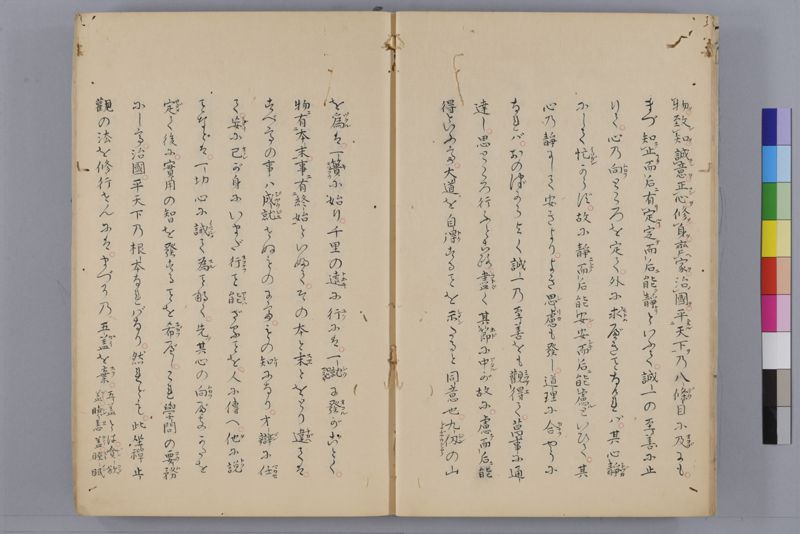
翻刻
【右丁】
_レ物 ̄ヲ致 ̄シ_レ知 ̄ヲ。誠 ̄ニシ_レ意 ̄ヲ。正 ̄フシ_レ心 ̄ヲ。修 ̄メ_レ身 ̄ヲ。斉 ̄ヘ_レ家 ̄ヲ。治 ̄メ_レ国 ̄ヲ。平 ̄ニスル_二 天下 ̄ヲ_一の八⁻条(デウ)⁻目に及(オヨブ)にも。
まづ知 ̄テ_レ止 ̄コトヲ而-后 ̄ニ有 ̄リ_レ定 ̄ルコト。定 ̄テ而-后 ̄ニ能 ̄ク-静 ̄ナリといふて。誠⁻一の至⁻善に止
りて。心の向(ムカフ)ところを定て。外に求(モトム)べきことなれば。其心-静(シヅカ)
にして忙(イソガシ)からず。故に静 ̄ニシテ而-后能-安 ̄シ。安 ̄シテ而-后 ̄ニ能-慮 ̄ルといひて。其
心の静にして安きより。よき思(シ)⁻慮(リヨ)も発し。道⁻理に合(カナフ)やうに
なれば。おのづからよく誠⁻一の至⁻善をも《振り仮名:観⁻得|ミツケエ》て。万⁻事に通⁻
達し。思ところ行ふところ。尽(コト〴〵)く其- 節(ホド)に中(アタル)が故に。慮 ̄テ而-后 ̄ニ能
得といふて。大⁻道を自⁻得(トク)することを示(シメシ)たると同⁻意也。《振り仮名:九⁻仞| ジン|シチヂヤウニシヤク》の山
【左丁】
を為(ツクル)は。一⁻《振り仮名:簣|キ|モツコウ 》に始り。千里の遠(トホキ)に行(ユク)には。一⁻《振り仮名:就|シウ|マタキ》に発(オコル)がごとく。
物 ̄ニ有_二本⁻末_一。事 ̄ニ有_二終⁻始_一といふて。その本と末(スヱ)とをとり違(チガヘ)ては。
すべての事は成(ジヤウ)⁻就(ジユ)せぬものにて。もの知(シリ)になり。才⁻弁(ベン)に任(マカセ)
て。妄(ミダリ)に己(オノレ)が身にいまだ行(オコナフ)こと能(アタハ)ざることを、人に伝へ。他(タ)に説(トク)
ことなどは。一⁻切心に誡(イマシメ)て為(スル)ことなく。先 ̄ツ其心の向(ムカフ)べきかたを
定(サダメ)て後に。実⁻用の智を発することを希(ネガフ)べし。これ学⁻問の要(ヨウ)⁻務(ム)
にして。治国。平天下の根⁻本なればなり。然れども。此坐⁻禅止⁻
観の法を修⁻行せんには。まづその五⁻蓋(ガイ)を棄(ステ)。《割書:五⁻蓋とは。貪(ドン)⁻欲(ヨク)|蓋(ガイ)。《振り仮名:瞋⁻恚|シンヱ》蓋(カイ)。《振り仮名:睡⁻眠|ズイメン》》
現代語訳
【右丁】
物を格し知を致し、意を誠にし、心を正し、身を修め、家を斉え、国を治め、天下を平らかにするという八条目に及ぶにも、まず「止まることを知って而る後に定まることあり、定まって而る後に能く静かなり」といって、誠一の至善に止まって、心の向かうところを定めて、外に求めるべきことなれば、その心は静かにして忙しからず。故に「静にして而る後能く安し、安して而る後に能く慮る」といって、その心の静にして安らかなより、よき思慮も発し、道理に適うようになれば、おのずからよく誠一の至善をも見つけ得て、万事に通達し、思うところ行うところ、ことごとくその節度に中るが故に、「慮って而る後に能く得」といって、大道を自得することを示したのと同意である。九仞の山
【左丁】
を作るのは、一簣に始まり、千里の遠きに行くには、一歩に発するが如く、「物に本末あり、事に終始あり」といって、その本と末とを取り違えては、すべての事は成就しないものであって、物知りになり、才弁に任せて、妄りに己の身にいまだ行うこと能わざることを、人に伝え、他に説くことなどは、一切心に戒めてすることなく、まずその心の向かうべき方を定めて後に、実用の智を発することを願うべきである。これ学問の要務にして、治国・平天下の根本なればなり。然れども、この坐禅止観の法を修行せんには、まずその五蓋を棄て、【割書:五蓋とは、貪欲蓋、瞋恚蓋、睡眠
英語訳
【Right page】
Even when reaching the eight items of investigating things and extending knowledge, making the intention sincere, rectifying the heart, cultivating the self, regulating the family, governing the state, and bringing peace to all under heaven, it first states: "Only after knowing where to stop can one have stability; only after being stable can one be tranquil." By stopping at the sincere unity of the highest good and determining where the mind should direct itself, since this is something to be sought externally, the mind becomes tranquil and unhurried. Therefore it says: "Only after being tranquil can one be at peace; only after being at peace can one deliberate." From this tranquility and peace of mind, good deliberation emerges, and when it accords with the principle of the Way, one naturally becomes able to perceive the sincere unity of the highest good, achieving mastery in all matters. Since one's thoughts and actions all hit their proper measure, it says: "Only after deliberating can one attain," showing the self-realization of the Great Way—this is the same meaning. A mountain of nine ren in height
【Left page】
is built beginning with one basketful of earth, and a journey of a thousand li begins with a single step. As it says, "Things have their root and branches; affairs have their end and beginning"—if one confuses the root with the branches, nothing can be accomplished. One should never indulge in becoming a know-it-all, relying on one's talent for argument to recklessly transmit to others and expound upon things one has not yet been able to practice oneself. First, one should determine the direction the mind should take, and only then seek to develop practical wisdom. This is the essential duty of learning and the foundation for governing the state and bringing peace to all under heaven. However, to practice this method of seated meditation and śamatha-vipaśyanā, one must first abandon the five hindrances. [Note: The five hindrances are: the hindrance of sensual desire, the hindrance of ill-will, the hindrance of sloth and torpor