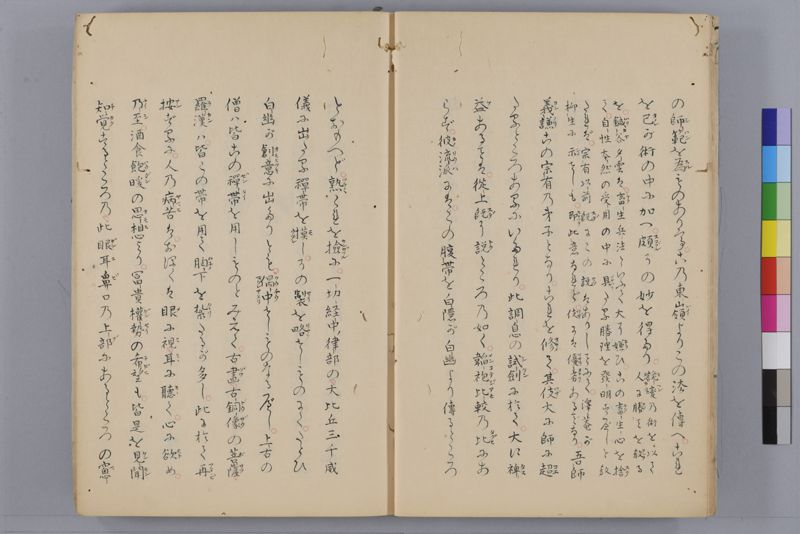
翻刻
【右丁】
の師(シ)⁻範(ハン)を為(スル)ものありて。この東⁻嶺(レイ)よりこの法を伝へ。これ
を己(オノレ)が術の中に加へ。頗(スコブル)その妙を得たり。《割書:《振り仮名:詭⁻変|キヘン|タバカリ》の術を以て|人に勝(カツ)ことを教(オシフ)る》
《割書:を。《振り仮名:鍼⁻谷|ハリカヤ》夕⁻雲は、畜(チク)⁻生兵⁻法といふて大に嫌(キラ)ひ。この畜(チク)⁻生⁻心を捨(ステ)|て。自⁻性本⁻然の受⁻用の中に具(ソナハリ)たる勝⁻理を発⁻明すべしと教》
《割書:たれば。宗-有以⁻前 既(スデ)にこの説(セツ)はありしことにて。沢⁻菴が|柳-生に示(シメ)せしも。即(スナハチ)此-意なれど。伎(ワザ)には優(マサリ)⁻劣(オトリ)あることなり。》吾-師
義(ヨシ)-謙(ノリ)この宗-有の弟子となり。これを修(オサメ)て。其 伎(ワザ)大に師に超(コエ)
たるところあるにいたれり。此調⁻息の試(シ)⁻剣(ケン)に於て。大に裨(タス)⁻
益(ケ)あることは。従⁻上 既(スデ)に説(トク)ところの如く。《振り仮名:韜⁻袍比⁻較|メンコテジアヒ》の比(タグヒ)にあ
らず。彼(カノ)流(リウ)⁻派(ハ)には。この腹-帯を白⁻隠が白⁻幽より伝るところ
【左丁】
とおもへど。熟(ツラ〳〵)これを撿(カンガフル)に。一⁻切⁻経⁻中 ̄ノ律⁻部の、大比丘三千威
儀に出たる禅⁻帯を《振り仮名:摸|モ|ウツシ》し。その製(セイ)を略(リヤク)せしものにて。たとひ
白⁻幽が《振り仮名:創⁻意|オモヒツキ》に出たりとも。《振り仮名:偶⁻中|クウチウ|マグレアタリ》せしものなるべし。上⁻古の
僧は皆この禅(ゼン)⁻帯(タイ)を用しものとみえて。古⁻画(グワ)、古⁻銅(ドウ)⁻像(ザウ)の菩(ボ)⁻薩(サツ)、
羅(ラ)⁻漢(カン)は。皆この帯を用て胸(ムネノ)-下を紮(クヽリ)たるが多し。此に於て再(フタヽビ)
按(アン)ずるに。人の《振り仮名:病⁻苦|ヤマヒ》はおほくは眼(メ)に視(ミ)、耳(ミヽ)に聴(キヽ)て。心に欲(モト)め。
《振り仮名:乃⁻至|ナイシ》。酒食 飽暖(ハウダン)の《振り仮名:思⁻想|オモヒ》より。富⁻貴 権(ゲン)⁻勢(セイ)の《振り仮名:希⁻望|ネガヒ》も。皆是を《振り仮名:見⁻聞|ケンモン》
知(チ)⁻覚(カク)するところの、此 眼(ガン)耳(ニ)鼻(ビ)口の上⁻部(ブ)にあるところの窓(マ)⁻
現代語訳
【右丁】
の師範をする者があって、この東嶺よりこの法を伝え、これを自分の術の中に加え、頗るその妙を得た。【割書:詭変の術を以て人に勝つことを教える】
【割書:を、鍼谷夕雲は、畜生兵法といって大いに嫌い、この畜生心を捨てて、自性本然の受用の中に具わった勝理を発明すべしと教】
【割書:えたれば、宗有以前既にこの説はあったことで、沢庵が柳生に示したのも、即ちこの意であるが、技には優劣があることである。】我が師義謙がこの宗有の弟子となり、これを修めて、その技大いに師に超えたところに至った。この調息が試剣において大いに裨益があることは、前述既に説くところの如く、韜袍比較の類ではない。彼の流派には、この腹帯を白隠が白幽より伝えるところ
【左丁】
と思うけれども、熟々これを考えるに、一切経中の律部の、大比丘三千威儀に出る禅帯を模し、その製を略したもので、たとえ白幽の創意に出たとしても、偶中したものであろう。上古の僧は皆この禅帯を用いたものと見えて、古画、古銅像の菩薩、羅漢は、皆この帯を用いて胸下を縛ったものが多い。ここにおいて再び按ずるに、人の病苦は多くは眼に視、耳に聴いて、心に欲め、乃至、酒食飽暖の思想より、富貴権勢の希望も、皆これを見聞知覚するところの、この眼耳鼻口の上部にあるところの窓
英語訳
【Right page】
There was one who served as an instructor, and he received this method from this Tōrei, incorporated it into his own martial art, and greatly mastered its subtlety. [Note: Teaching to defeat people using deceptive techniques]
[Note: Harikaya Sekiun greatly disliked this, calling it "beast-like military strategy," and taught that one should abandon this beast-like mind and develop the principle of victory that is naturally inherent in one's original nature]
[Note: Therefore, this teaching already existed before Munemochi, and what Takuan showed to the Yagyū was precisely this meaning, but there are superior and inferior levels in technique.] My teacher Yoshinori became a disciple of this Munemochi, practiced this method, and reached a point where his technique greatly surpassed his master's. That this breath regulation greatly benefits swordsmanship is, as already explained above, not merely a matter of competitive comparison. In that school, they think this belly band was transmitted from Hakuyū to Hakuin,
【Left page】
but upon careful consideration, it is a simplified version modeled after the meditation belt mentioned in the "Three Thousand Dignified Behaviors of Great Monks" in the Vinaya section of the complete Buddhist canon, and even if it originated from Hakuyū's original idea, it would have been a fortunate coincidence. It appears that ancient monks all used this meditation belt, as many bodhisattvas and arhats in ancient paintings and bronze statues are shown using this belt to bind the area below the chest. Reflecting on this again, human illness and suffering mostly arise from seeing with the eyes and hearing with the ears, desiring in the mind, and extending to thoughts of food, drink, and comfort, as well as hopes for wealth, status, and power - all of which are perceived through these windows located in the upper part of the body: the eyes, ears, nose, and mouth.