翻刻
【右丁】
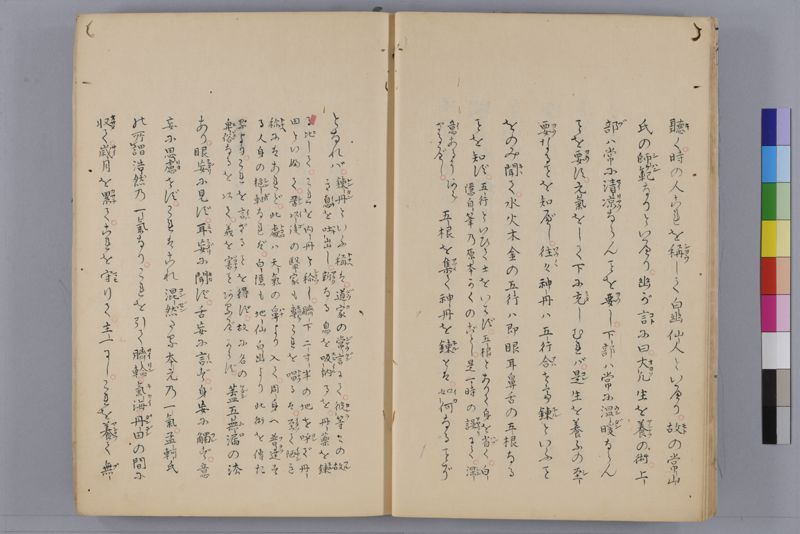
聴(キ)く。時の人これを称(シヨウ)して白⁻幽仙⁻人といへり。故(モト)の常⁻山⁻
氏の師(シ)⁻範(ハン)なりといへり。幽が言(コト)に曰。《振り仮名:大-凡|オヨソ》生を養(ヤシナフ)の術。上⁻
部(ブ)は常に清(セイ)⁻涼(リヤウ)ならんことを要(ヨウ)し。下⁻部は常に温(ウン)⁻暖(ダン)ならん
ことを要(ヨウ)す。元⁻気をして下に充(ミタ)しむれば。是(コレ)生を養ふの至(シ)⁻
要(ヨウ)なることを知べし。往々(ワウ〳〵)神⁻丹は五⁻行 合(アハ)せて錬(ネル)といふこと
をのみ聞(キヽ)て。水火木金の五⁻行は即眼耳鼻舌の五⁻根なる
ことを知ず。《割書:五⁻行といひて土をいはず。五⁻根とありて身を省(ハブ)く。白⁻|隠自⁻筆の原⁻本かくのごとし。是一⁻時の誤(アヤマリ)にて。深(シン)⁻》
《割書:意(イ)あるにあら|ざるべし。》五⁻根を集(アツメ)て神⁻丹を錬(ネル)とは。《振り仮名:如⁻何|イカ》なることぞ
【左丁】
となれば。《割書:錬(レン)⁻丹(タン)といふ称(トナヘ)は。道(ダウ)⁻家(カ)の常(ジヤウ)⁻言(ゲン)にて。彼(カレ)⁻等(ラ)この故(フル) |き息(イキ)を吐(ハキ)-出し。新(アラタ)なる息を吸(スヒ)-納(イル)事を。丹⁻薬を錬(ネル)》
《割書:事 比(ヒ)して。これを内⁻丹と称(シヨウ)し。臍⁻下二⁻寸⁻半の地を呼(ヨン)で丹⁻|田といふて。晋(シン)以(イ)⁻後(ゴ)の医⁻家も専(モツパラ)これを唱(トナフ)るは。至(イタツ)て陋(イヤシ)き》
《割書:称(トナヘ)にはあれど。此 処(トコロ)は天⁻気の鼻(ハナ)より入て。周⁻身へ普(フ)⁻達(タツ)す|る人身の《振り仮名:枢⁻軸|シンギ》なれば。白⁻隠も地⁻仙白⁻幽より此術を伝た》
《割書:るより。これを言(イハ)ざることを得ず。故に名の|卑(ヒ)⁻俗(ゾク)なるを以て。義を害(ソコナフ)ことあるべからず。》蓋(ケダシ)五⁻無(ム)⁻漏(ロ)の法
あり。眼 妄(ミダリ)に見ず。耳(ミヽ)妄(ミダリ)に聞(キカ)ず。舌妄に言(イハ)ず。身妄に触(フレ)ず。意
妄に思⁻慮(リヨ)せず。これはこれ混(コン)⁻然(ゼン)たる本⁻元の一⁻気。孟⁻軻⁻氏
の所_レ謂浩⁻然の一⁻気なり。これを引て臍(サイ)⁻輪(リン)、気(キ)⁻海(カイ)、丹(タン)⁻田(デン)の間に
収(オサメ)て。歳(サイ)⁻月を累(カサネ)て。これを守(マモ)りて。主ー一にし。これを養(ヤシナフ)て無(ブ)⁻
現代語訳
【右丁】
聞く。時の人はこれを称して白幽仙人といったという。元の常山氏の師範なりといったという。幽の言葉に曰く、「およそ生を養う術は、上部は常に清涼であることを要し、下部は常に温暖であることを要する。元気をして下に充実させれば、これが生を養う最も重要なことであると知るべきである。往々にして神丹は五行を合わせて練るということのみを聞いて、水火木金の五行は即ち眼耳鼻舌の五根であることを知らない。《割書:五行といって土を言わず、五根とあって身を省く。白隠自筆の原本はこのようである。これは一時の誤りで、深い意味があるのではないであろう。》五根を集めて神丹を練るとは、いかなることか
【左丁】
となれば、《割書:練丹という称は、道家の常言で、彼らがこの故き息を吐き出し、新たなる息を吸い納れることを、丹薬を練ることに比して、これを内丹と称し、臍下二寸半の地を呼んで丹田といって、晋以後の医家も専らこれを唱えるのは、至って卑しい称ではあれど、この処は天気が鼻より入って、周身へ普く達する人身の枢軸なれば、白隠も地仙白幽よりこの術を伝えたるより、これを言わざることを得ず。故に名の卑俗なるを以て、義を害うことあるべからず。》思うに五無漏の法がある。眼は妄りに見ず、耳は妄りに聞かず、舌は妄りに言わず、身は妄りに触れず、意は妄りに思慮せず。これはこれ混然たる本元の一気、孟軻氏のいわゆる浩然の一気なり。これを引いて臍輪、気海、丹田の間に収めて、歳月を累ねて、これを守って主一にし、これを養って無〔欠〕
英語訳
【Right page】
I heard. People of that time called him the Immortal Hakuyū, it is said. He was said to be the teacher of the former Tsuneyama clan. Hakuyū said in his words: "Generally speaking, in the art of nurturing life, the upper part must always be cool and refreshing, and the lower part must always be warm. If you make the original qi fill the lower part, you should know that this is the most essential thing in nurturing life. People often only hear that the divine elixir is refined by combining the five elements, but they do not know that the five elements of water, fire, wood, and metal are precisely the five sense organs of eyes, ears, nose, and tongue. {{Marginal note: When speaking of the five elements, earth is not mentioned; when speaking of the five sense organs, the body is omitted. Hakuin's original manuscript is like this. This is a momentary error and probably has no deep meaning.}} What does it mean to gather the five sense organs and refine the divine elixir?
【Left page】
As for this, {{Marginal note: The term "refining elixir" is common parlance among Taoists. They compare the act of exhaling old breath and inhaling new breath to refining elixir medicine, calling this "internal elixir." They call the area two and a half inches below the navel the "elixir field," and medical practitioners since the Jin dynasty have also exclusively advocated this. Though this is quite a vulgar term, this place is the pivot of the human body where heavenly qi enters through the nose and spreads throughout the entire body. Since Hakuin also received this technique from the earthly immortal Hakuyū, he cannot avoid mentioning it. Therefore, one should not let the vulgarity of the name harm the meaning.}} There is probably a method of the five non-outflows: the eyes do not see wrongly, the ears do not hear wrongly, the tongue does not speak wrongly, the body does not touch wrongly, and the mind does not think wrongly. This is the primordial unified qi in its natural state, what Mencius called the "vast and flowing qi." Drawing this and storing it in the area between the navel wheel, the sea of qi, and the elixir field, accumulating months and years, protecting it with single-minded focus, and nurturing it to [incomplete]