翻刻
【右丁】
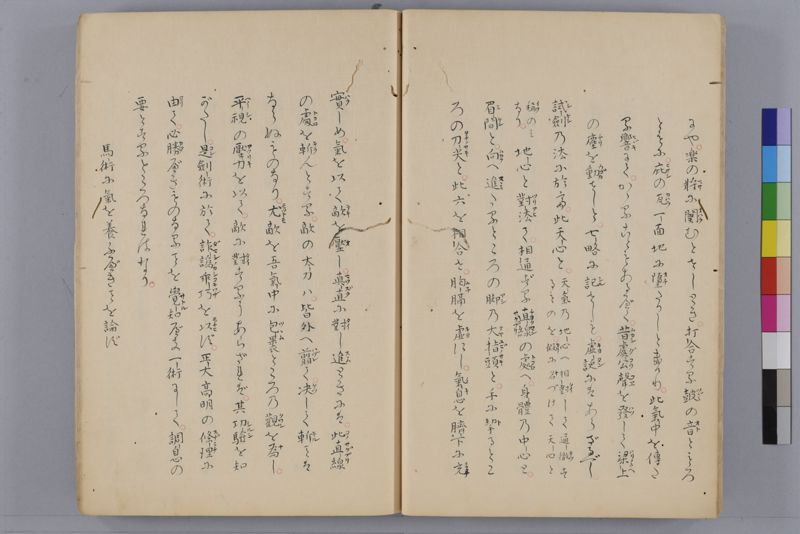
にや。楽の将(マサ)に闋(オハラ)むとせしとき。打-合する鼓(ツヾミ)の音(オト)ともろ
ともに。庇(ヒサシ)の瓦(カハラ)一⁻面地に堕(オチ)たりしときけり。此気⁻中を伝た
る響(ヒヾキ)にて。かゝることもあるべく。昔(ムカシ)《振り仮名:虞⁻公|グコウ》声(コヱ)を発(ハツ)して《振り仮名:梁-上|ハリノウヘ》
の塵(チリ)を動(ウゴカ)せしと。七⁻略に記(シル)せしも。虚(キヨ)⁻誕(タン)にはあらざるべし。
試(シ)⁻剣(ケン)の法に於て。此天⁻心と。《割書:天⁻気の地⁻心へ相⁻対(タイ)して通⁻徹(テツ)す|るものを。仮(カリ)に名(ナ)づけて天⁻心と》
《割書:称(イフ)のみ|なり。》地⁻心と《振り仮名:対⁻法|ツリアヒ》て。相⁻通ずる《振り仮名:直⁻線|チヨクセン|サゲブリ 》の処(トコロ)へ。身⁻体の中⁻心と。
《振り仮名:眉⁻間|ミケン》と。向(ムカフ)へ進(スヽミ)たるところの脚(アシ)の《振り仮名:大⁻指-頭|オヤユビノサキ》と。手に挈(ト)るとこ
ろの《振り仮名:刀⁻尖|タチノサキ》と。此六を相-合せ。《振り仮名:胸⁻隔|ムネ 》を虚(キヨ)にし。《振り仮名:気⁻息|イキ》を臍⁻下に充(ミチ)
【左丁】
実(ハラ)しめ。気を以て敵(テキ)を圧(オ)し。《振り仮名:真⁻直|マツスグ》に対(タイ)し進(スヽム)ときには。此(コノ)《振り仮名:直⁻線|サゲブリ》
の処(トコロ)を斬(キラ)んとする。敵の太⁻刀は。皆外へ翦(ハヅレ)て。決(ケツ)して斬(キル)ことは
ならぬものなり。尤(モツトモ)敵を吾気⁻中に《振り仮名:包⁻裹|ツヽム》ところの観(クワン)を為(ナ)し。
平(ヘイ)⁻視(シ)の圧(アツ)⁻力(リキ)を以て。敵に対(タイ)するにあらざれば。其 《振り仮名:功⁻験|シルシ》を知
がたし。是(コレ)剣⁻術に於て。《振り仮名:詐⁻譌乖⁻巧|ダマシノカシコキワザ》を以(モチヒ)ず。正⁻大高⁻明の《振り仮名:条⁻理|スヂミチ》に
由(ヨリ)て。必 勝(カツ)べきものなることを《振り仮名:覚⁻知|サトル》べき一⁻術にして。調⁻息の
要とするところなれはなり。
馬⁻術に気を養ふべきことを論ず
現代語訳
【右丁】
であったのだろうか。楽がまさに終わろうとした時、打ち合わせる鼓の音とともに、庇の瓦が一面に地に落ちたということである。この気中を伝わる響きによって、このようなこともあり得るだろう。昔、虞公が声を発して梁の上の塵を動かしたと『七略』に記されているのも、嘘ではないだろう。
剣術の法において、この天心と地心が対応して、相通ずる直線の処に、身体の中心と眉間と、向かって進む足の親指の先と、手に取る刀の先と、この六つを相合わせ、胸を空虚にし、気息を臍下に充実させ
【左丁】
気をもって敵を圧し、真っ直ぐに対して進む時には、この直線の処を斬ろうとする敵の太刀は、皆外に逸れて、決して斬ることはできないものである。もっとも敵を自分の気中に包み込むような観想をなし、平静な視線の圧力をもって敵に対するのでなければ、その効験を知り難い。これは剣術において、だましの巧妙な技を用いず、正大で高明な条理によって、必ず勝つべきものであることを悟るべき一つの術であって、調息の要とするところなのである。
馬術に気を養うべきことを論ず
英語訳
【Right page】
During the performance, just as the music was about to end, along with the sound of the beating drums, roof tiles fell to the ground all at once. Through this resonance transmitted through the qi, such things can indeed happen. In ancient times, it is recorded in the "Seven Summaries" that Duke Yu raised his voice and moved the dust on the beams above - this is probably not a fabrication.
In the method of swordsmanship, when this heavenly heart corresponds with the earthly heart, at the place where the straight line connecting them passes, one must align six points: the body's center, the space between the eyebrows, the tip of the big toe of the advancing foot, and the tip of the sword held in hand. Making the chest empty and filling the breath below the navel,
【Left page】
when one advances straight forward using qi to pressure the enemy, any enemy sword attempting to cut along this straight line will deflect outward and absolutely cannot make a cut. However, unless one maintains a visualization of enveloping the enemy within one's qi-field and faces the enemy with the pressure of a calm gaze, it is difficult to know its effectiveness. This is one technique in swordsmanship where one should realize that victory is certain not through deceptive clever tricks, but through upright and enlightened principles - this is what breath regulation essentially requires.
Discussing the Cultivation of Qi in Horsemanship