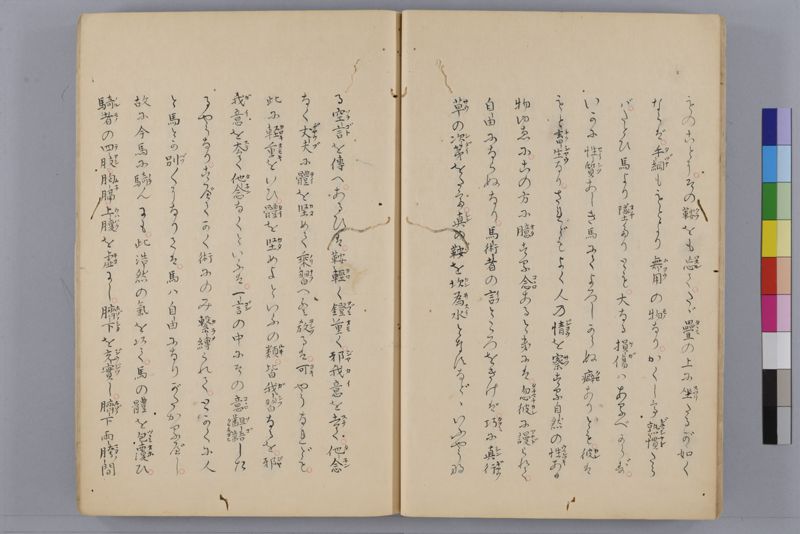
翻刻
【右丁】
ものことに。その鞍(クラ)をも忘(ワスレ)て。たゞ畳(タヽミ)の上に坐(スワリ)たるが如く
ならば。《振り仮名:手⁻綱|タヅナ》ももとより無(ム)⁻用(ヨウ)の物(モノ)なり。かくして《振り仮名:熟-慣|ジユクシナレ》たら
ば。たとひ馬より堕(オチ)たりとも。大なる《振り仮名:損⁻傷|ケガ》はあるべからず。
いかに性(セイ)⁻質(シツ)あしき馬にてよろしからぬ癖(クセ)ありとも。彼(カレ)は
もと畜(チク)⁻生(シヤウ)なり。されどもよく人の情(ジヨウ)を察(サツ)する自⁻然の性(ウマレツキ)ある
物ゆゑに。この方に臆(オク)する念(コゝロ)あるときには。忽(タチマチ)彼(カレ)に謾(アナド)られて。
自⁻由にならぬなり。馬⁻術⁻者の言(イフ)ところをきけば。巧(タクミ)に真(シン)行(ギヤウ)
草(サウ)の《振り仮名:次⁻第|シダイ》をたて。真(シン)の鞍(クラ)を坎為水(カンヰスイ)となすなどゝいふやうな
【左丁】
る空(ソラ)⁻言(ゴト)を伝へ。あるひは。鞍-軽(カロ)く鐙(アブミ)⁻重(オモ)く。邪我意(ジヤカイ)を去(ステ)て。他(タ)⁻念(ネン)
なく丈(ヂヤウ)⁻夫(ブ)に体(テイ)を堅(カタ)めて乗(ノリ)⁻習(ナラ)へと教(ヲシフ)るは。可(ヨキ)やうなれども。
此に軽重(カロキオモキ)をいひ。体(タイ)を堅(カタ)めよといふの類(ルヰ)。皆我(ガ)⁻習(シフ)なるを。邪(ジヤ)
我意(ガイ)を去(ステ)て他(タ)⁻念(ネン)なくといふは。一⁻言(ゴン)の中にその意(コヽロ)《振り仮名:齟⁻齬|ソゴ|クヒチガヒ》した
るやうなり。すべてかく術にのみ《振り仮名:繋⁻縛|カラメ》られて。とかくに人
と馬とか別(ベツ)〳〵になりては。馬は自⁻由になりがたかるべし。
故に今馬に騎(ノラ)んにも。此浩⁻然の気を以て。馬の体を《振り仮名:包⁻覆|ツヽミオホ》ひ。
《振り仮名:騎-者|ノルモノ》の《振り仮名:四⁻肢|テアシ》、《振り仮名:胸⁻膈|ムネ 》、《振り仮名:上⁻腹|ウハハラ》を虚(キヨ)にし。《振り仮名:臍⁻下|ホゾノシタ》を《振り仮名:充⁻実|ジウジツ》し。臍(ホゾノ)⁻下両⁻胯(マタノ)-間
現代語訳
【右丁】
ものとして、その鞍をも忘れて、ただ畳の上に座っているかのようになれば、手綱ももとより無用の物である。このように熟練すれば、たとえ馬から落ちたとしても、大きな怪我はないはずである。どんなに性質の悪い馬で良くない癖があっても、彼はもと畜生である。しかし、よく人の情を察する自然の性質がある物であるから、この方に怯える念があるときには、たちまち彼に侮られて、自由にならないのである。馬術者の言うところを聞けば、巧みに真行草の次第を立て、真の鞍を坎為水とするなどという
【左丁】
空言を伝え、あるいは、鞍軽く鐙重く、邪我意を去って、他念なく丈夫に体を堅めて乗り習えと教えるのは、良いようであるが、ここに軽重を言い、体を堅めよという類は、皆我習(自分勝手な習慣)なのに、邪我意を去って他念なくというのは、一言の中にその意が食い違っているようである。すべてこのように術にのみ縛られて、とかく人と馬とが別々になっては、馬は自由になり難いであろう。故に今馬に騎るにも、この浩然の気をもって、馬の体を包み覆い、騎者の四肢、胸膈、上腹を虚にし、臍下を充実し、臍下両胯間
英語訳
【Right page】
and forget even that saddle, becoming as if merely sitting on a tatami mat, then the reins would naturally be useless things. If one becomes skilled in this way, even if one were to fall from the horse, there should be no serious injury. No matter how ill-natured a horse may be or what bad habits it may have, it is originally a beast. However, since it is a creature with the natural disposition to keenly perceive human emotions, when there is fear on this side, one is immediately despised by the horse and loses control. When listening to what horsemen say, they skillfully establish the progression of formal, semi-formal, and informal styles, and speak of making the true saddle into "kan-i-sui" (hexagram representing water) and other
【Left page】
empty words, or teach that one should keep the saddle light and stirrups heavy, abandon selfish thoughts, have no other thoughts, and practice riding with a firm body like a stalwart man. While this seems good, speaking here of light and heavy, and saying to firm the body - these are all self-centered habits, yet saying to abandon selfish thoughts and have no other thoughts creates a contradiction within a single statement. When one is bound only by such techniques and the person and horse remain separate, the horse will be difficult to control freely. Therefore, when riding a horse now, using this vast qi to envelop and cover the horse's body, making the rider's four limbs, chest and diaphragm, and upper abdomen empty, filling the area below the navel, between the navel and both hips