翻刻
【右丁】
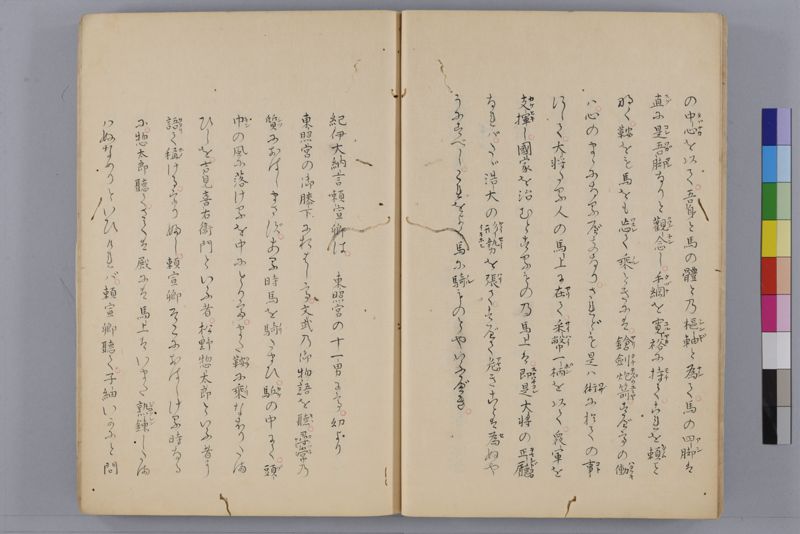
の《振り仮名:中⁻心|タヾナカ》を以て。吾-身と馬の体との《振り仮名:枢⁻軸|シンギ》と為(ナシ)て。馬の《振り仮名:四-脚|アシ》は
直(スグ)に是(コレ)《振り仮名:吾-脚|ワガアシ》なりと観(クワン)⁻念(ネン)し。手(タ)-綱(ヅナ)を《振り仮名:寛⁻裕|ユルヤカ》に持(モチ)て。これを頼(タノム)こと
なく。鞍をも馬をも忘(ワスレ)て乗(ノル)ときには。鎗(ヤリ)剣(タチ)炮(テツパウ)箭(ユミヤ)。すべての働(ハタラキ)
は。心のまゝになるべきなり。されども是は術(ワザ)に於ての事(コト)
にして。大⁻将たる人の馬⁻上に在(アリ)て。《振り仮名:采-幣|サイハイ》一⁻柄(ポン)を以て。衆⁻軍を
《振り仮名:支⁻揮|カケヒキ》し。国⁻家を治むとするものの馬⁻上は。即(スナハチ)是(コレ)大将の《振り仮名:正-庁|ヲマシドコロ》
なれば。たゞ浩⁻大の《振り仮名:形⁻勢目|ケイセイ|イキホヒ 》を張(ハリ)て。すべて危(アヤウ)きことは為(セ)ぬや
うにすべし。これをよく馬に騎(ノル)ものとやいふべき。
【左丁】
紀-伊大⁻納-言頼-宣-卿は。東⁻照⁻宮の十一⁻男にて。幼より
東⁻照⁻宮の御膝⁻下におはして。文⁻武の御物⁻語を聴(キヽ)。《振り仮名:尋-常|ヨノツネ|ナミ〳〵》の
質(シツ)におはしまさず。ある時馬を騎(ノリ)たまひ。駆(カケ)#1の中にて。頭(ヅ)⁻
巾(キン)の風に落けるを中にとりて。また鞍(クラ)に乗(ノリ)なほりたま
ひしを。吉-見喜-右衛門といふ者。松-野惚-太⁻郎といふ者に
語(カタリ)て称(ホメ)ける。をりふし。頼宣卿そこにおはしける時なる
に。惚太郎聴て。さては殿には馬⁻上はいまた《振り仮名:熟⁻錬|ジユクレン》したま
はぬなめりといひければ。頼宣卿聴て。子⁻細いかにと問
現代語訳
【右丁】
の中心をもって、我が身と馬の体との軸として、馬の四脚は直接これが我が脚であると観念し、手綱を緩やかに持って、これを頼むことなく、鞍をも馬をも忘れて乗るときには、槍・剣・鉄砲・弓矢、すべての働きは心のままになるはずである。しかしこれは術における事であって、大将たる人が馬上にあって、采配一本をもって、衆軍を指揮し、国家を治めようとする者の馬上は、すなわちこれが大将の正庁であるから、ただ浩大な威勢を張って、すべて危険なことはしないようにすべきである。これをよく馬に乗る者というべきである。
【左丁】
紀伊大納言頼宣卿は、東照宮の十一男で、幼い頃より東照宮の御膝下におられて、文武の御物語を聞き、尋常の資質におられない。ある時馬に乗られ、駆けている最中に、頭巾が風で落ちたのを途中で取って、また鞍に乗り直されたのを、吉見喜右衛門という者が、松野惚太郎という者に語って褒めた。折しも、頼宣卿がそこにおられた時であったので、惚太郎が聞いて、「それでは殿は馬上はまだ熟練されていないのでしょう」と言ったところ、頼宣卿が聞いて、「詳しくはどのようなことか」と問
英語訳
【Right page】
making the center between the navel and both hips the axis between one's own body and the horse's body, contemplating that the horse's four legs are directly one's own legs, holding the reins loosely without relying on them, and when riding while forgetting both saddle and horse, then spear, sword, firearms, and bow and arrow - all actions should follow one's will. However, this pertains to technique, and for a great general who is mounted and commands many troops with a single war fan and seeks to govern the nation, his position on horseback is precisely the general's main hall. Therefore, he should display only a vast and majestic bearing and avoid doing anything dangerous. This is what one should call truly skilled horsemanship.
【Left page】
Lord Yoronobu, the Great Councilor of Kii, was the eleventh son of Toshogu (Tokugawa Ieyasu), and from childhood was raised under Toshogu's direct care, listening to his stories of literature and military arts, and was not of ordinary disposition. Once when he was riding a horse, during a gallop, his headband fell off in the wind, which he caught midway and remounted properly on the saddle. Yoshimi Kiemon told this story to Matsuno Botaro, praising him. As it happened, Lord Yoronobu was present at that time, and when Botaro heard this, he said, "Then it seems His Lordship has not yet mastered horsemanship." When Lord Yoronobu heard this, he asked, "What do you mean by that in detail?"