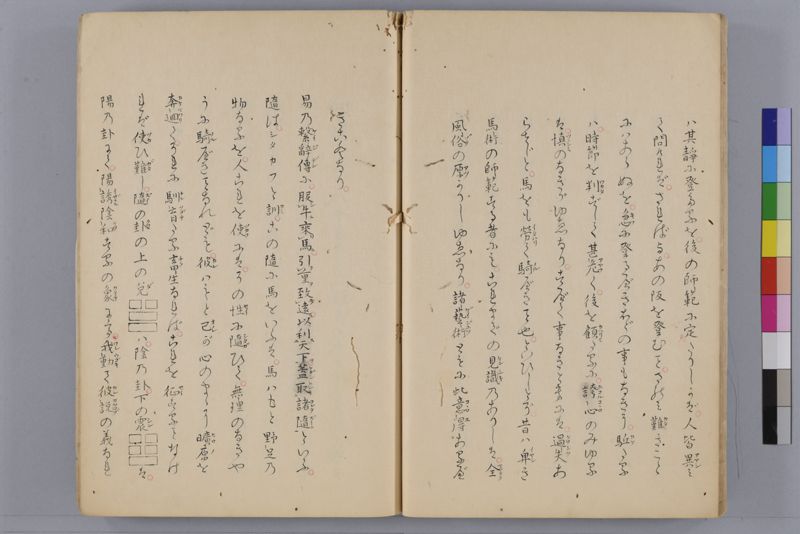
翻刻
【右丁】
は其静に登たるを。後の師⁻範の定たりしかば。人皆 異(アヤシ)み
て問ければ。さればよ。あの阪を登むこと。さのみ難(カタ)きこと
にはあらぬを。急(キフ)に登るべきほどの事もなきに。駆(カケ)たる
は。時⁻節を判(ワカタ)ずして甚-危(アヤフ)く。 後を顧(カヘリミ)たるに。誇(ホコル)-心(コヽロ)のみゆる
は。慎(ツヽシミ)のなきがゆゑなり。すべて事なきときには。《振り仮名:過⁻失|クワシツ》あ
らせじと。馬をも労(イタハリ)て騎(ノル)べきこと也。といひしとぞ。昔は卑(イヤシ)き
馬⁻術の師⁻範する者にも。これまでの見(ケン)⁻識(シキ)のありしは。全(マツタク)
風⁻俗(ゾク)の厚(アツ)かりしゆゑなり。諸⁻芸(ゲイ)⁻術(ジユツ)ともに此《振り仮名:意-得|コヽロエ》 あるべ
【左丁】
きことなり。
易の《振り仮名:繋⁻辞⁻伝|ケイジデン》に。服 ̄シ_レ牛 ̄ニ乗 ̄リ_レ馬 ̄ニ。引 ̄テ_レ重 ̄ヲ致 ̄テ_レ遠 ̄ニ。以利 ̄ス_二 天下 ̄ヲ_一。蓋(ケダシ)取(トレリ)_二諸(コレヲ)随(ズイニ)_一#1といふ。
随は。シタカフと訓(ヨミ)。この随に馬をいふは。馬はもと野-足の
物なるを。人これを使(ツカフ)には。その性(セイ)に随(シタガ)ひて。無⁻理のなきや
うに騎(ノル)べきことなれども。彼(カレ)はもと己(オノレ)が心のまゝに《振り仮名:曠⁻原|ヒロノ》を
《振り仮名:奔-廻|カケマワリ》て。それに馴(ナレ)-育(ソダチ)たる畜(チク)⁻生なれば。これを征(セイ)することなけ
れば使(ツカ)ひ難(ガタ)し。随(ズイ)の卦(クワ)の上の兌(ダ)【卦の占形図】は。陰の卦。下の震(シン)【卦の占形図】は。
陽の卦にて。陽-誘(イザナヒ)陰-和(クワ)するの象(カタチ)にて。我(ワレ)-動(ウゴキ)て彼(カレ)-説(ヨロコブ)の義なれ
現代語訳
【右丁】
は、その静かに登った者を後の師範に定めたので、人皆が不思議に思って問うたところ、「そうなのだ。あの坂を登ることは、それほど難しいことではないのに、急いで登るほどのこともないのに、駆けたのは時節を判断せずして甚だ危険である。後ろを振り返ったのに、誇り心が見えるのは、慎みがないからである。すべて事がないときには、過失がないよう馬を労わって騎乗すべきことである」と言ったということである。昔は身分の低い馬術の師範をする者にも、これほどの見識があったのは、全く風俗が厚かったからである。諸芸術ともにこの心得があるべき
【左丁】
ことである。
易の繋辞伝に「牛に服し馬に乗り、重きを引いて遠きに致し、以って天下を利す。蓋し諸をこれ随に取れり」という。随は「したがう」と読む。この随に馬をいうのは、馬はもと野生の動物であるのを、人がこれを使うには、その性質に従って、無理のないように乗るべきことであるが、彼はもと自分の心のままに広野を駆け回って、それに慣れ育った畜生であるから、これを制御することがなければ使い難い。随の卦の上の兌は陰の卦、下の震は陽の卦にて、陽が誘い陰が和する象にて、われ動きて彼喜ぶの義である
英語訳
【Right page】
chose the one who climbed quietly as the successor master instructor. When everyone found this strange and asked about it, [the master] said: "Indeed, climbing that slope is not particularly difficult, and there was no need to rush up it. The one who galloped showed poor judgment of the situation and was very dangerous. Looking back with visible pride shows a lack of humility. When there is no emergency, one should always ride with care for the horse to avoid mistakes." He said this because in the old days, even lowly instructors of horsemanship possessed such discernment, which was entirely due to the depth of moral customs. All arts and skills should embody this understanding.
【Left page】
In the "Appended Statements" of the I Ching, it says: "Harnessing oxen and riding horses, drawing heavy loads to distant places, thereby benefiting all under Heaven - this is taken from the hexagram Sui (Following)." Sui is read as "shitagau" (to follow). The reason horses are mentioned in relation to this hexagram of Following is that horses are originally wild animals, and when humans use them, we should ride them in accordance with their nature without forcing them unnaturally. However, since they are beasts that originally galloped freely across wide plains according to their own will and were raised in that manner, they are difficult to use without proper control. In the hexagram Sui, the upper trigram Dui is a yin trigram, and the lower trigram Zhen is a yang trigram, representing the image of yang leading and yin harmonizing - the principle of "we move and they rejoice."