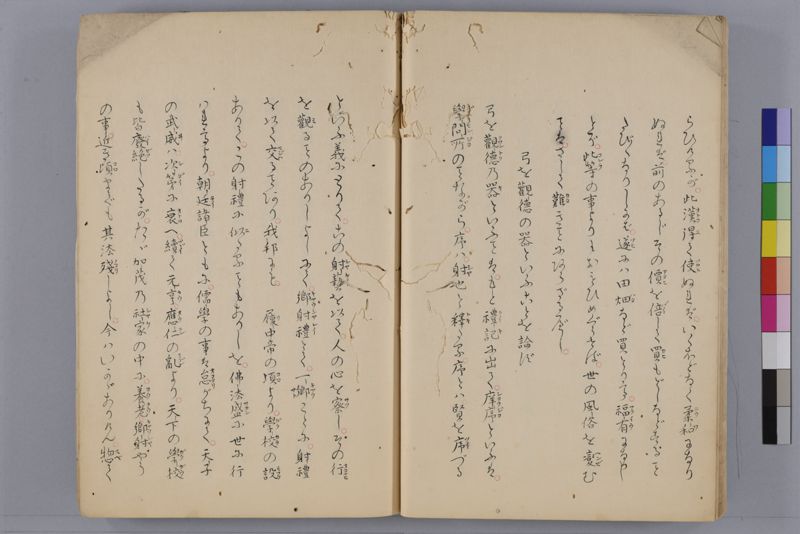
翻刻
【右丁】
らひけるが。此 漢(オトコ)得(エ)て使(ツカヒ)ぬれば。いくほどなく《振り仮名:柔⁻和|ニウワ》になり
ぬれば。前のあるじその価(アタヒ)を倍(バイ)して買(カヒ)もどしなどすること
たび〳〵なりしかば。遂(ツヒ)には田 畑(ハタ)など買とりて。福(フク)⁻有(イウ)になりし
とぞ。《振り仮名:此-等|コレラ》の事よりもおもひめぐらせば。世の風⁻俗を変(ヘンゼ)む
ことは。さして難(カタ)きことにあらざるべし。
弓を観⁻徳の器といふことを論ず
弓を《振り仮名:観⁻徳|クワントク》の器(キ)といふことは。もと礼(ライ)⁻記(キ)に出て。庠(シヨウ)⁻序(ジヨ)といふは。
《振り仮名:学⁻問⁻所|ガクモンジヨ》のことながら。序は。射(シヤ)也と釈(トキ)たる。序とは。賢を序(ツイ)づる
【左丁】
といふ義にとりて。この射(シヤ)⁻芸(ケイ)を以て。人の心を察(サツ)し。その行(オコナヒ)
を観(ミ)ることのありしよしにて。郷射礼(キヤウシヤレイ)とて。一⁻《振り仮名:郷|キヤウ|サト 》ことに。射⁻礼
を以て交(マジハ)ることあり。我-邦にも。 履(リ)⁻中⁻帝の頃(コロ)より。学(ガク)⁻校(カウ)の設(モフケ)
ありて。この射⁻礼に似(ニ)たることもありしを。仏⁻法 盛(サカン)に世に行
はれてより。朝⁻廷(テイ)諸⁻臣ともに。儒⁻学の事は怠(オコタリ)がちにて。天⁻子
の武⁻威(ヰ)は。次(シ)⁻第(ダイ)に衰(オトロ)へ。続(ツヾイ)て元⁻享(カウ)、応(オウ)⁻仁(ニン)の乱(ミダレ)より。天⁻下の学(ガク)⁻校(ガウ)
も皆 廃(ハイ)⁻絶(ゼツ)したるが。たゞ加⁻茂の社(シヤ)⁻家(ケ)の中に。養(ヨウ)⁻老(ラウ)、郷(キヤウ)⁻射(シヤ)やう
の事。近き頃(コロ)までも其法 残(ノコリ)しよし。今はいかゞありけん。総(スベ)【惣】て
現代語訳
【右丁】
らっていたが、この男が手に入れて使うと、いくらも経たないうちに柔和になったので、前の主人がその価格を倍にして買い戻すなどということが度々あったので、ついには田畑なども買い取って、裕福になったということである。これらのことから思いめぐらせば、世の風俗を変えることは、さして難しいことではないであろう。
弓を観徳の器ということを論ず
弓を観徳の器というのは、もともと礼記に出ていて、庠序というのは学問所のことであるが、序は射であると解釈されている。序とは、賢者を序列づける
【左丁】
という意味にとって、この射芸をもって、人の心を察し、その行いを観察することがあったということで、郷射礼といって、一つの郷ごとに、射礼をもって交流することがあった。我が国にも、履中帝の頃より、学校の設置があって、この射礼に似たこともあったが、仏法が盛んに世に行われるようになってから、朝廷諸臣ともに、儒学のことは怠りがちになって、天子の武威は次第に衰え、続いて元享・応仁の乱より、天下の学校もすべて廃絶したが、ただ加茂の社家の中に、養老・郷射のようなこと、近い頃まで其の法が残っていたということである。今はどうであろうか。すべて
英語訳
【Right page】
would take them in, but when this man acquired and used them, they became gentle in no time at all, so their former owners would often buy them back at double the price. Eventually he even bought fields and became wealthy. Reflecting on these examples, changing the customs of the world should not be particularly difficult.
Discussion on calling the bow an instrument of moral observation
Calling the bow an instrument of moral observation originally appears in the Book of Rites, where xiangxu refers to places of learning, and xu is interpreted as meaning archery. Xu means to rank the worthy
【Left page】
in this sense, and through this art of archery, people's hearts were examined and their conduct observed. There was something called the village archery ceremony, where each village would interact through archery rituals. In our country too, from the time of Emperor Richū, schools were established and there were things similar to these archery ceremonies. However, after Buddhism became prevalent in the world, both the court and its ministers became negligent in Confucian learning, the emperor's martial authority gradually declined, and following the disturbances of the Genkō and Ōnin periods, all the schools throughout the land were abolished. Only in the Kamo shrine families did practices like yōrō and kyōsha ceremonies remain until recent times. How things stand now, I wonder. In general