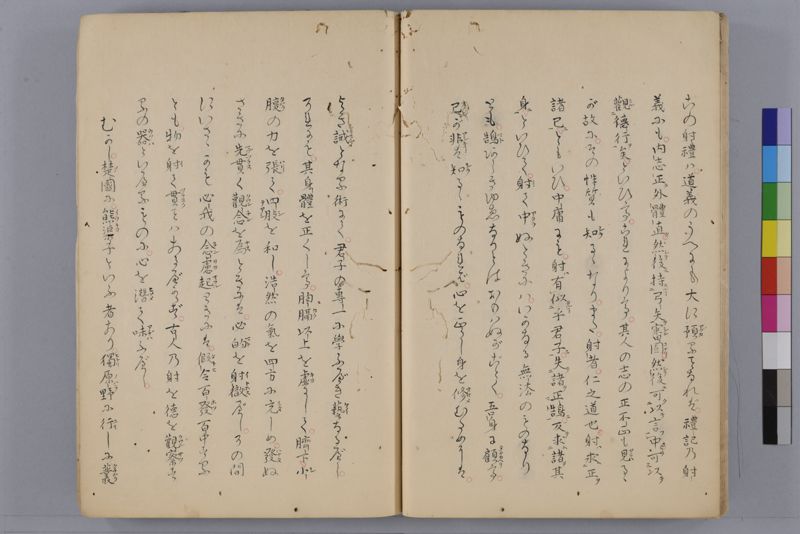
翻刻
【右丁】
この射⁻礼は。道⁻義のうへにも大に預(アヅカ)ることなれば。礼⁻記の射⁻
義にも。内-志-正 ̄ク外-体-直 ̄ク。然 ̄シテ-後 ̄ニ持 ̄スルコト_二弓⁻矢 ̄ヲ_一審(シン)⁻固(コ) ̄ナリ。然 ̄シテ-後 ̄ニ可 ̄ク_二以 ̄テ言 ̄フ_一_レ 中 ̄ルコトヲ可_三以 ̄テ
観(ミル)_二徳⁻行 ̄ヲ_一矣、といひて。これによりて。其人の志の正不⁻正も見(アラハ)るゝ
が故に。その性⁻質も知(シラ)るゝなり。また。射-者。仁之道也。射 ̄ハ求 ̄ム_二正 ̄ヲ
諸己 ̄ニ_一、ともいひ。中⁻庸にも。射 ̄ハ有_レ似 ̄タルコト_二乎君⁻子 ̄ニ_一失 ̄テ_二諸 ̄ヲ《振り仮名:正⁻鵠| |マト 》 ̄ニ_一。反 ̄テ求 ̄ム_二諸 ̄ヲ其
身 ̄ニ_一、といひて。射(イ)て中(アタラ)ぬときには。いかなる無⁻法のものなり
とも。鵠(マト)あしきゆゑなりとはおもはぬがごとく。吾-身に顧(タチカヘリ)て。
己(オノレ)が非(アシキ)は知(シラ)るゝものなれば。心を正うし身を修(オサメ)むためには。
【左丁】
よき誡(イマシメ)となる術にて。君⁻子の専⁻一に学ふべき芸(ケイ)なるべし。
それにも。其身⁻体を正くして。胸⁻膈(カク)以⁻上を虚(キヨ)にして。臍⁻下、小(シ)⁻
腹(タハラ)の力を張(ハリ)て。《振り仮名:四⁻肢| シ|テアシ 》を和し。浩⁻然の気を四⁻方に充(ミタ)しめ。発(ハナタ)ぬ
さきに先(マヅ)貫(ツラヌ)く観(クワン)⁻念(ネン)を為(ナス)ときには。必 的(マト)を《振り仮名:射-徹|イトホス》べし。その間
にいさゝかも必⁻我の念(ネン)⁻慮(リヨ)起(オコル)ときには。《振り仮名:仮-令|タトヒ》百⁻発(ホツ)百⁻中する
とも。物を射(イ)て貫(ツラヌク)ことはあるべからず。古⁻人の射を徳を観(クワン)⁻察(サツ)す
るの器(ウツハ)といへるものに。心を潜(ヒソメ)て味(アヂハ)ふべし。
むかし。楚(ソ)⁻国に。熊(イウ)⁻渠(キヨ)⁻子といふ者あり。独(ヒトリ)《振り仮名:原⁻野|ノハラ》に行(ユキ)しに。叢(クチムラ)#1
現代語訳
【右丁】
この射礼は、道義の上にも大いに関わることであるから、礼記の射義にも、「内志正しく外体直くして、然る後に弓矢を持つこと審固なり。然る後に以て中ることを言ふべし、以て徳行を観るべし」といって、これによって、その人の志の正・不正も現れるがゆえに、その性質も知られるのである。また、「射は仁の道なり。射は正しきを己に求む」ともいい、中庸にも、「射は君子に似たることあり、諸を正鵠に失いて、反りて諸を其身に求む」といって、射て当たらないときには、どのような無法な者であっても、的が悪いせいだとは思わないように、我が身に立ち返って、己の非は知られるものであるから、心を正しくし身を修めるためには、
【左丁】
よい戒めとなる術であって、君子が専一に学ぶべき芸であろう。
その射においても、身体を正しくして、胸膈以上を虚にして、臍下・小腹の力を張って、四肢を和らげ、浩然の気を四方に充たしめ、矢を放つ前にまず貫く観念をなすときには、必ず的を射通すことができる。その間にわずかでも我に執着する念慮が起きるときには、たとえ百発百中するとも、物を射て貫くことはできないであろう。古人が射を徳を観察する器といったことに、心を潜めて味わうべきである。
むかし、楚国に熊渠子という者があった。独り原野に行ったところ、草むら(以下次頁へ続く)
英語訳
【Right page】
Since this archery ceremony has great bearing on moral principles as well, the "Archery Meaning" (射義) chapter of the Book of Rites states: "When the will within is correct and the body without is upright, then one's hold of the bow and arrow becomes careful and firm. Only then may one speak of hitting the mark, and only then may one observe one's moral conduct." Because of this, the correctness or incorrectness of a person's will is revealed, and thus their character becomes known. Furthermore, it also says, "Archery is the way of benevolence; in archery one seeks correctness within oneself," and the Doctrine of the Mean also states, "Archery has something in common with the conduct of a gentleman: when the archer misses the center of the target, he turns and seeks the cause of failure within himself." Just as no one, however lawless, blames the target when their arrow misses, one turns back to oneself and comes to know one's own faults. Therefore, for the purpose of rectifying one's mind and cultivating oneself,
【Left page】
it is a method that serves as excellent admonishment, and should be the art that a gentleman studies with singular devotion.
In archery too, when one straightens the body, empties the region above the diaphragm, tenses the strength in the lower abdomen below the navel, relaxes the four limbs, fills the four directions with the vast and flowing spirit (浩然の気), and first forms the mental image of piercing through before releasing the arrow — one will surely shoot through the target. But if even the slightest self-conscious thought arises in that moment, then even one who hits a hundred out of a hundred shots will be unable to pierce through an object. One should quietly and deeply savor the meaning behind the ancient people's calling of archery a vessel for observing virtue.
Long ago, in the state of Chu, there was a man called Yúqúzǐ (熊渠子). He went out alone into the open fields, where, in the undergrowth — (continues on next page)